
植物研究 ›› 2026, Vol. 46 ›› Issue (4): 642-654.doi: 10.7525/j.issn.1673-5102.2026.04.006
沈芳宇1, 张宇2, 张胤3, 陈凡2, 刘健3, 代羽洁1, 张雪驰2( ), 张胜1,4()
收稿日期:2025-11-04
出版日期:2026-07-20
发布日期:2026-07-22
通讯作者:
张雪驰,张胜
E-mail:dtraixcc@163.com;shengzhang@scu.edu.cn
作者简介:沈芳宇(2002—),女,硕士研究生,主要从事植物生理生态学研究。
基金资助:
Fangyu SHEN1, Yu ZHANG2, Yin ZHANG3, Fan CHEN2, Jian LIU3, Yujie DAI1, Xuechi ZHANG2(), Sheng ZHANG1,4()
Received:2025-11-04
Online:2026-07-20
Published:2026-07-22
Contact:
Xuechi ZHANG, Sheng ZHANG
E-mail:dtraixcc@163.com;shengzhang@scu.edu.cn
摘要:
光是调节植物生长发育不可或缺的环境因子,而UV-B辐射则会干扰植物正常的生长发育,引发氧化损伤并抑制光合作用。为探究杨树(Populus)对UV-B胁迫的形态生理响应特征及潜在机制,以雌雄异株青杨(Populus cathayana)为材料,进行UV-B胁迫及外源生长素(IAA)、乙烯前体(ACC)、茉莉酸甲酯(MeJA)、水杨酸(SA)和褪黑素(MT)添加处理,测定叶片光合参数、抗氧化指标、激素含量和相关基因表达量及茎和叶花青素含量,并对这些指标进行主成分分析(PCA)。结果表明:在UV-B胁迫下,雌、雄青杨叶片净光合效率下降,活性氧(ROS)积累量增加,雄株对UV-B的耐受性强于雌株。在UV-B胁迫下,外源激素添加处理能够在不同程度上改善青杨叶片光合性能,调控ROS稳态,其中,IAA、ACC和MT添加处理对雌性青杨的UV-B胁迫缓解效果优于雄性青杨。SA添加处理显著降低青杨叶片H2O2含量;MeJA添加处理进一步促进青杨器官花青素积累并降低叶片H2O2含量,提高净光合效率及青杨对UV-B的耐受性。此外,PtrJAZ1/2/3/5/9基因相对表达量在UV-B胁迫和MeJA添加处理下均显著上调,暗示其可作为茉莉酸(JA)信号通路的关键调控因子,介导花青素合成与胁迫响应。综上,在UV-B辐射胁迫下,雄株比雌株表现出更强的生理可塑性与抗逆潜力。本研究为植物抗逆栽培与激素调控提供了实践启示。
中图分类号:
沈芳宇, 张宇, 张胤, 陈凡, 刘健, 代羽洁, 张雪驰, 张胜. 植物激素介导雌雄青杨对UV-B胁迫的生理响应[J]. 植物研究, 2026, 46(4): 642-654.
Fangyu SHEN, Yu ZHANG, Yin ZHANG, Fan CHEN, Jian LIU, Yujie DAI, Xuechi ZHANG, Sheng ZHANG. Phytohormone-mediated Modulation of UV-B Stress Physiological Responses in Male and Female Populus cathayana[J]. Bulletin of Botanical Research, 2026, 46(4): 642-654.
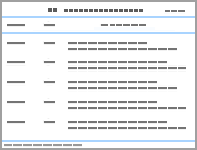
表1
试验处理组设置
处理组 Treatment group | 试验处理 Experimental treatment |
|---|---|
| CK | 喷施蒸馏水(含0.04%乙醇) |
| sUVB | 进行UV-B辐射,喷施蒸馏水(含0.04%乙醇) |
| UVB+IAA | 进行UV-B辐射,喷施30 μmol∙L-1 IAA |
| UVB+ACC | 进行UV-B辐射,喷施100 μmol∙L-1 ACC |
| UVB+MeJA | 进行UV-B辐射,喷施250 μmol∙L-1 MeJA |
| UVB+SA | 进行UV-B辐射,喷施500 μmol∙L-1 SA |
| UVB+MT | 进行UV-B辐射,喷施100 μmol∙L-1 MT |
表2
引物序列
引物 Primer | 序列(5′→3′) Sequence(5′→3′) |
|---|---|
| 18S-F | CCGTCCTAGTCTCAACCATA |
| 18S-R | CTCTCAGTCTGTCAATCCTTAC |
| PtrJAZ1-F | TCGTCACCTTCCAAGTCCAA |
| PtrJAZ1-R | CAGCAGAACCAGAGGCAATC |
| PtrJAZ2-F | TTCTGTTGCTGCTCTTGATTCC |
| PtrJAZ2-R | TGATACGGTGCTCTTGCTGTA |
| PtrJAZ3-F | GCCTTGAGACACCTAGTTCAC |
| PtrJAZ3-R | AGCCTTGTTAATAGCGTCATCA |
| PtrJAZ4-F | TTCTCTGTGCCATCTACTCCTA |
| PtrJAZ4-R | AATGTTCTCCGCCTTGTCTC |
| PtrJAZ5-F | CGGCTGACAAGGCTAAGGA |
| PtrJAZ5-R | ACGGAATTGAAATGGTGGACTC |
| PtrJAZ6-F | AAGGAGCAAGAGGTTACCAATG |
| PtrJAZ6-R | ACGACAACACTTCCACCATAG |
| PtrJAZ7-F | AGGCTCAGGCAATCATGTTCT |
| PtrJAZ7-R | AGGTTGGTTCACAGGACTAAGA |
| PtrJAZ8-F | AGTCGTCACCTTCCAAGTCC |
| PtrJAZ8-R | GAACCAGAGGCAATCACGGA |
| PtrJAZ9-F | CCACCACCACCGTTACCAA |
| PtrJAZ9-R | GCTTCGCAATCTATCCTCCATT |
| PtrJAZ10-F | CGGTGGGTCTTCTGGAACG |
| PtrJAZ10-R | CGCTGACAGGTGGTCTACGAAT |
| PtrJAZ11-F | ACGCTGGTTCAGTGAGTGTT |
| PtrJAZ11-R | GCTTGTGCCTGTGCTTGAG |
| PtrJAZ12-F | AAGAAGCGACGGGACAGGTT |
| PtrJAZ12-R | TGGTGGAGGTGCGGCACTAAT |
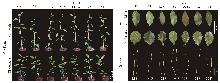
图1
UV-B胁迫及激素处理14 d后的雌雄青杨表型M. 雄株;F. 雌株。
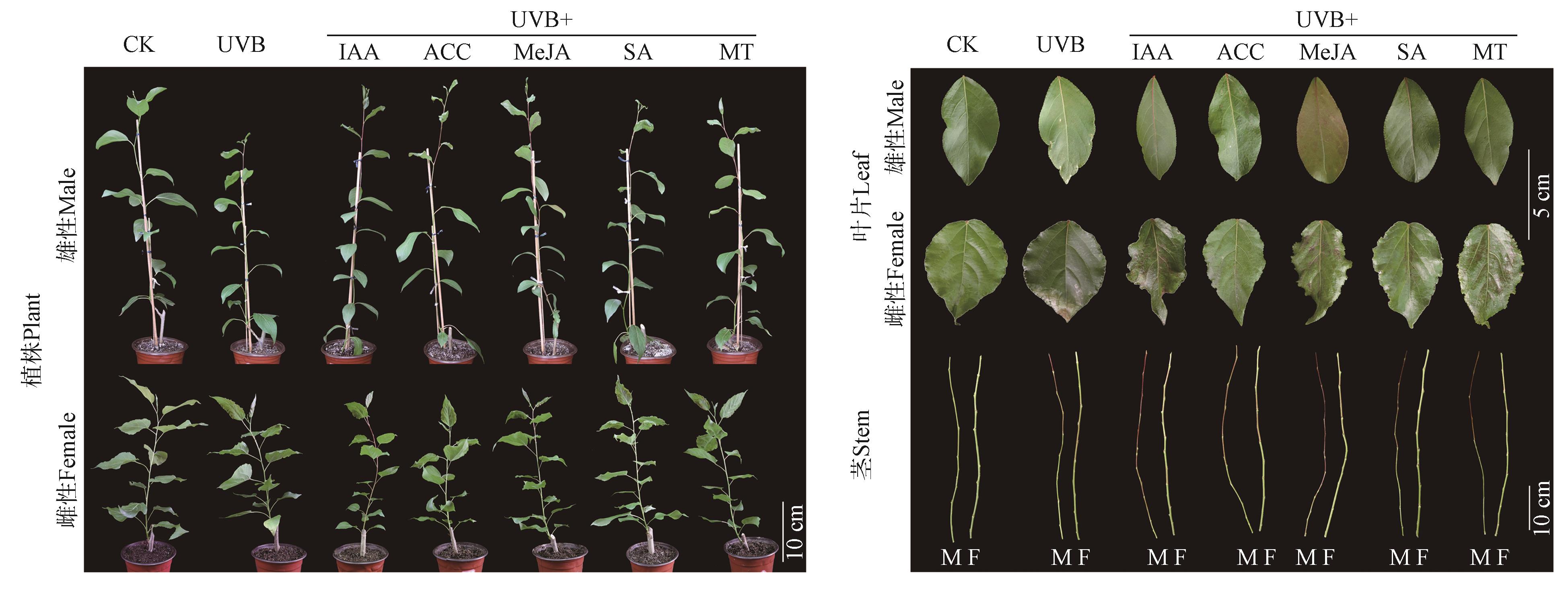
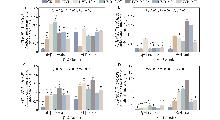
图2
处理7、14 d时各组雌雄青杨器官花青素水平A和B分别表示处理7 d后各处理组中青杨叶和茎中花青素质量比吸光度;C和D分别表示处理14 d后各处理组中青杨叶和茎中花青素质量比吸光度。g.性别效应;t.外源激素处理效应;g×t.性别与外源激素处理的交互效应。不同小写字母表示同一性别中各处理组间存在显著差异(P<0.05)。***、**和*分别表示同一处理组中不同性别在P<0.001、P<0.01和P<0.05水平下的显著性差异;ns表示无显著性差异。下同。
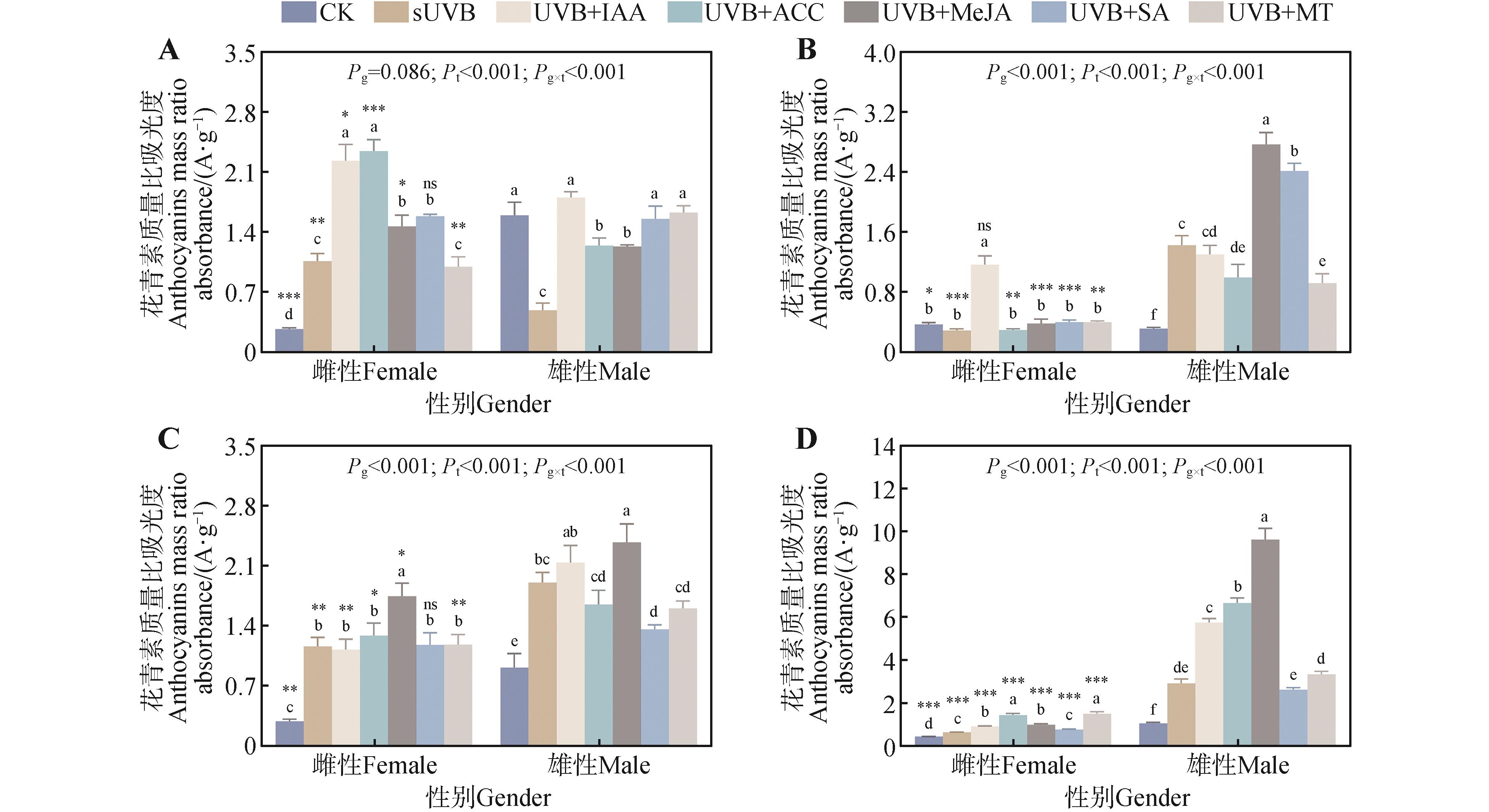
图3
处理14 d后各组青杨叶片气体交换参数、叶绿素荧光参数和光合色素质量分数
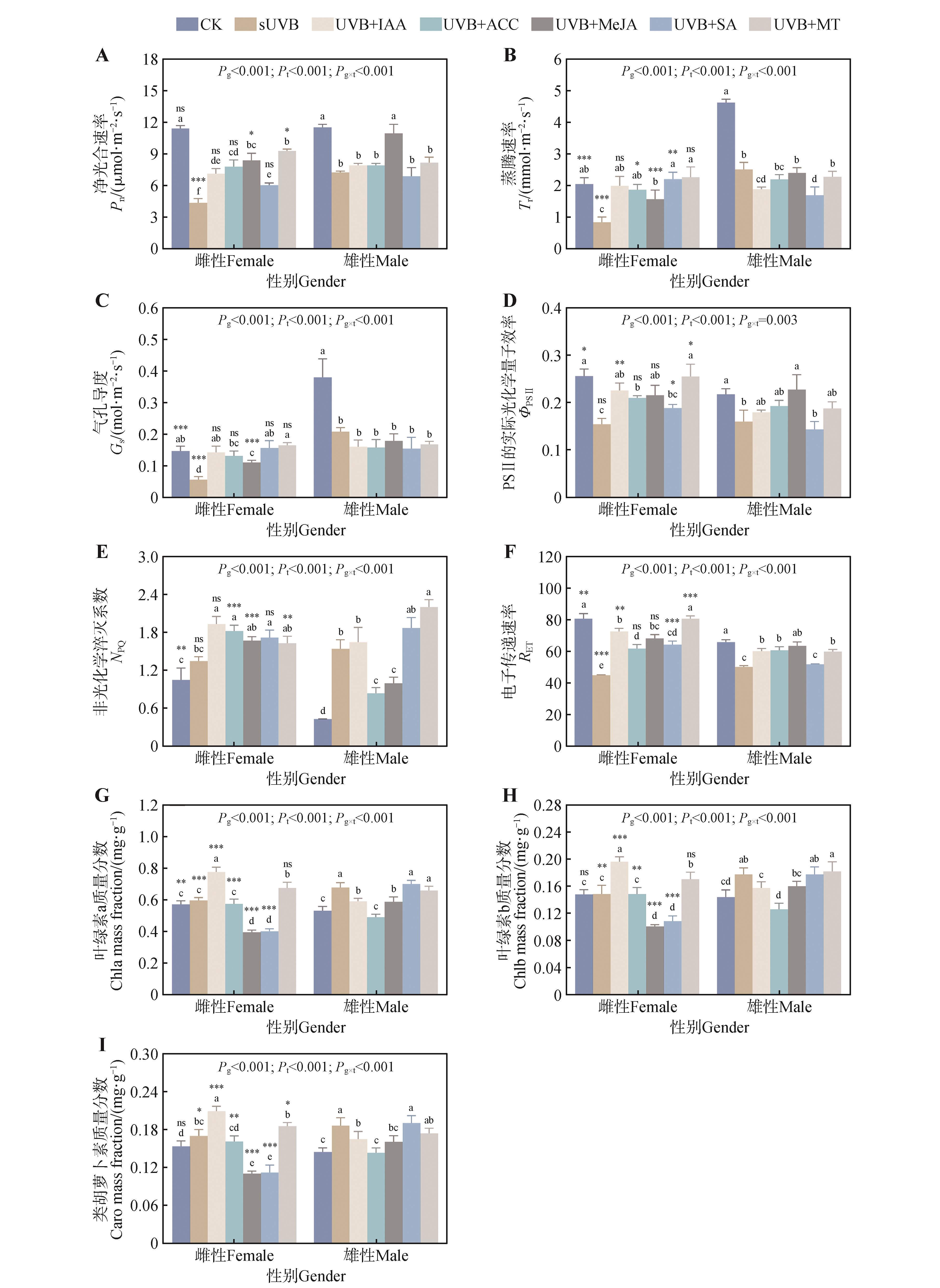
图4
处理14 d后各组青杨叶片过氧化氢及超氧阴离子质量摩尔浓度
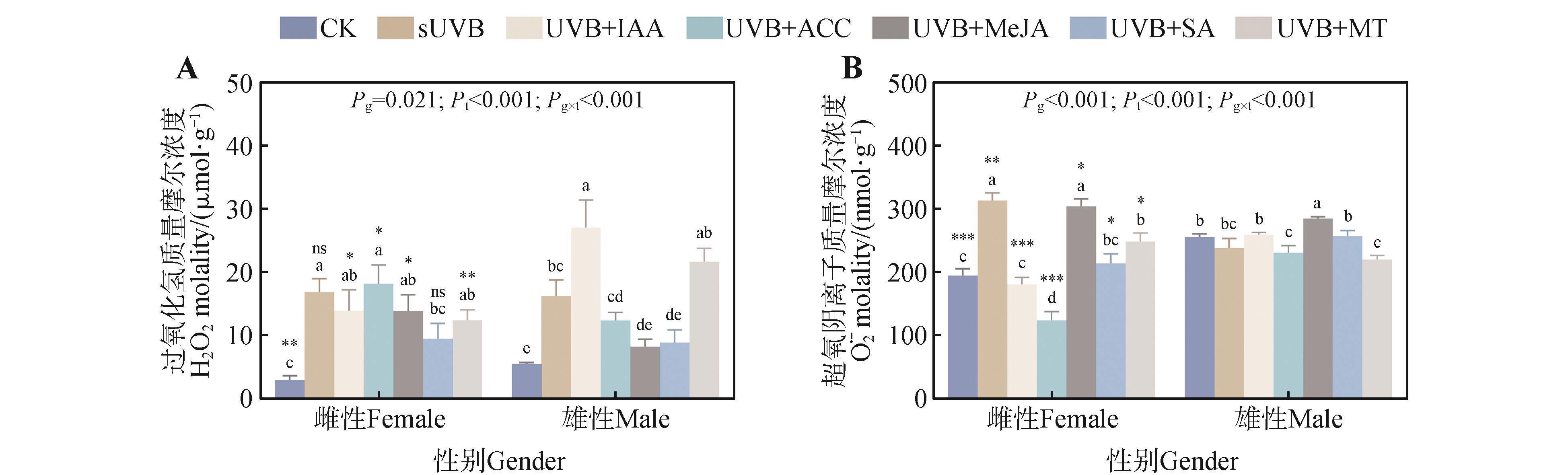
图5
处理14 d后各组青杨叶片抗氧化酶活性
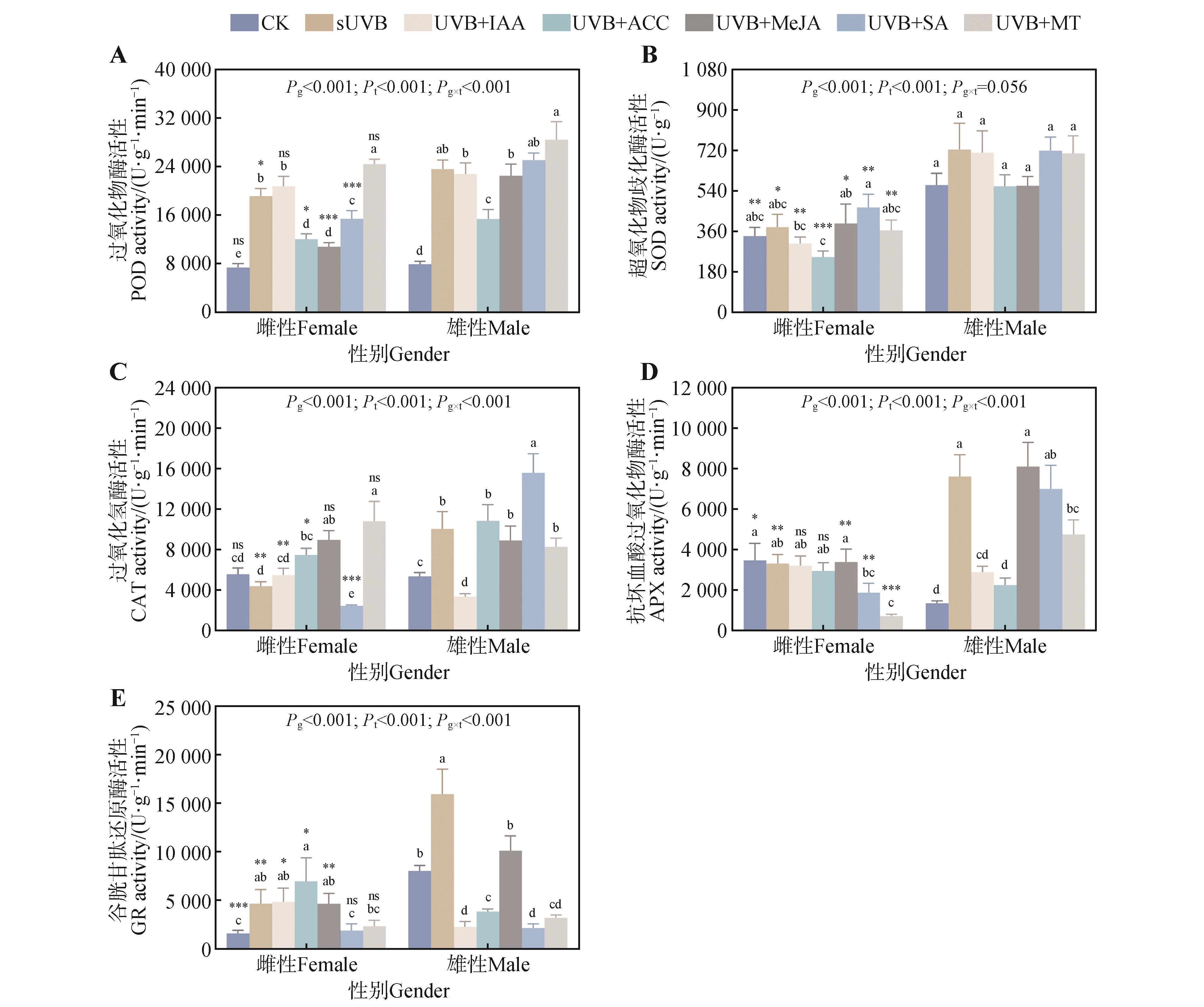
图6
处理14 d后各组青杨器官生理参数主成分分析
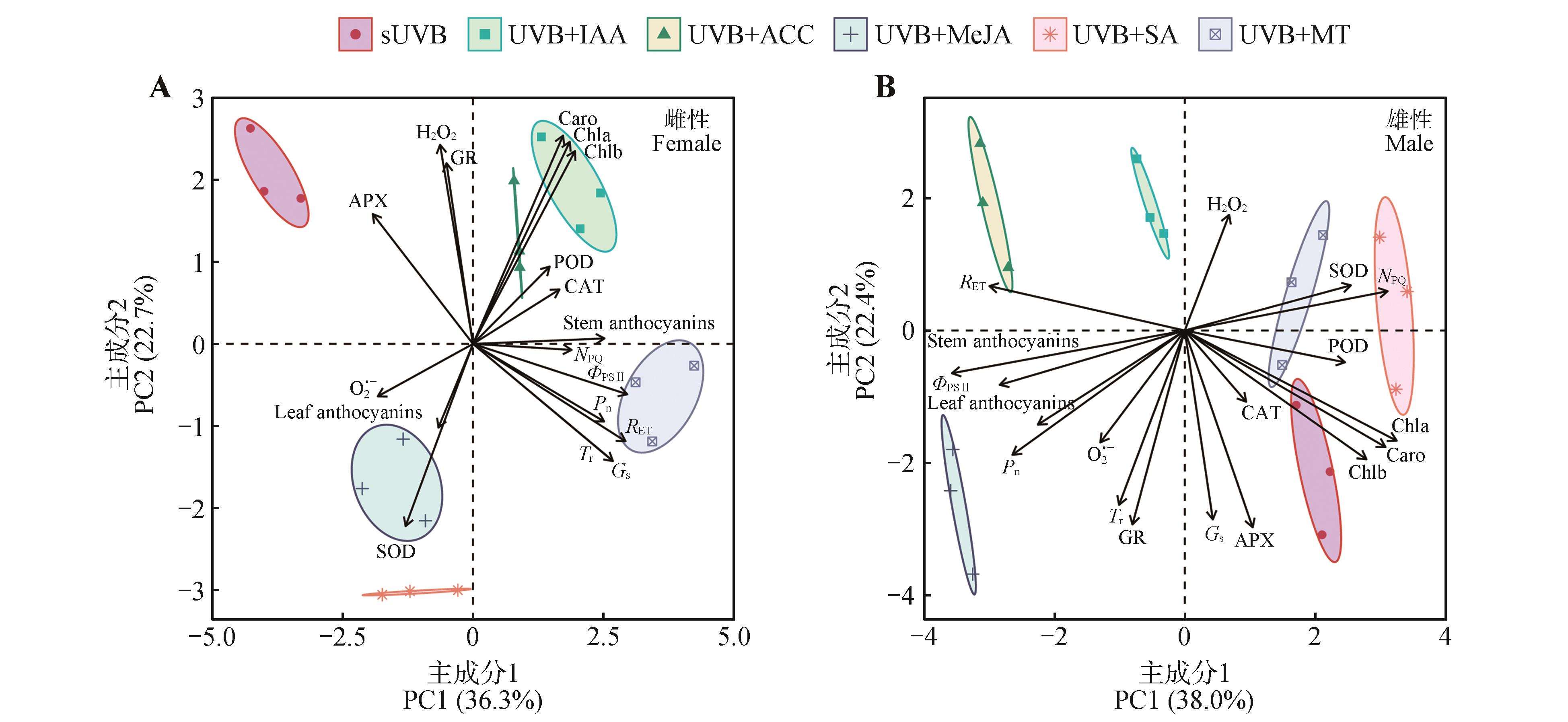
图7
处理14 d后雌、雄青杨叶片内源茉莉酸质量摩尔浓度
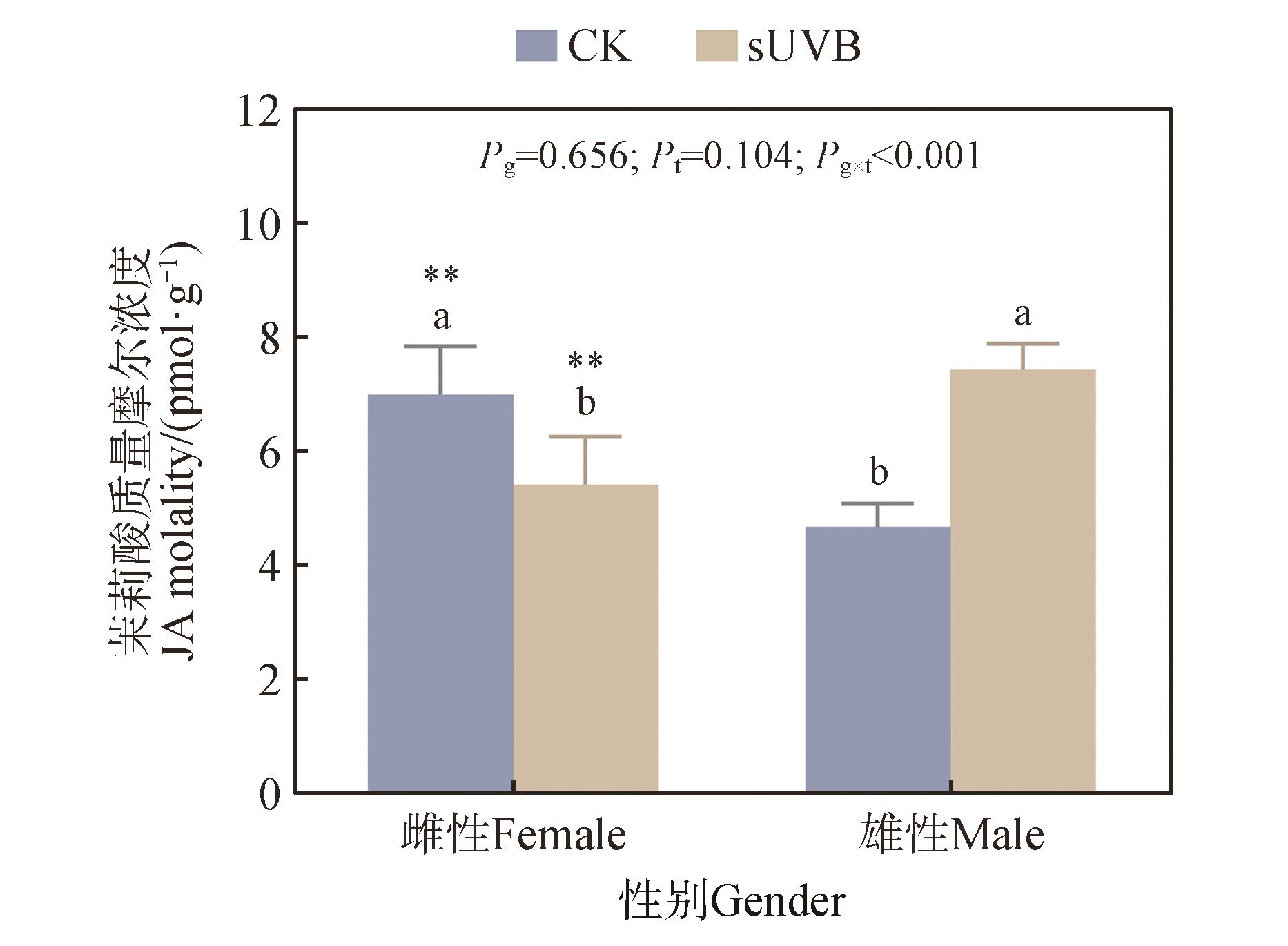
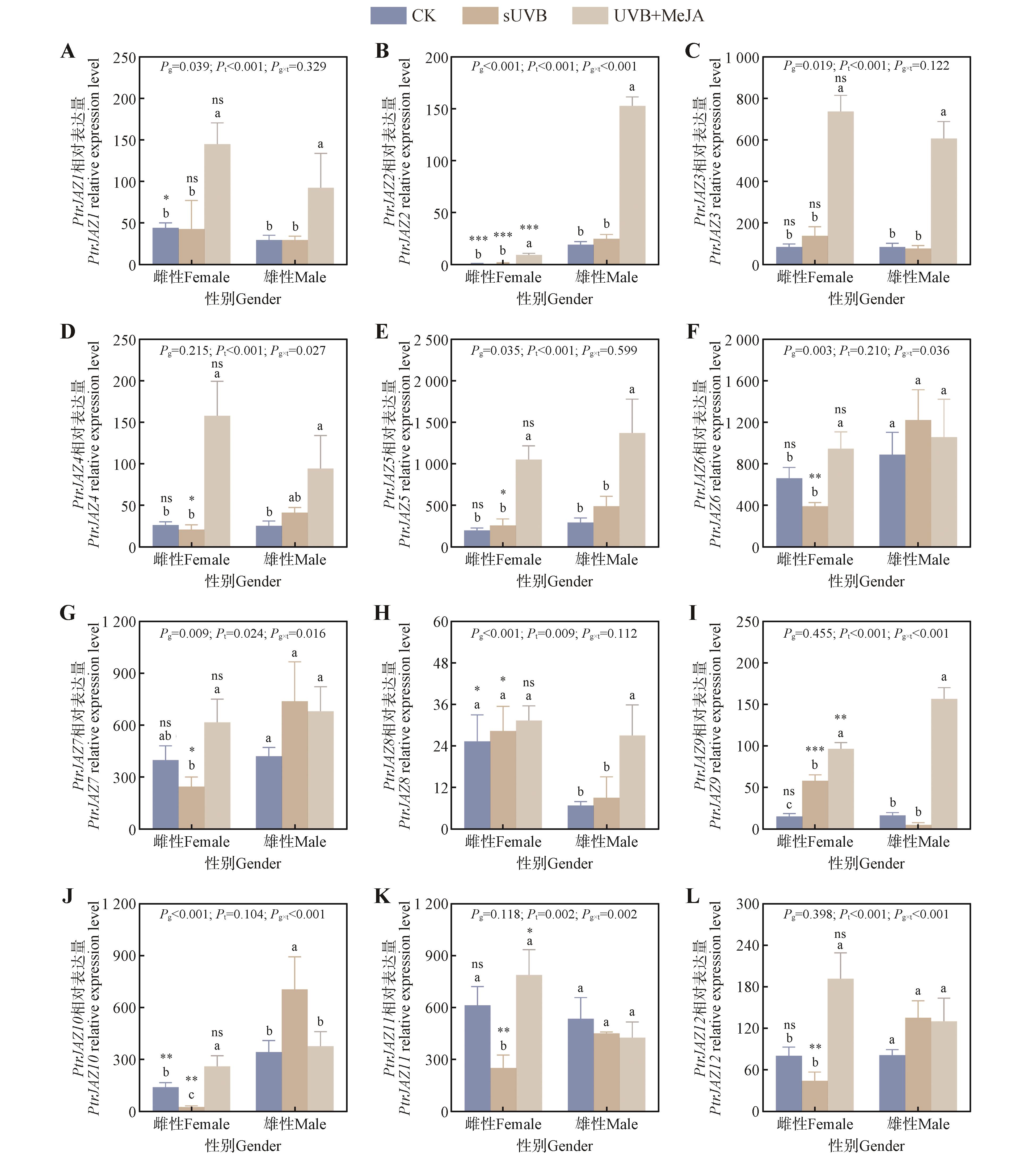
图8
处理24 h后青杨叶片PtrJAZs基因相对表达量
| [1] | Kami C, Lorrain S, Hornitschek P,et al.Light-regulated plant growth and development[M]//Timmermans M C P.Current topics in developmental biology:plant development.San Diego:Academic Press,2010:29-66. |
| [2] | Hideg É, Jansen M A K, Strid Å.UV-B exposure,ROS,and stress:inseparable companions or loosely linked associates?[J].Trends in Plant Science,2013,18(2):107-115. |
| [3] | Kataria S, Jajoo A, Guruprasad K N.Impact of increasing ultraviolet-B(UV-B) radiation on photosynthetic processes[J].Journal of Photochemistry and Photobiology B:Biology,2014,137:55-66. |
| [4] | Dai Y J, Li M H, Li H H,et al.Phytohormone-regulated UV-B photomorphogenesis and acclimation[J].Environmental and Experimental Botany,2024,224:105830. |
| [5] | Rizzini L, Favory J J, Cloix C,et al.Perception of UV-B by the Arabidopsis UVR8 protein[J].Science,2011,332(6025):103-106. |
| [6] | Jenkins G I.The UV-B photoreceptor UVR8:from structure to physiology[J].The Plant Cell,2014,26(1):21-37. |
| [7] | Gruber H, Heijde M, Heller W,et al.Negative feedback regulation of UV-B-induced photomorphogenesis and stress acclimation in Arabidopsis [J].Proceedings of the National Academy of Sciences of the United States of America,2010,107(46):20132-20137. |
| [8] | Podolec R, Lau K, Wagnon T B,et al.A constitutively monomeric UVR8 photoreceptor confers enhanced UV-B photomorphogenesis[J].Proceedings of the National Academy of Sciences of the United States of America,2021,118(6):e2017284118. |
| [9] | Bieza K, Lois R.An Arabidopsis mutant tolerant to lethal ultraviolet-B levels shows constitutively elevated accumulation of flavonoids and other phenolics[J].Plant Physiology,2001,126(3):1105-1115. |
| [10] | Pietta P G.Flavonoids as antioxidants[J].Journal of Natural Products,2000,63(7):1035-1042. |
| [11] | Ferreyra M L F, Serra P, Casati P.Recent advances on the roles of flavonoids as plant protective molecules after UV and high light exposure[J].Physiologia Plantarum,2021,173(3):736-749. |
| [12] | Qian C Z, Chen Z R, Liu Q,et al.Coordinated transcriptional regulation by the UV-B photoreceptor and multiple transcription factors for plant UV-B responses[J].Molecular Plant,2020,13(5):777-792. |
| [13] | Haskirli H, Yilmaz O, Ozgur R,et al.Melatonin mitigates UV-B stress via regulating oxidative stress response,cellular redox and alternative electron sinks in Arabidopsis thaliana [J].Phytochemistry,2021,182:112592. |
| [14] | Li C, Du J C, Xu H N,et al.UVR8-TCP4-LOX2 module regulates UV-B tolerance in Arabidopsis [J].Journal of Integrative Plant Biology,2024,66(5):897-908. |
| [15] | Bandurska H, Cieślak M.The interactive effect of water deficit and UV-B radiation on salicylic acid accumulation in barley roots and leaves[J].Environmental and Experimental Botany,2013,94:9-18. |
| [16] | An J P, Xu R R, Liu X,et al.Jasmonate induces biosynthesis of anthocyanin and proanthocyanidin in apple by mediating the JAZ1-TRB1-MYB9 complex[J].The Plant Journal,2021,106(5):1414-1430. |
| [17] | Liu S C, Wang Y, Shi M,et al.SmbHLH60 and SmMYC2 antagonistically regulate phenolic acids and anthocyanins biosynthesis in Salvia miltiorrhiza [J].Journal of Advanced Research,2022,42:205-219. |
| [18] | Pontin M A, Piccoli P N, Francisco R,et al.Transcriptome changes in grapevine(Vitis vinifera L.) cv.Malbec leaves induced by ultraviolet-B radiation[J].BMC Plant Biology,2010,10(1):224. |
| [19] | Ge X M, Hu X, Zhang J,et al.RESISTANCE LOCUSUV8 mediates ultraviolet-B-induced stomatal closure in an ethylene-dependent manner[J].Plant Science,2020,301:110679. |
| [20] | Zhao J Y, Bo K L, Pan Y P,et al.Phytochrome-interacting factor PIF3 integrates phytochrome B and UV-B signaling pathways to regulate gibberellin- and auxin-dependent growth in cucumber hypocotyls[J].Journal of Experimental Botany,2023,74(15):4520-4539. |
| [21] | Tuskan G A, DiFazio S, Jansson S,et al.The genome of black cottonwood,Populus trichocarpa(Torr. & Gray)[J].Science,2006,313(5793):1596-1604. |
| [22] | Brunner A M, Busov V B, Strauss S H.Poplar genome sequence:functional genomics in an ecologically dominant plant species[J].Trends in Plant Science,2004,9(1):49-56. |
| [23] | Xu X, Zhao H X, Zhang X L,et al.Different growth sensitivity to enhanced UV-B radiation between male and female Populus cathayana [J].Tree Physiology,2010,30(12):1489-1498. |
| [24] | Liu M, Korpelainen H, Li C Y.Sexual differences and sex ratios of dioecious plants under stressful environments[J].Journal of Plant Ecology,2021,14(5):920-933. |
| [25] | Xiang X D, Zhou X L, Zi H L,et al. Populus cathayana genome and population resequencing provide insights into its evolution and adaptation[J].Horticulture Research,2024,11(1):uhad255. |
| [26] | Jin X, Zimmermann J, Polle A,et al.Auxin is a long-range signal that acts independently of ethylene signaling on leaf abscission in Populus [J].Frontiers in Plant Science,2015,6:634. |
| [27] | Wang Y C, Wang N, Xu H F,et al.Auxin regulates anthocyanin biosynthesis through the Aux/IAA-ARF signaling pathway in apple[J].Horticulture Research,2018,5:59. |
| [28] | Xu C Z, Shen Y, He F,et al.Auxin-mediated Aux/IAA-ARF-HB signaling cascade regulates secondary xylem development in Populus [J].New Phytologist,2019,222(2):752-767. |
| [29] | Liu H J, Zhang H, Yang F,et al.Ethylene activates poplar defense against Dothiorella gregaria Sacc by regulating reactive oxygen species accumulation[J].Physiologia Plantarum,2022,174(3):e13726. |
| [30] | Felten J, Vahala J, Love J,et al.Ethylene signaling induces gelatinous layers with typical features of tension wood in hybrid aspen[J].New Phytologist,2018,218(3):999-1014. |
| [31] | Ullah C, Schmidt A, Reichelt M,et al.Lack of antagonism between salicylic acid and jasmonate signalling pathways in poplar[J].New Phytologist,2022,235(2):701-717. |
| [32] | Kong L F, Song Q, Wei H B,et al.The AP2/ERF transcription factor PtoERF15 confers drought tolerance via JA-mediated signaling in Populus [J].New Phytologist,2023,240(5):1848-1867. |
| [33] | Wu J, Liang X Y, Lin M,et al.Comprehensive analysis of MAPK gene family in Populus trichocarpa and physiological characterization of PtMAPK3-1 in response to MeJA induction[J].Physiologia Plantarum,2023,175(1):e13869. |
| [34] | Zafar Z, Rasheed F, Atif R M,et al.Foliar application of salicylic acid improves water stress tolerance in Conocarpus erectus L. and Populus deltoides L. saplings:evidence from morphological,physiological,and biochemical changes[J].Plants,2021,10(6):1242. |
| [35] | Yu P Z, Tang X, Chen B L,et al.The melatonin synthase-encoding gene ASMT mediates poplar resistance to drought stress and fungi Dothiorella gregaria [J].Gene,2025,937:149154. |
| [36] | Xu H P, Zhang S Y, Liang C L,et al.Melatonin enhances resistance to Botryosphaeria dothidea in pear by promoting jasmonic acid and phlorizin biosynthesis[J].BMC Plant Biology,2024,24(1):470. |
| [37] | Sun H L, Cao X Y, Wang X Y,et al.RBOH-dependent hydrogen peroxide signaling mediates melatonin-induced anthocyanin biosynthesis in red pear fruit[J].Plant Science,2021,313:111093. |
| [38] | Ding F, Wang G, Zhang S X.Exogenous melatonin mitigates methyl viologen-triggered oxidative stress in poplar leaf[J].Molecules,2018,23(11):2852. |
| [39] | Rabino I, Mancinelli A L.Light,temperature,and anthocyanin production[J].Plant Physiology,1986,81(3):922-924. |
| [40] | Lichtenthaler H K.Chlorophylls and carotenoids:pigments of photosynthetic biomembranes[M]//Packer L,Douce R.Methods in enzymology:plant cell membranes.San Diego:Academic Press,1987:350-382. |
| [41] | Boussadia O, Steppe K, Zgallai H,et al.Effects of nitrogen deficiency on leaf photosynthesis,carbohydrate status and biomass production in two olive cultivars ‘Meski’ and ‘Koroneiki’[J].Scientia Horticulturae,2010,123(3):336-342. |
| [42] | Jiang H, Zhang S, Feng L H,et al.Transcriptional profiling in dioecious plant Populus cathayana reveals potential and sex-related molecular adaptations to solar UV-B radiation[J].Physiologia Plantarum,2015,153(1):105-118. |
| [43] | Ruban A V, Wilson S.The mechanism of non-photochemical quenching in plants:localization and driving forces[J].Plant and Cell Physiology,2021,62(7):1063-1072. |
| [44] | Landi M, Tattini M, Gould K S.Multiple functional roles of anthocyanins in plant-environment interactions[J].Environmental and Experimental Botany,2015,119:4-17. |
| [45] | Steyn W J, Wand S J E, Holcroft D M,et al.Anthocyanins in vegetative tissues:a proposed unified function in photoprotection[J].New Phytologist,2002,155(3):349-361. |
| [46] | Hughes N M, Morley C B, Smith W K.Coordination of anthocyanin decline and photosynthetic maturation in juvenile leaves of three deciduous tree species[J].New Phytologist,2007,175(4):675-685. |
| [47] | Gould K S, Dudle D A, Neufeld H S.Why some stems are red:cauline anthocyanins shield photosystem II against high light stress[J].Journal of Experimental Botany,2010,61(10):2707-2717. |
| [48] | Cuypers A, Hendrix S, Amaral Dos Reis R,et al.Hydrogen peroxide,signaling in disguise during metal phytotoxicity[J].Frontiers in Plant Science,2016,7:470. |
| [49] | Dorion S, Ouellet J C, Rivoal J.Glutathione metabolism in plants under stress:beyond reactive oxygen species detoxification[J].Metabolites,2021,11(9):641. |
| [50] | Choudhary S, Bhat T M, Alwutayd K M,et al.Salicylic acid enhances thermotolerance and antioxidant defense in Trigonella foenum graecum L. under heat stress[J].Heliyon,2024,10(6):e27227. |
| [51] | Li S H, Dong Y X, Li D L,et al.Eggplant transcription factor SmMYB5 integrates jasmonate and light signaling during anthocyanin biosynthesis[J].Plant Physiology,2024,194(2):1139-1165. |
| [52] | Chung H S, Koo A J K, Gao X L,et al.Regulation and function of Arabidopsis JASMONATE ZIM-domain genes in response to wounding and herbivory[J].Plant Physiology,2008,146(3):952-964. |
| [53] | Zhai Q Z, Deng L, Li C Y.Mediator subunit MED25:at the nexus of jasmonate signaling[J].Current Opinion in Plant Biology,2020,57:78-86. |
| [54] | Chini A, Fonseca S, Fernández G,et al.The JAZ family of repressors is the missing link in jasmonate signalling[J].Nature,2007,448(7154):666-671. |
| [1] | 刘俊龙, 孙慧, 吴中能, 苗婷婷, 宋楠楠, 苏晓华, 丁昌俊. 淹水胁迫对杨树幼苗叶绿素荧光及碳氮磷化学计量特征的影响[J]. 植物研究, 2026, 46(4): 700-711. |
| [2] | 李沃森, 翟睿, 赵晴, 赵金凤, 孟德恺, 陈艳杰, 李爽, 周晨光. 杨树C2H2型锌指转录因子PtrZAT11在木材形成中的功能[J]. 植物研究, 2026, 46(4): 677-687. |
| [3] | 张旭, 秦叶玲, 师若欣, 刘楠, 许志茹, 刘关君. 小黑杨WOX4a启动子克隆及表达活性分析[J]. 植物研究, 2026, 46(3): 449-457. |
| [4] | 王汉时, 李潇, 庞忠义, 彭彦辉, 王瑞雪, 张太进, 刘洋, 赵曦阳, 赵春莉, 蒋路平. 基于多性状综合评价的杨树优良无性系筛选[J]. 植物研究, 2026, 46(2): 378-392. |
| [5] | 刘艺蛟, 赵吉庆, 陈金焕. 黑果枸杞LrMYB64基因克隆及功能研究[J]. 植物研究, 2026, 46(2): 231-245. |
| [6] | 吴卫倩, 胡子建, 沈诗雅, 张贵芳, 林金星, 张曦. 植物不定根再生与扦插生根相关激素调控研究进展[J]. 植物研究, 2026, 46(1): 13-24. |
| [7] | 张政, 张鹏. 黑龙江西部3种杨树生长及生理特征比较[J]. 植物研究, 2025, 45(5): 807-815. |
| [8] | 王建华, 陈慧泽, 韩榕. 叶面TiO2-NPs预处理对UV-B胁迫下小麦幼苗生长抑制的缓解效应[J]. 植物研究, 2025, 45(4): 592-602. |
| [9] | 李卓穗, 高一琳, 刘寒, 尚旭岚. 二倍体青钱柳愈伤组织诱导及次生代谢物积累[J]. 植物研究, 2025, 45(4): 533-545. |
| [10] | 郭玉伟, 梁晶, 伍海兵, 周传杰, 孙琳琳, 王志保, 李晓茹, 陈祥凤, 李木兰. 鲁西黄泛平原不同林龄杨树人工林碳储量分布格局及影响因素分析[J]. 植物研究, 2025, 45(2): 241-253. |
| [11] | 李潇, 王汉时, 王宏星, 蒋路平, 庞忠义, 彭彦辉, 赵曦阳. 灌溉和施肥对‘新林1号’杨生长和光合生理特性的影响[J]. 植物研究, 2025, 45(1): 77-87. |
| [12] | 曹佳玉, 曹丽娜, 张俏艺, 张双, 胡志宝, 赵唐锐, 许志茹, 李春明, 全先奎, 刘关君. 小黑杨Rubisco小亚基基因启动子的克隆及表达活性分析[J]. 植物研究, 2024, 44(4): 625-633. |
| [13] | 郭冰冰, 刘明洋, 代龙军, 杨洪, 王立丰. 植物激素调控橡胶树产排胶机制研究进展[J]. 植物研究, 2024, 44(2): 161-167. |
| [14] | 张婧, 张伟溪, 丁昌俊, 苑正赛, 代丽蕊, 苏晓华, 沈应柏, 曲冠证. 五个杨树品种生长、光合生理及根尖离子流速特性比较分析[J]. 植物研究, 2024, 44(1): 96-106. |
| [15] | 刘玮, 朱自强. 植物根部热形态建成的研究进展[J]. 植物研究, 2024, 44(1): 1-7. |
| 阅读次数 | ||||||
|
全文 |
|
|||||
|
摘要 |
|
|||||
