
植物研究 ›› 2026, Vol. 46 ›› Issue (4): 584-598.doi: 10.7525/j.issn.1673-5102.2026.04.002
康超1, 杨秋雨1, 段朦1, 李亚飞1, 王万喜2( ), 吴强盛2()
收稿日期:2026-03-05
出版日期:2026-07-20
发布日期:2026-07-22
通讯作者:
王万喜,吴强盛
E-mail:342701127@qq.com;wuqiangsh@163.com
作者简介:康超(1987—),男,硕士,主要从事环境工程与绿化研究。
基金资助:
Chao KANG1, Qiuyu YANG1, Meng DUAN1, Yafei LI1, Wanxi WANG2(), Qiangsheng WU2()
Received:2026-03-05
Online:2026-07-20
Published:2026-07-22
Contact:
Wanxi WANG, Qiangsheng WU
E-mail:342701127@qq.com;wuqiangsh@163.com
摘要:
温度胁迫是限制香樟(Cinnamomum camphora)分布与生长的重要因素,其高温与低温响应机制存在本质差异。本文系统比较了香樟应对高温与低温胁迫的核心策略:高温胁迫下,光合系统以光呼吸增强进行代谢性耗散,氧化还原调控以单萜信号为核心,驱动WRKY与HSF转录因子级联网络,渗透调节以脯氨酸响应最为迅速;低温胁迫下,光合系统依赖非光化学淬灭和环式电子流进行物理性保护,分子调控以钙-乙烯-ERF/CBF级联通路为中枢,渗透调节以可溶性糖积累为主导。基于上述机制,本文从物理、化学和生物技术3个维度评估了现有调控策略的有效性,指出当前研究在单萜信号通路解析、多重逆境耦合机制、精准调控技术研发等方面仍存在瓶颈。未来应聚焦多组学整合解析分子网络、构建复合胁迫预测模型、突破遗传转化瓶颈及评估调控策略的生态经济可行性,以推动香樟抗逆栽培从被动防护向主动的机制驱动型精准调控转变。
中图分类号:
康超, 杨秋雨, 段朦, 李亚飞, 王万喜, 吴强盛. 香樟对温度胁迫的响应机制及调控策略研究进展[J]. 植物研究, 2026, 46(4): 584-598.
Chao KANG, Qiuyu YANG, Meng DUAN, Yafei LI, Wanxi WANG, Qiangsheng WU. Advances in Response Mechanisms and Regulatory Strategies of Cinnamomum camphora to Temperature Stress[J]. Bulletin of Botanical Research, 2026, 46(4): 584-598.
图1
香樟温度胁迫机制及调控策略
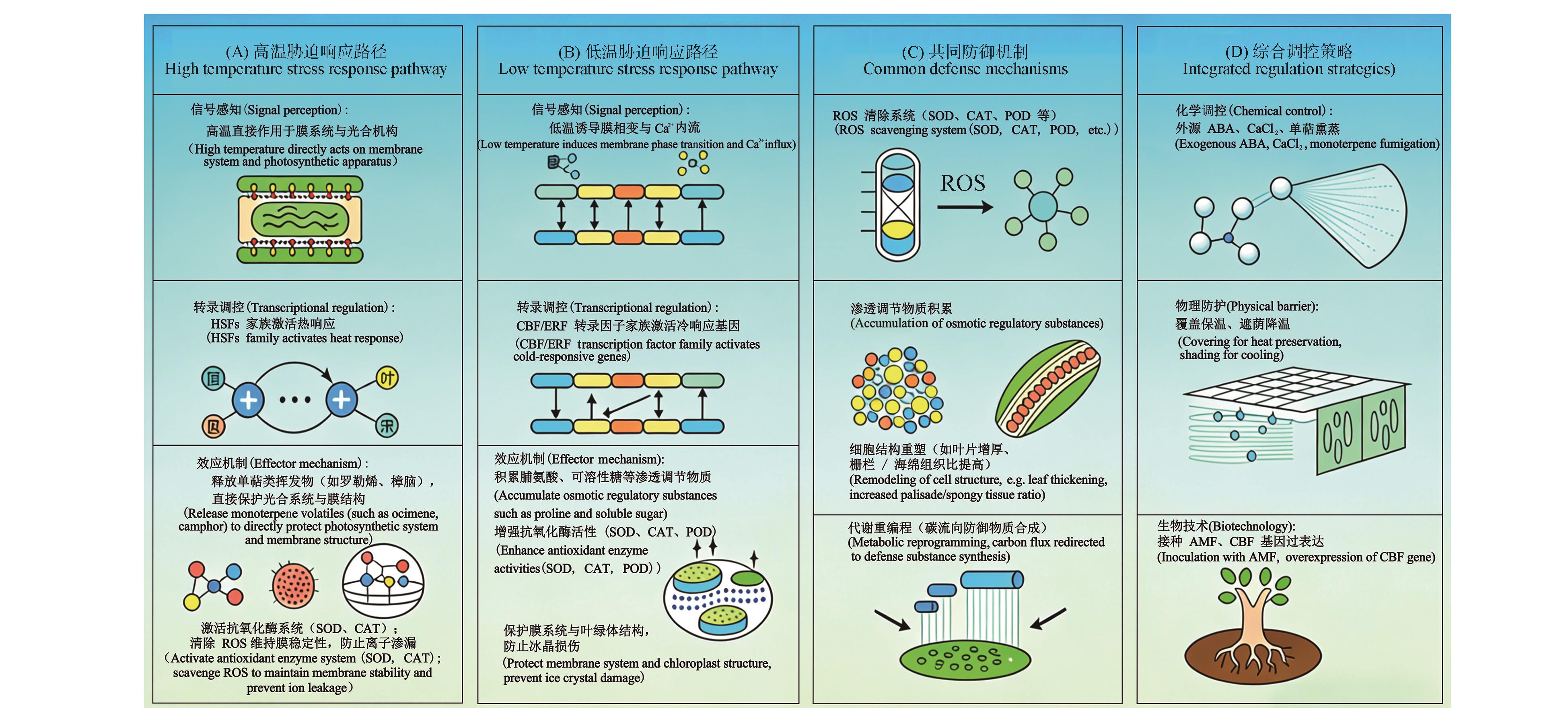

表1
香樟遭受低温和高温胁迫后人为调控策略
技术措施类别 Categories of technical measures | 处理方法 Treatment method | 靶定植物/胁迫类型 Target plants/Stress type | 生理机制与效果支持度评估 Assessment of physiological mechanisms and effect support degree |
|---|---|---|---|
外源化学物质施用 Exogenous chemical application | ABA喷施 | 香樟幼苗/低温胁迫 | 中 有研究指出ABA能提高植物抗寒力,但尚缺乏在香樟中的实证 |
| CaCl₂处理 | 香樟幼苗/低温胁迫 | 中 原理阐述清晰,有在其他植物(水稻)上的机制研究作为参考,但尚缺乏香樟抗寒的具体数据 | |
| 外源蔗糖处理 | 香樟幼苗/低温胁迫 | 中高 有明确的生理机制阐述 | |
| 植物生长调节剂喷施 | 植物(通用)/低温胁迫 | 低 缺乏针对香樟的具体试验 | |
| 单萜熏蒸(如樟脑、芳樟醇) | 香樟/高温胁迫 | 高 有系统的试验数据支持,明确了其对光合、代谢、细胞结构的保护作用及基于基因表达的分子机制,并提出了信号分子功能的新证据 | |
栽培与物理防护 Cultivation and physical protection | 及时清雪 | 香樟/低温胁迫(雪压) | 高 防止物理机械损伤(雪压断枝)和减轻积雪覆盖导致的低温冻害 |
| 树干包裹与覆盖保墒胸径5 cm以上苗木(移栽后) | 香樟/干旱、高温、低温 | 高 降低气孔导度以减少水分流失 | |
| 合理修剪 | 香樟/低温胁迫(倒春寒) | 高 直接移除受冻害组织,减少养分消耗和病原侵染风险,并调控发育节律以避开晚霜危害 | |
| 外物保温(树干包裹、遮盖树冠等) | 香樟/低温胁迫 | 中高 通过物理隔绝减少树体热量散失和冷风直接侵袭 | |
生物措施 Biological measures | 接种丛枝菌根真菌(AMF) | 香樟幼苗/低温胁迫 | 高 有盆栽试验证据,AMF通过促进生长、调整生物量分配及激活抗氧化系统和渗透调节系统来增强抗寒性 |
| [1] | Intergovernmental Panel on Climate Change.Climate change 2022:impacts,adaptation and vulnerability:working group Ⅱ contribution to the sixth assessment report of the intergovernmental panel on climate change[M].Cambridge:Cambridge University Press,2023. |
| [2] | Ding Y L, Shi Y T, Yang S H.Advances and challenges in uncovering cold tolerance regulatory mechanisms in plants[J].The New Phytologist,2019,222(4):1690-1704. |
| [3] | Bita C E, Gerats T.Plant tolerance to high temperature in a changing environment:scientific fundamentals and production of heat stress-tolerant crops[J].Frontiers in Plant Science,2013,4:273. |
| [4] | 陈有民.园林树木学[M].北京:中国林业出版社,1990. |
| Chen Youmin.Garden dendrology[M].Beijing:China Forestry Publishing House,1990. | |
| [5] | 韩浩章,张丽华,王晓立,等.自然越冬过程中3种表型香樟抗寒性比较[J].西南林业大学学报(自然科学),2017,37(2):12-18. |
| Han Haozhang, Zhang Lihua, Wang Xiaoli,et al.Study on the comparison of 3 Cinnamomum camphora phenotypes hardiness during natural overwintering[J].Journal of Southwest Forestry University(Natural Sciences),2017,37(2):12-18. | |
| [6] | 胡园春,张红艳.枣庄地区香樟冻害类型及主要气象因子影响分析[J].农业工程,2018,8(10):126-129. |
| Hu Yuanchun, Zhang Hongyan.Freeze injury types of camphor tree and influence analysis of primary meteorological factors in Zaozhuang area[J].Agricultural Engineering,2018,8(10):126-129. | |
| [7] | 王雅青.城市环境中香樟光合特性对极端高温干旱的响应[D].长沙:中南林业科技大学,2023. |
| Wang Yaqing.Response of photosynthetic characteristics of Cinnamomum camphora to extreme heat and drought in urban environments[D].Changsha:Central South University of Forestry & Technology,2023. | |
| [8] | 张诚.香樟叶片功能性状对城市干热环境的响应与适应机制[D].合肥:安徽农业大学,2023. |
| Zhang Cheng.Response and adaptation mechanism of leaf functional traits in Cinnamomum camphora to urban hot and arid environment[D].Hefei:Anhui Agricultural University,2023. | |
| [9] | 王彬,田正凤,应彬彬,等.高温胁迫对樟树光合性能的影响[J].浙江农林大学学报,2019,36(1):47-53. |
| Wang Bin, Tian Zhengfeng, Ying Binbin,et al.Photosynthetic abilities in Cinnamomum camphora with high temperature stress[J].Journal of Zhejiang A & F University,2019,36(1):47-53. | |
| [10] | 周帅.非生物胁迫对香樟挥发物及荧光特性的影响[D].杭州:浙江农林大学,2012. |
| Zhou Shuai.The effect of abiotic stresses on volatile organic compounds and chlorophyll fluorescence in Cinnamomum camphora [D].Hangzhou:Zhejiang A & F University,2012. | |
| [11] | 商天其.短时高温、CO2浓度倍增以及叶片生长阶段对香樟(Cinnamomum camphora)单萜释放和光合生理的影响[D].杭州:浙江农林大学,2018. |
| Shang Tianqi.Effects of short-term high temperature,doubled CO2 concentration and foliar ontogeny stages on release of monoterpenes and photosynthetic physiology on Cinnamomum camphora [D].Hangzhou:Zhejiang A & F University,2018. | |
| [12] | 胡义,胡庭兴,陈洪,等.干旱胁迫及复水对香樟幼树生理特性及生长的影响[J].西北植物学报,2015,35(2):294-301. |
| Hu Yi, Hu Tingxing, Chen Hong,et al.Physiological properties and growth of Cinnamomum camphora saplings under drought stress and rewatering[J].Acta Botanica Boreali-Occidentalia Sinica,2015,35(2):294-301. | |
| [13] | 刘玉凤.香樟幼苗对CaCl2及自然低温的响应[D].新乡:河南科技学院,2025. |
| Liu Yufeng.Response of Cinnamomum camphora seedlings to CaCl2 and natural low temperatures[D].Xinxiang:Henan Institute of Science and Technology,2025. | |
| [14] | 姬钰.香樟解剖结构对Na2SO4胁迫及自然降温的响应[D].新乡:河南科技学院,2023. |
| Ji Yu.Response of anatomical structure of Cinnamomum camphora to Na2SO4 stress and natural cooling[D].Xinxiang:Henan Institute of Science and Technology,2023. | |
| [15] | 尤扬,陈仕均,张晓云,等.低温对香樟叶肉含晶细胞和溶酶体的影响[J].植物生理学报,2018,54(7):1239-1244. |
| You Yang, Chen Shijun, Zhang Xiaoyun,et al.Effects of low temperature on the mesophyal crystal idioblasts and lysosomes of Cinnamomum camphora [J].Plant Physiology Communications,2018,54(7):1239-1244. | |
| [16] | 朱渊铭,张培兰,林宇清,等.香樟bZIP基因家族鉴定及表达分析[J].扬州大学学报(农业与生命科学版),2024,45(3):44-54,81. |
| Zhu Yuanming, Zhang Peilan, Lin Yuqing,et al.Identification and functional analysis of the bZIP gene family of Cinnamomum camphora [J].Journal of Yangzhou University(Agricultural and Life Science Edition),2024,45(3):44-54,81. | |
| [17] | 张佳佳,张力维,李勇鹏,等.不同非生物胁迫下香樟实时定量PCR内参基因的选择[J].生物技术通报,2016,32(10):205-211. |
| Zhang Jiajia, Zhang Liwei, Li Yongpeng,et al.Evaluation of candidate reference genes for normalization of quantitative RT-PCR in Cinnamomum camphora under various abiotic stresses[J].Biotechnology Bulletin,2016,32(10):205-211. | |
| [18] | 吴春玉,蒋长洪,谢佩耘,等.干旱胁迫对接种AMF的香樟幼苗生物量分配及生长的影响[J].重庆师范大学学报(自然科学版),2015,32(6):109-115. |
| Wu Chunyu, Jiang Changhong, Xie Peiyun,et al.Effects of campora seedlings on biomass allocation and growth under drought stress and inoculated AMF[J].Journal of Chongqing Normal University(Natural Science),2015,32(6):109-115. | |
| [19] | 侯颖,张立伟,王立涛,等.丛枝菌根真菌对香樟幼苗生长和抗寒生理指标的影响[J].东北林业大学学报,2023,51(9):95-100. |
| Hou Ying, Zhang Liwei, Wang Litao,et al.Effects of arbuscular mycorrhiza fungi on seedlings growth and physiological indexes of cold resistance in Cinnamomum Camphora [J].Journal of Northeast Forestry University,2023,51(9):95-100. | |
| [20] | 苏丹,张春明,许榕凡,等.江西乐安古樟林香樟根系及根际土壤AM真菌[J].菌物学报,2025,44(6):42-54. |
| Su Dan, Zhang Chunming, Xu Rongfan,et al.AM fungi in the roots and rhizosphere soil of Cinnamomum camphora in ancient camphor forest of Le’an,Jiangxi Province[J].Mycosystema,2025,44(6):42-54. | |
| [21] | Tian Z F, Luo Q Y, Li Y,et al.Terpinene and β-pinene acting as signaling molecules to improve Cinnamomum camphora thermotolerance[J].Industrial Crops and Products,2020,154:112641. |
| [22] | 李悦鹏,张晓兰,于雷,等.MAPK级联途径激酶结构特点及其信号转导途径在园艺作物逆境中的作用[J].植物生理学报,2018,54(8):1305-1315. |
| Li Yuepeng, Zhang Xiaolan, Yu Lei,et al.Structural characteristics of MAPK cascade kinase and the function of signal transduction pathway in adversity stress of horticultural crop[J].Plant Physiology Communications,2018,54(8):1305-1315. | |
| [23] | Huang L Q, Yang C, Iqbal A,et al.Jasmonate pathway regulates sphingolipid desaturation during cold stress[J].New Phytologist,2025,247(1):191-208. |
| [24] | 孙永江,王琪,邵琪雯,等.高温胁迫对植物光合作用的影响研究进展[J].植物学报,2023,58(3):486-498. |
| Sun Yongjiang, Wang Qi, Shao Qiwen,et al.Research advances on the effect of high temperature stress on plant photosynthesis[J].Chinese Bulletin of Botany,2023, 58(3):486-498. | |
| [25] | 刘亚珂,姜霞,苏春花.石漠化区香樟不同叶龄光合特性及其主要环境因子的关系分析[J].福建农业科技,2023,54(7):48-58. |
| Liu Yake, Jiang Xia, Su Chunhua.Analysis on the relationship between the photosynthetic characteristics of Cinnamomum camphora at different leaf ages and its main environmental factors in rocky desertification areas[J].Fujian Agricultural Science and Technology,2023,54(7):48-58. | |
| [26] | Strasserf R J, Srivastava A,Govindjee.Polyphasic chlorophyll a fluorescence transient in plants and Cyanobacteria[J].Photochemistry and Photobiology,1995,61(1):32-42. |
| [27] | Takahashi S, Murata N.How do environmental stresses accelerate photoinhibition?[J].Trends in Plant Science,2008,13(4):178-182. |
| [28] | Crafts-Brandner S J, Salvucci M E.Rubisco activase constrains the photosynthetic potential of leaves at high temperature and CO2 [J].Proceedings of the National Academy of Sciences of the United States of America,2000,97(24):13430-13435. |
| [29] | 李自阳.优选樟树光合特性的初步研究[D].郑州:河南农业大学,2011. |
| Li Ziyang.The preliminary research on the photosynthetic characteristics in optimizing Cinnamomum camphora [D].Zhengzhou:Henan Agricultural University,2011. | |
| [30] | Müller P, Li X P, Niyogi K K.Non-photochemical quenching.A response to excess light energy[J].Plant Physiology,2001,125(4):1558-1566. |
| [31] | 宋娇阳.冬夏季节香樟叶片BVOCs释放及其光合能量转换利用效率关系研究[D].杭州:浙江农林大学,2024. |
| Song Jiaoyang.Studies on BVOCs emission variation associated with photosynthetic energy utilization effency in Cinnamomum camphora during winter and summer[D].Hangzhou:Zhejiang A & F University,2024. | |
| [32] | 王涛,冯敬磊,张翠.高温胁迫影响玉米生长发育的分子机制研究进展[J].植物学报,2024,59(6):963-977. |
| Wang Tao, Feng Jinglei, Zhang Cui.Research progress on molecular mechanisms of heat stress affecting the growth and development of maize[J].Bulletin of Botany,2024,59(6):963-977. | |
| [33] | Liu Y K, He C Z.A review of redox signaling and the control of MAP kinase pathway in plants[J].Redox Biology,2017,11:192-204. |
| [34] | Mo S R, Qian Y, Zhang W J,et al.Mitogen-activated protein kinase action in plant response to high-temperature stress:a mini review[J].Protoplasma,2021,258(3):477-482. |
| [35] | Kang X M, Zhao L Q, Liu X T. Calcium signaling and the response to heat shock in crop plants[J]. International Journal of Molecular Sciences, 2024, 25(1):324. |
| [36] | Wang Y Y, Qian Q X, Xu H Z,et al.Dynamic physiological responses of Cinnamomum camphora with monoterpene protection under high temperature shock[J].Forests,2023,14(10):2005. |
| [37] | Bi B, Shao L M, Xu T,et al.Transcriptomic analysis reveals calcium and ethylene signaling pathway genes in response to cold stress in Cinnamomum camphora [J].Horticulturae,2024,10(9):995. |
| [38] | Sardoei A S, Fazeli-Nasab B.Physiological and molecular mechanisms of freezing in plants[J].Phyton,2025,94(6):1601-1630. |
| [39] | Feng Y, Li Z Q, Kong X J,et al.Plant coping with cold stress:molecular and physiological adaptive mechanisms with future perspectives[J].Cells,2025,14(2):110. |
| [40] | Chen J H, Tang M, Jin X Q,et al.Regulation of Calvin-Benson cycle enzymes under high temperature stress[J].aBIOTECH,2022,3(1):65-77. |
| [41] | Li H X, Wang X Y, Liu Y,et al.Cysteine thiol-based oxidative post-translational modifications fine-tune protein functions in plants[J].Agronomy,2024,14(12):2757. |
| [42] | 赵清贺.香樟抗寒抗盐生理特性的研究[D].郑州:河南农业大学,2009. |
| Zhao Qinghe.Studies on characteristics of physiological of Cinnamomum camphora under chilling stress and salt stress[D].Zhengzhou:Henan Agricultural University,2009. | |
| [43] | 丁锦平,宋涛,朱新玉,等.栽培时间对香樟半致死温度及抗寒性的影响[J].东北林业大学学报,2023,51(11):40-44. |
| Ding Jinping, Song Tao, Zhu Xinyu,et al.Effects of cultivation time on semi-lethal temperature and cold resistance evaluation of Cinnamomum camphora [J].Journal of Northeast Forestry University,2023,51(11):40-44. | |
| [44] | Takahashi S, Badger M R.Photoprotection in plants:a new light on photosystem II damage[J].Trends in Plant Science,2011,16(1):53-60. |
| [45] | 李金涛,景莉清,逯丹阳,等.植物抵御冷胁迫的分子机制研究进展[J].信阳师范大学学报(自然科学版),2025,38(3):354-361. |
| Li Jintao, Jing Liqing, Lu Danyang,et al.Molecular mechanisms of plant resistance to cold stress[J].Journal of Xinyang Normal University (Natural Science Edition),2025,38(3):354-361. | |
| [46] | 周婵.香樟胚性愈伤组织诱导、增殖及抗寒性鉴定体系的建立[D].南阳:南阳师范学院,2019. |
| Zhou Chan.Study on embryogenic callus induction,proliferation for camphor tree and establishment of its cold-resistance verification system[D].Nanyang:Nanyang Normal University,2019. | |
| [47] | Serrano M, Coluccia F, Torres M,et al.The cuticle and plant defense to pathogens[J].Frontiers in Plant Science,2014,5:274. |
| [48] | Lunn D, Kannan B, Germon A,et al.Greater aperture counteracts effects of reduced stomatal density on water use efficiency:a case study on sugarcane and meta-analysis[J].Journal of Experimental Botany,2024,75(21):6837-6849. |
| [49] | He N P, Liu C C, Tian M,et al.Variation in leaf anatomical traits from tropical to cold-temperate forests and linkage to ecosystem functions[J].Functional Ecology,2018,32(1):10-19. |
| [50] | Fontanier C, Moss J Q, Gopinath L,et al.Lipid composition of three bermudagrasses in response to chilling stress[J].Journal of the American Society for Horticultural Science,2020,145(2):95-103. |
| [51] | Wang J L, Wang Y L, Jin H T,et al.Research progress on responses and regulatory mechanisms of plants under high temperature[J].Current Issues in Molecular Biology,2025,47(8):601. |
| [52] | Kratsch H A, Wise R R.The ultrastructure of chilling stress[J].Plant,Cell & Environment,2000,23(4):337-350. |
| [53] | Samtani H, Sharma A, Khurana J P,et al.Thermosensing in plants:deciphering the mechanisms involved in heat sensing and their role in thermoresponse and thermotolerance[J].Environmental and Experimental Botany,2022,203:105041. |
| [54] | Hu S S, Ding Y F, Zhu C.Sensitivity and responses of chloroplasts to heat stress in plants[J].Frontiers in Plant Science,2020,11:375. |
| [55] | Jiang R H, Chen X L, Liao X Z,et al.A chromosome-level genome of the camphor tree and the underlying genetic and climatic factors for its top-geoherbalism[J].Frontiers in Plant Science,2022,13:827890. |
| [56] | 倪辉,孙维红,丁乐,等.香樟全基因组WRKY基因家族的鉴定与分析[J].植物科学学报,2022,40(4):513-523. |
| Ni Hui, Sun Weihong, Ding Le,et al.Identification and analysis of the WRKY gene family in whole genome of Cinnamomum camphora (L.) Presl[J].Plant Science Journal,2022,40(4):513-523. | |
| [57] | Gao J, Chen Y C, Gao M,et al.LcWRKY17,a WRKY transcription factor from Litsea cubeba,effectively promotes monoterpene synthesis[J].International Journal of Molecular Sciences,2023,24(8):7210. |
| [58] | Xie Q J, Dong W F, Wang M Y,et al.BpWRKY6 regulates insect resistance by affecting jasmonic acid and terpenoid synthesis in Betula platyphylla [J].Plant Biotechnology Journal,2025,23(9):3682-3696. |
| [59] | Xu C Y, Wang B, Luo Q Y,et al.The uppermost monoterpenes improving Cinnamomum camphora thermotolerance by serving signaling functions[J].Frontiers in Plant Science,2022,13:1072931. |
| [60] | Cai Y Y, Xu C Y, Zheng T F,et al.Thermal protection function of camphor on Cinnamomum camphora cell membrane by acting as a signaling molecule[J].Plant Physiology and Biochemistry,2023,198:107672. |
| [61] | Cai Y Y, Xu H Z, Xu C Y,et al.Adjusting function of camphor on primary metabolism in Cinnamomum camphora stressed by high temperature[J].Plant Science,2024,339:111956. |
| [62] | Steponkus P L, Lynch D V, Uemura M,et al.The influence of cold acclimation on the lipid composition and cryobehaviour of the plasma membrane of isolated rye protoplasts [J].Philosophical Transactions of the Royal Society of London:Series B,Biological Sciences,1990,326(1237):571-583. |
| [63] | Brownlee C, Wheeler G L.Cellular calcium homeostasis and regulation of its dynamic perturbation[J].Quantitative Plant Biology,2025,6:e5. |
| [64] | 李敏,伍国强,魏明,等.植物CDPK在响应逆境胁迫中的作用及机制[J].生物工程学报,2024,40(10):3337-3359. |
| Li Min, Wu Guoqiang, Wei Ming,et al.Functions and mechanisms of CDPKs in plant responses to abiotic stress[J].Chinese Journal of Biotechnology,2024,40(10):3337-3359. | |
| [65] | Ludwig A A, Saitoh H, Felix G,et al.Ethylene-mediated cross-talk between calcium-dependent protein kinase and MAPK signaling controls stress responses in plants[J].Proceedings of the National Academy of Sciences of the United States of America,2005,102(30):10736-10741. |
| [66] | Khan S, Alvi A F, Saify S,et al.The ethylene biosynthetic enzymes,1-aminocyclopropane-1-carboxylate(ACC) synthase(ACS) and ACC oxidase(ACO):the less explored players in abiotic stress tolerance[J].Biomolecules,2024,14(1):90. |
| [67] | Chen Y F, Randlett M D, Findell J L,et al.Localization of the ethylene receptor ETR1 to the endoplasmic reticulum of Arabidopsis [J].Journal of Biological Chemistry,2002,277(22):19861-19866. |
| [68] | Shi Y T, Tian S W, Hou L Y,et al.Ethylene signaling negatively regulates freezing tolerance by repressing expression of CBF and type-a ARR genes in Arabidopsis [J].The Plant Cell,2012,24(6):2578-2595. |
| [69] | Wen X, Zhang C L, Ji Y S,et al.Activation of ethylene signaling is mediated by nuclear translocation of the cleaved EIN2 carboxyl terminus[J].Cell Research,2012,22(11):1613-1616. |
| [70] | Solano R, Stepanova A, Chao Q M,et al.Nuclear events in ethylene signaling:a transcriptional cascade mediated by ETHYLENE-INSENSITIVE3 and ETHYLENE-RESPONSE-FACTOR1[J].Genes & Development,1998,12(23):3703-3714. |
| [71] | Xu L, Yang L J, Li A P,et al.An AP2/ERF transcription factor confers chilling tolerance in rice[J].Science Advances,2024,10(35):eado4788. |
| [72] | Kidokoro S, Yoneda K, Takasaki H,et al.Different cold-signaling pathways function in the responses to rapid and gradual decreases in temperature[J].The Plant Cell,2017,29(4):760-774. |
| [73] | 李勇鹏.香樟CBF类似基因的克隆及其在植物转基因抗寒育种中的潜在应用[D].南阳:南阳师范学院,2015. |
| Li Yongpeng.Cloning of CBF-like gene in Cinnamomum Camphora L. and its application on improving cold tolerance of plants via genetic transformation[D].Nanyang:Nanyang Normal University,2015. | |
| [74] | Song Y, Zhang X Y, Li M Z,et al.The direct targets of CBFs:in cold stress response and beyond[J].Journal of Integrative Plant Biology,2021,63(11):1874-1887. |
| [75] | Fowler S, Thomashow M F. Arabidopsis transcriptome profiling indicates that multiple regulatory pathways are activated during cold acclimation in addition to the CBF cold response pathway[J].The Plant Cell,2002,14(8):1675-1690. |
| [76] | Kumar D, Hazra S, Datta R,et al.Transcriptome analysis of Arabidopsis mutants suggests a crosstalk between ABA,ethylene and GSH against combined cold and osmotic stress[J].Scientific Reports,2016,6:36867. |
| [77] | Kim S H, Kim H S, Bahk S,et al.Phosphorylation of the transcriptional repressor MYB15 by mitogen-activated protein kinase 6 is required for freezing tolerance in Arabidopsis [J].Nucleic Acids Research,2017,45(11):6613-6627. |
| [78] | 王卫红.香樟幼树越冬死亡的原因及对策[J].现代农村科技,2024(8):84. |
| Wang Weihong.Causes and countermeasures of wintering death of Cinnamomum camphora young trees[J].Modern Agricultural Science and Techology,2024(8):84. | |
| [79] | 黄志强.香樟栽培技术[J].特种经济动植物,2023,26(5):148-150. |
| Huang Zhiqiang.Cultivation techniques of Cinnamomum camphora [J].Special Economic Animals and Plants,2023,26(5):148-150. | |
| [80] | 关信,郑洋群,张亚东,等.干旱胁迫下外源ABA对香樟R2R3-MYB亚家族转录因子表达的影响[J].西北林学院学报,2025,40(2):51. |
| Guan Xin, Zheng Yangqun, Zhang Yadong,et al.Effects of exogenous ABA on the expression of R2R3-MYB subfamily transcription factors in Cinnamomum camphora under drought stress[J].Journal of Northwest Forestry University,2025,40(2):51. | |
| [81] | 曾伟伟,李一凡,朱渊铭,等.香樟NAC基因家族的全基因组鉴定及盐胁迫下的表达分析[J].西南农业学报,2024,37(7):1393-1408. |
| Zeng Weiwei, Li Yifan, Zhu Yuanming,et al.Genome-wide identification and expression analysis of NAC gene family under salt stress in Cinnamomum camphora [J].Southwest China Journal of Agricultural Sciences,2024,37(7):1393-1408. | |
| [82] | 梅海军.自然降温过程中优选樟树的耐寒性研究[D].郑州:河南农业大学,2011. |
| Mei Haijun.Study on cold tolerance mechanism of Cinnamomum camphora as temperature fell[D].Zhengzhou:Henan Agricultural University,2011. |
| [1] | 关沛泽, 匡珮菁, 魏裕庭, 关梓涵, 赵可, 崔玉波. 氟喹诺酮类抗生素胁迫下翅碱蓬生理响应与分子调控特征[J]. 植物研究, 2026, 46(4): 712-727. |
| [2] | 刘上, 王锦华, 哈斯, 刘畅. 组成型过表达PagPYL4基因对84K杨耐旱性与生长的影响[J]. 植物研究, 2025, 45(5): 722-730. |
| [3] | 许国菊, 郭飘雪, 朱寻然, 杨兹梅, 成环宇, 强玮. 钩藤水杨酸响应基因UrSTR4参与钩藤碱合成[J]. 植物研究, 2025, 45(4): 491-503. |
| [4] | 张婧, 张伟溪, 丁昌俊, 苑正赛, 代丽蕊, 苏晓华, 沈应柏, 曲冠证. 五个杨树品种生长、光合生理及根尖离子流速特性比较分析[J]. 植物研究, 2024, 44(1): 96-106. |
| [5] | 杜习武, 秦俊, 叶康, 胡永红, 陶懿伟, 彭勇政, 沈雁翔, 梁言, 曾丽. 淹水胁迫对星花玉兰及其品种光合特性的影响[J]. 植物研究, 2022, 42(3): 483-491. |
| [6] | 张东, 刘艳, 张晗, 张子健, 王洋, 刘美岑. 甘草叶片形态结构和光合作用对干旱胁迫的响应[J]. 植物研究, 2021, 41(3): 449-457. |
| [7] | 朱畇昊, 张梦佳, 董诚明. 外源MeJA对高温胁迫下半夏抗氧化系统和胁迫基因的影响[J]. 植物研究, 2021, 41(1): 67-73. |
| [8] | 朱小洁, 周翔宇, 范航, 高喜凤, 杨蕾. 9种唇形科芳香植物挥发性萜类成分的比较分析[J]. 植物研究, 2020, 40(5): 696-705. |
| [9] | 赵春建, 李玉正, 关佳晶, 苏伟然, 田瑶, 王婷婷, 李申, 李春英. 东北红豆杉—无花果复合种植对两种植物生长和土壤酶活性影响[J]. 植物研究, 2020, 40(5): 679-685. |
| [10] | 刘婷岩, 郝龙飞, 王庆成, 白淑兰. 不同栽植密度对斑叶稠李苗木培育质量的影响[J]. 植物研究, 2019, 39(6): 863-868. |
| [11] | 李占君, 张厚良, 郭兴, 范瑞红, 马珂, 刘继云, 杨逢建. 不同改良措施对松嫩平原重度盐碱地土壤结构与元素组成、 杨树叶片光合及生长状况影响差异研究[J]. 植物研究, 2019, 39(5): 733-739. |
| [12] | 及利, 韩姣, 王芳, 王君, 宋笛, 张丽杰, 祁永会, 杨雨春. 干旱胁迫对不同土壤基质下核桃楸幼苗的生理特性的影响[J]. 植物研究, 2019, 39(5): 722-732. |
| [13] | 李荣玉, 邱国玉, 沈小雪, 柴民伟. 镉胁迫下铵态氮对红树植物秋茄(Kandelia obovata)生理生态特征的影响[J]. 植物研究, 2018, 38(5): 653-660. |
| [14] | 刘照莹, 姜传英, 翟彤彤, 常媛, 姚志红, 刘志华, 张荣沭. 棘孢木霉组合应用对杨树生长和光合特性影响[J]. 植物研究, 2018, 38(1): 64-74. |
| [15] | 张明, 刘福德, 安树青, 曹学章. 海南岛热带山地雨林演替后期幼树的叶片特征[J]. 植物研究, 2017, 37(6): 907-914. |
| 阅读次数 | ||||||
|
全文 |
|
|||||
|
摘要 |
|
|||||
