
植物研究 ›› 2026, Vol. 46 ›› Issue (4): 751-763.doi: 10.7525/j.issn.1673-5102.2026.04.015
• 研究论文column:Original Paper • 上一篇 下一篇
韩嘉伟, 黄河, 刘慧亮, 吴海波, 沈海龙, 张鹏( )
)
收稿日期:2026-03-07
出版日期:2026-07-20
发布日期:2026-07-22
通讯作者:
张鹏
E-mail:zhangpeng@nefu.edu.cn
作者简介:韩嘉伟(1998—),男,硕士研究生,主要从事林木种苗培育理论与技术研究。
基金资助:
Jiawei HAN, He HUANG, Huiliang LIU, Haibo WU, Hailong SHEN, Peng ZHANG()
Received:2026-03-07
Online:2026-07-20
Published:2026-07-22
Contact:
Peng ZHANG
E-mail:zhangpeng@nefu.edu.cn
摘要:
为探究干旱胁迫下,红松(Pinus koraiensis)苗木对不同形态氮素的响应规律,确定提高红松苗木耐旱性的适宜供氮形态,本研究以2年生红松苗木为试验材料,研究中度干旱(D40)、重度干旱(D70)、充分浇水(D0)3个土壤水分处理,与施用硝态氮(NN)、铵态氮(AN)、有机氮(GN)和不施氮(CK)4个施肥处理的二因素交互处理对红松苗木形态、生物量、针叶水分和渗透调节物质质量分数的影响。结果表明:干旱水平和氮素形态的交互作用对红松苗木的根系形态、根系生物量、针叶生物量、苗木质量、针叶水分和渗透调节物质的影响显著(P<0.05)。在D0下施AN的苗木苗高、总根长、总根表面积、根系生物量、苗木质量指数和各器官渗透调节物质质量分数显著优于施GN的苗木(P<0.05);在D40下施GN的苗木苗高、地径、总根体积、根尖数量、各器官及全株生物量、苗木质量指数、针叶水分状态和各器官脯氨酸质量分数与施无机氮(NN和AN)的苗木无显著差异(P>0.05);在D70下施GN的苗木的地径生长量、总根长、总根表面积、根系生物量、针叶生物量、全株生物量、苗木质量指数、针叶水分状态和针叶渗透调节物质质量分数显著优于相应的施无机氮(NN和AN)的苗木(P<0.05)。同时研究发现,苗木对氮素形态的响应受到干旱胁迫水平的显著影响(P<0.05)。在D0下无机氮(尤其是AN)更有利于红松苗木的生长和渗透调节物质的积累;而在D70下,与施用无机氮相比,施用GN可以通过促进受旱苗木体内渗透调节物质的积累来改善其生长。本研究阐明了干旱胁迫下红松苗木对不同形态氮素的生长响应规律,为苗圃通过施氮手段培育耐旱苗木提供依据和参考。
中图分类号:
韩嘉伟, 黄河, 刘慧亮, 吴海波, 沈海龙, 张鹏. 干旱胁迫下不同氮素形态对红松苗木生长、针叶水分及渗透调节物质的影响[J]. 植物研究, 2026, 46(4): 751-763.
Jiawei HAN, He HUANG, Huiliang LIU, Haibo WU, Hailong SHEN, Peng ZHANG. Effects of Different Nitrogen Forms on Growth, Water Status and Osmoprotectants in Pinus koraiensis Seedlings under Drought Stress[J]. Bulletin of Botanical Research, 2026, 46(4): 751-763.

表1
无氮营养液中各营养元素浓度及配制肥料表
营养元素及目标浓度 Nutrients and target concentration/(mg·L-1) | 肥料 Fertilizers | 施肥量Fertilization rate/(mg·L-1) | |||
|---|---|---|---|---|---|
对照 CK | 硝态氮 Nitrate nitrogen | 铵态氮 Ammonium nitrogen | 有机氮 Glycinate nitrogen | ||
| N(500.00) | Ca(NO3)2 | — | 2 929.00 | — | — |
| N(500.00) | (NH4)2SO4 | — | — | 2 360.00 | — |
| N(500.00) | C2H5NO2 | — | — | — | 2 681.00 |
| P(200.00) | KH2PO4 | 877.00 | 877.00 | 877.00 | 877.00 |
| K(500.00) | K2SO4 | 555.00 | 555.00 | 555.00 | 555.00 |
| Ca(267.00) | CaCl2 | 741.00 | 74.00 | 741.00 | 741.00 |
| Mg(133.00) | MgSO4·7H2O | 1 348.00 | 1 348.00 | — | 1 348.00 |
| Mg(133.00) | MgCl2·6H2O | — | — | 1 111.00 | — |
| Fe(13.33) | FeSO4·7H2O | 66.33 | 66.33 | 66.33 | 66.33 |
| Mn(2.67) | MnCl2·4H2O | 9.60 | 9.60 | 9.60 | 9.60 |
| Zn(1.07) | ZnSO4·7H2O | 4.70 | 4.70 | 4.70 | 4.70 |
| Cu(0.50) | CuSO4·5H2O | 1.96 | 1.96 | 1.96 | 1.96 |
| Mo(0.07) | Na2MoO4·2H2O | 0.18 | 0.18 | 0.18 | 0.18 |
| B(1.67) | H3BO3 | 9.55 | 9.55 | 9.55 | 9.55 |
表2
干旱水平和氮素形态对红松苗木苗高、地径及其生长量的主效应和交互作用
变异来源 Sources | 自由度 df | P | |||
|---|---|---|---|---|---|
苗高 Seedling height | 苗高生长量 Seedling height growth | 地径 Root collar diameter | 地径生长量 Root collar diameter growth | ||
干旱水平 Drought level | 2 | <0.001 | <0.001 | <0.001 | <0.001 |
氮素形态 Nitrogen form | 3 | <0.001 | <0.001 | <0.001 | <0.001 |
干旱水平×氮素形态 Drought level × Nitrogen form | 6 | 0.276 | 0.241 | 0.651 | 0.232 |
图1
干旱水平和氮素形态对红松苗木苗高、地径及其生长量的影响CK.不施氮;NN.硝态氮;AN.铵态氮;GN.有机氮;D0.充分浇水;D40.中度干旱;D70.重度干旱。不同大写字母表示相同形态氮素不同干旱水平之间差异显著(P<0.05);不同小写字母表示相同干旱水平不同形态氮素之间差异显著(P<0.05)。下同。
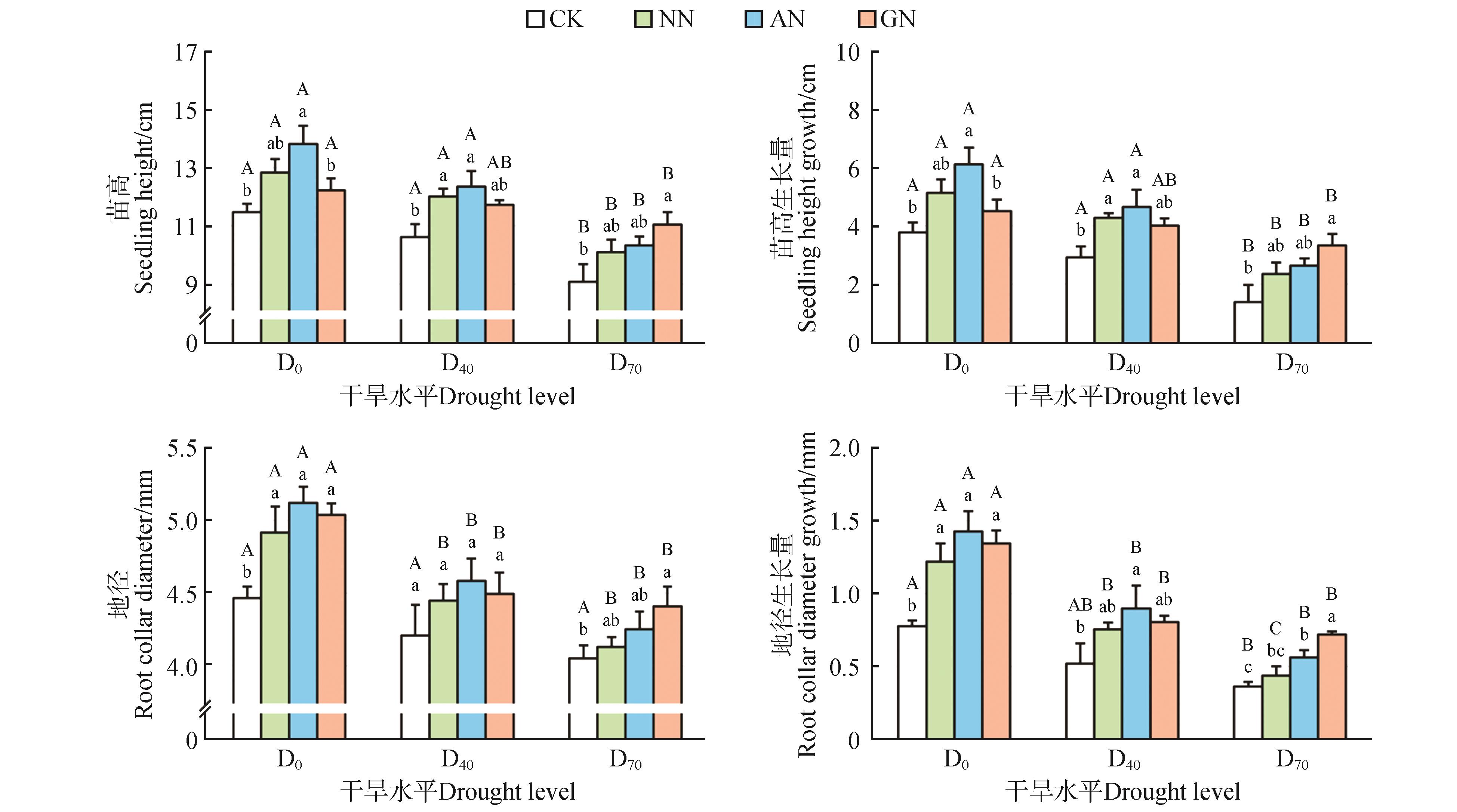
表3
干旱水平和氮素形态对红松苗木根系形态的主效应和交互作用
变异来源 Sources | 自由度 df | P | |||
|---|---|---|---|---|---|
总根长 Total root length | 总根表面积 Total root area | 总根体积 Total root volume | 根尖数量 Number of root tips | ||
干旱水平 Drought level | 2 | <0.001 | <0.001 | 0.015 | 0.158 |
氮素形态 Nitrogen form | 3 | <0.001 | <0.001 | 0.089 | 0.004 |
干旱水平×氮素形态 Drought level × Nitrogen form | 6 | 0.001 | <0.001 | 0.902 | 0.969 |
图2
干旱水平和氮素形态对红松苗木根系形态的影响
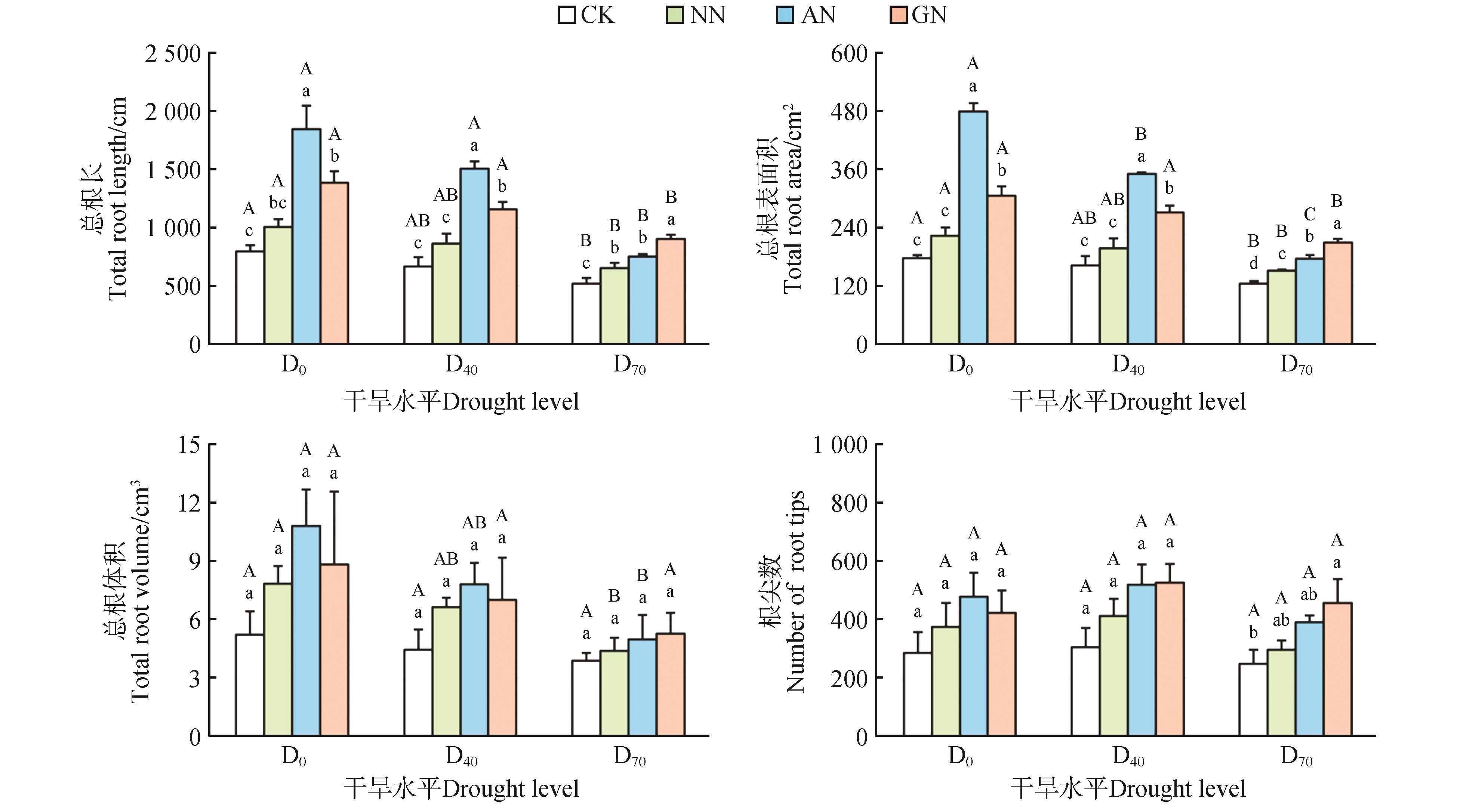
表4
干旱水平和氮素形态对红松苗木生物量和苗木质量指数的主效应和交互作用
变异来源 Sources | 自由度 df | P | ||||
|---|---|---|---|---|---|---|
根系生物量 Root biomass | 茎干生物量 Stem biomass | 针叶生物量 Needle biomass | 全株生物量 Total biomass | 苗木质量指数 Dickson’s quality index | ||
干旱水平 Drought level | 2 | <0.001 | 0.023 | <0.001 | <0.001 | <0.001 |
氮素形态 Nitrogen form | 3 | <0.001 | 0.339 | <0.001 | <0.001 | <0.001 |
干旱水平×氮素形态 Drought level × Nitrogen form | 6 | 0.004 | 0.996 | 0.011 | 0.052 | 0.013 |
图3
干旱水平和氮素形态对红松苗木生物量的影响
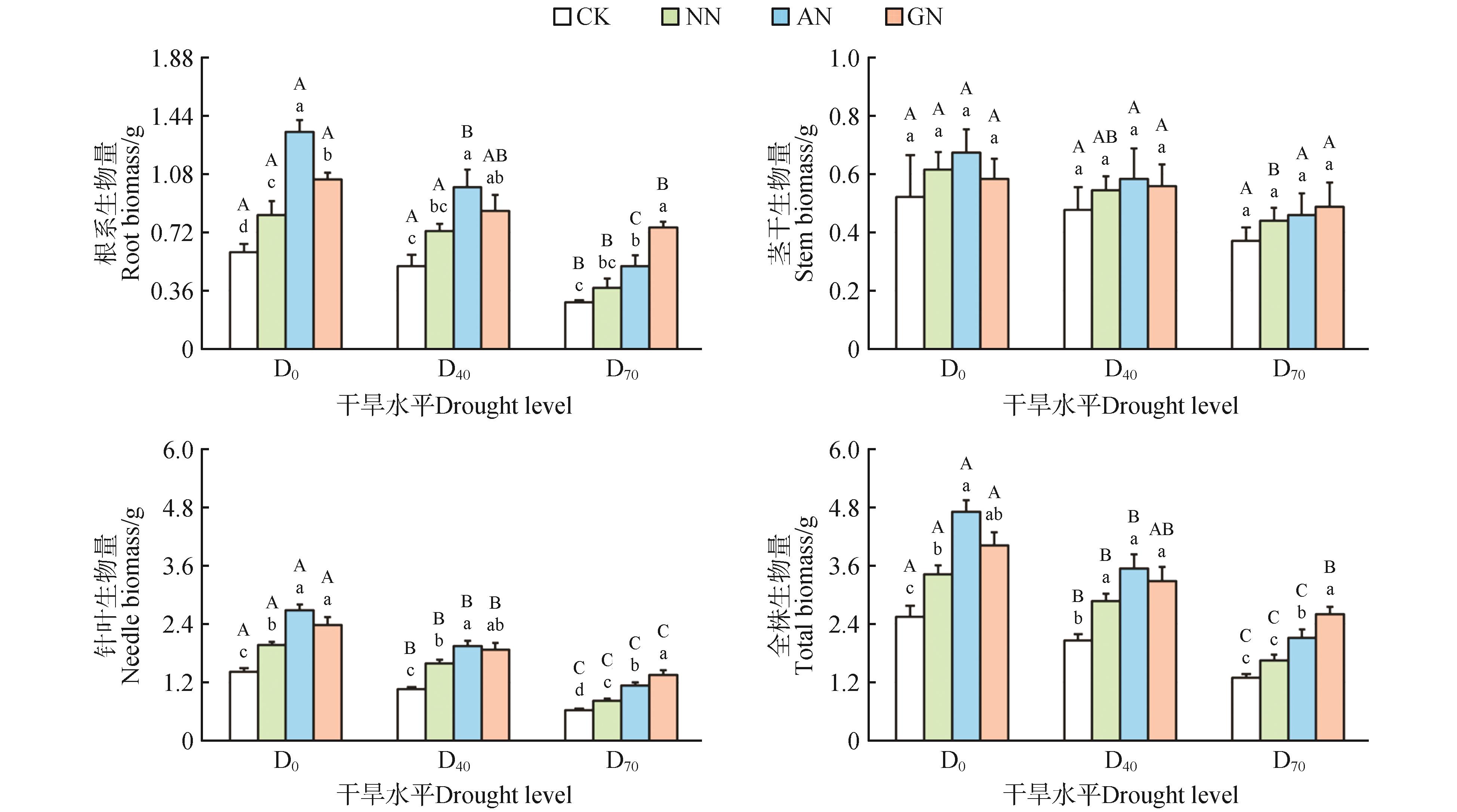
图4
干旱水平和氮素形态对红松苗木质量指数的影响CK.不施氮;NN.硝态氮;AN.铵态氮;GN.有机氮;D0.充分浇水;D40.中度干旱;D70.重度干旱。图中“×”代表对应处理的均值。不同大写字母表示相同形态氮素不同干旱水平之间差异显著(P<0.05);不同小写字母表示相同干旱水平不同形态氮素之间差异显著(P<0.05)。
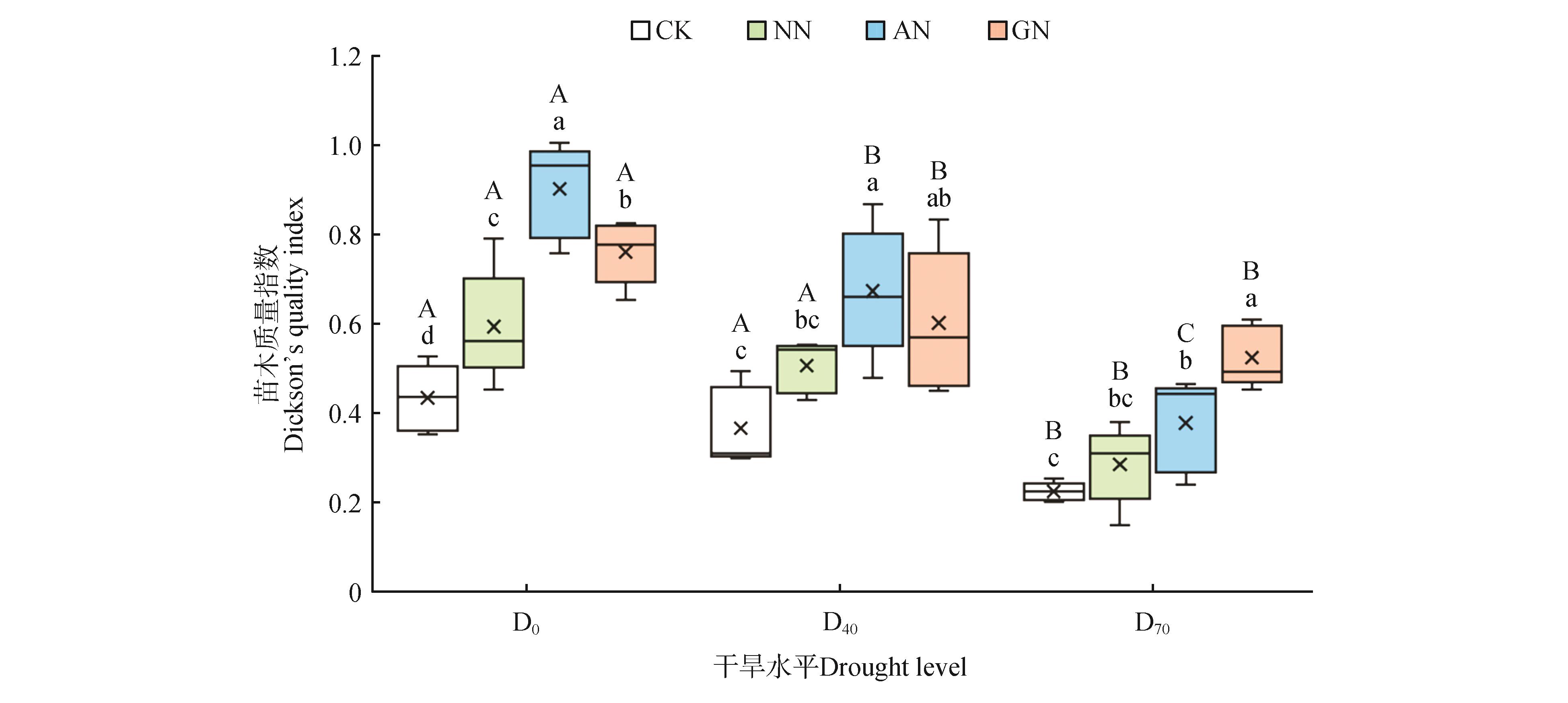
表5
干旱水平和氮素形态对红松苗木针叶水势和针叶相对含水量的主效应和交互作用
变异来源 Sources | 自由度 df | P | |
|---|---|---|---|
针叶水势 Needle water potential | 针叶相对含水量 Needle relative water content | ||
干旱水平 Drought level | 2 | <0.001 | <0.001 |
氮素形态 Nitrogen form | 3 | <0.001 | 0.005 |
干旱水平×氮素形态 Drought level × Nitrogen form | 6 | <0.001 | 0.002 |
图5
干旱水平和氮素形态对红松苗木针叶水势和针叶相对含水量的影响
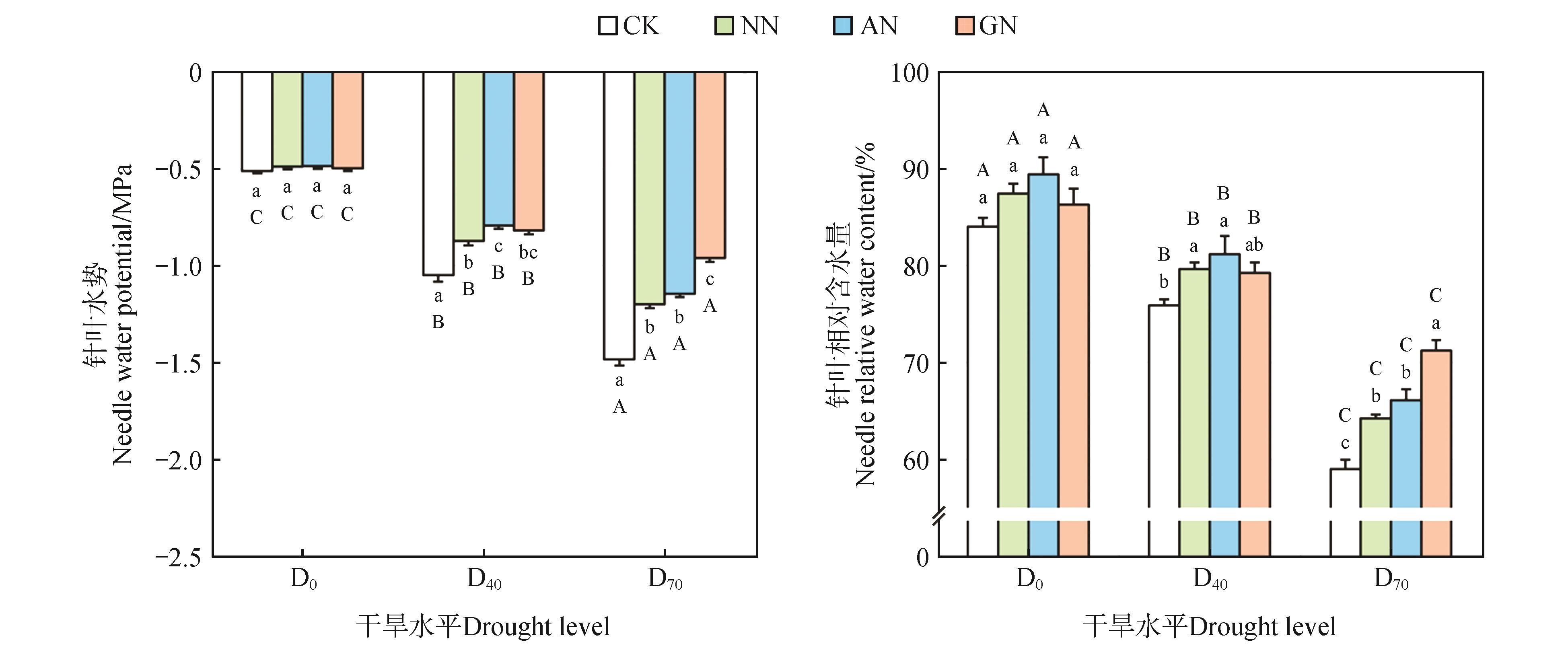
表6
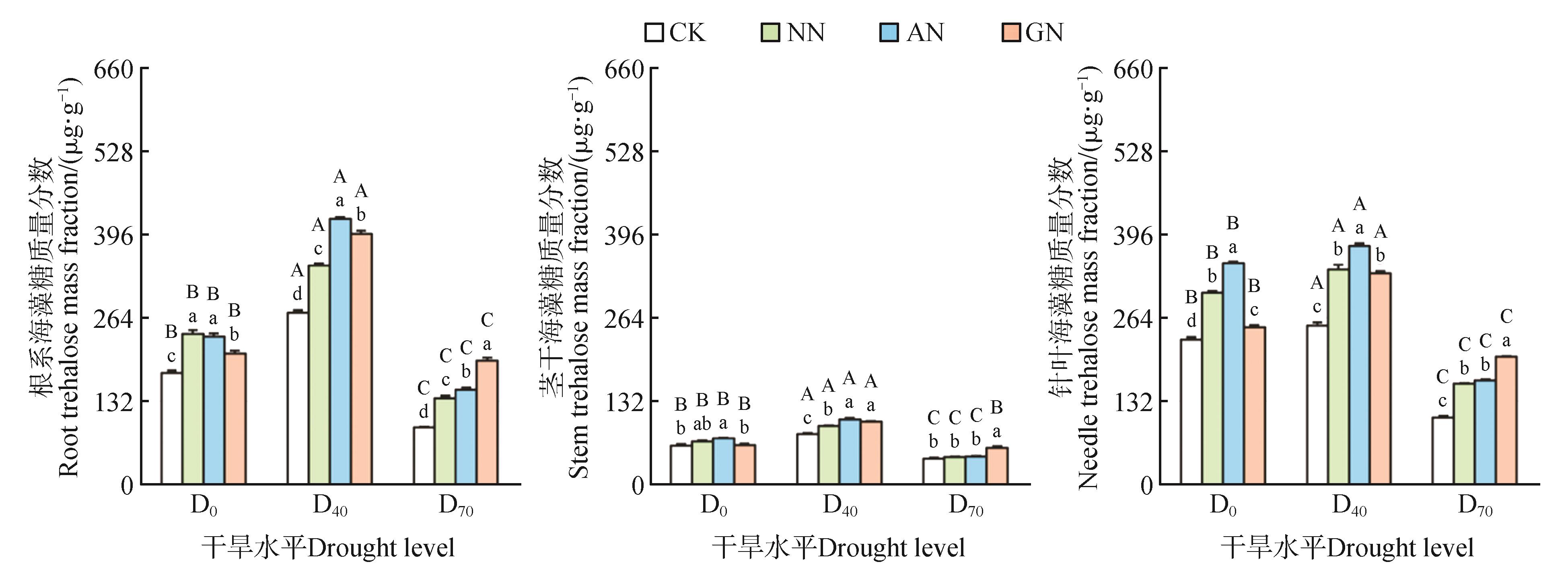
干旱水平和氮素形态对红松苗木渗透调节物质质量分数的主效应和交互作用
器官 Organ | 变异来源 Sources | 自由度 df | P | ||
|---|---|---|---|---|---|
脯氨酸质量分数 Proline mass fraction | 甜菜碱质量分数 Betaine mass fraction | 海藻糖质量分数 Trehalose mass fraction | |||
根系 Root | 干旱水平 Drought level | 2 | <0.001 | <0.001 | <0.001 |
氮素形态 Nitrogen form | 3 | <0.001 | <0.001 | <0.001 | |
干旱水平×氮素形态 Drought level × Nitrogen form | 6 | <0.001 | 0.003 | <0.001 | |
茎干 Stem | 干旱水平 Drought level | 2 | <0.001 | <0.001 | <0.001 |
氮素形态 Nitrogen form | 3 | <0.001 | <0.001 | <0.001 | |
干旱水平×氮素形态 Drought level × Nitrogen form | 6 | 0.016 | 0.084 | <0.001 | |
针叶 Needle | 干旱水平 Drought level | 2 | <0.001 | <0.001 | <0.001 |
氮素形态 Nitrogen form | 3 | <0.001 | <0.001 | <0.001 | |
干旱水平×氮素形态 Drought level × Nitrogen form | 6 | <0.001 | <0.001 | <0.001 | |
图6
干旱水平和氮素形态对红松苗木脯氨酸质量分数的影响
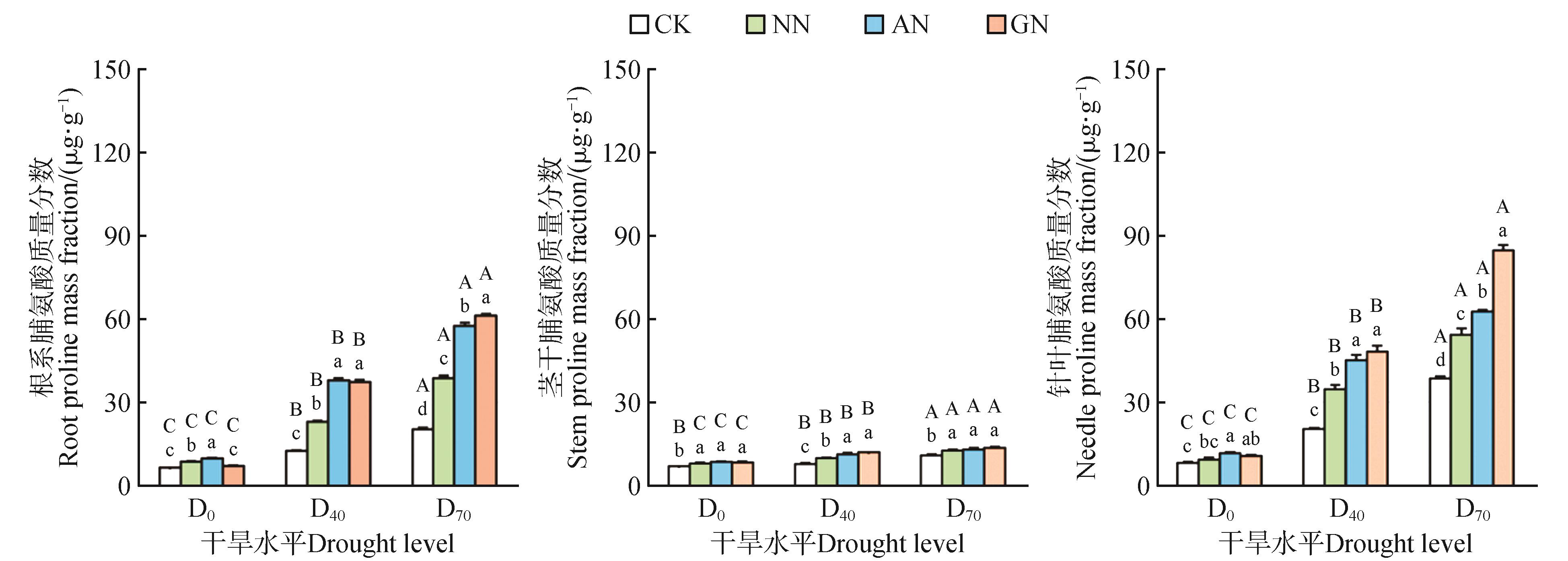
图7
干旱水平和氮素形态对红松苗木甜菜碱质量分数的影响
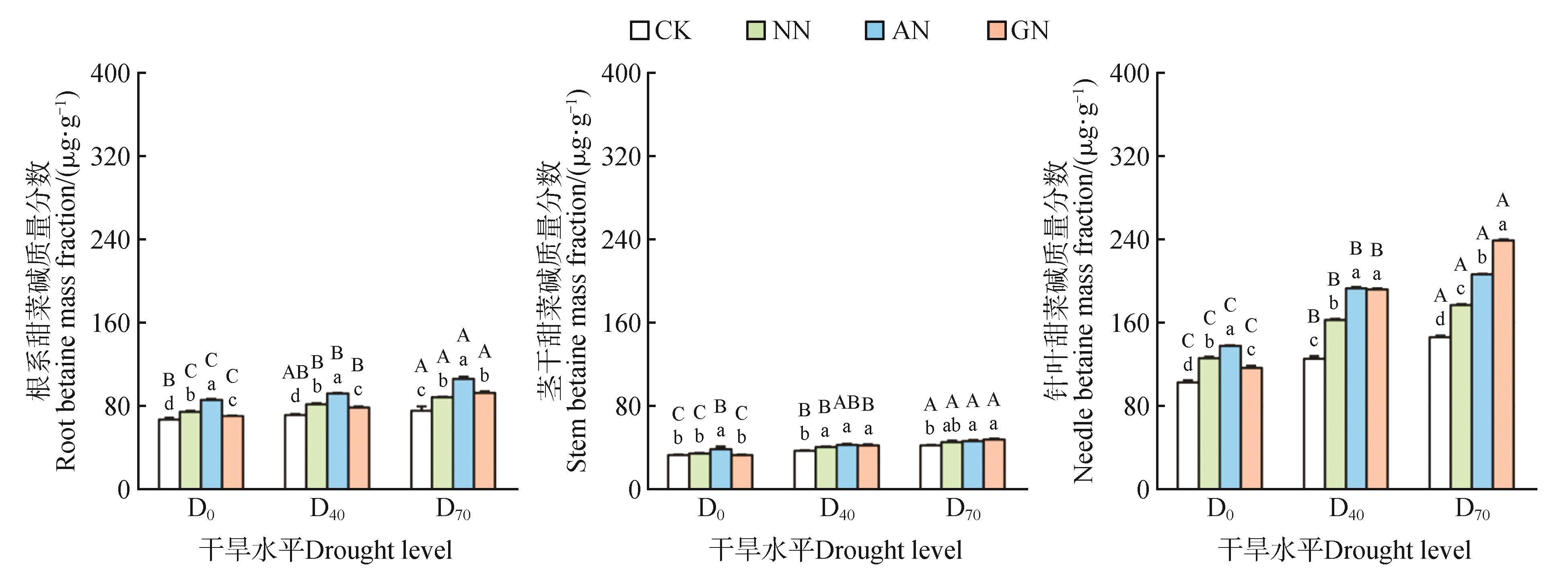
图8
干旱水平和氮素形态对红松苗木海藻糖质量分数的影响
| [1] | Nadelhoffer K J, Aber J D, Melillo J M.Fine roots,net primary production,and soil nitrogen availability:a new hypothesis[J].Ecology,1985,66(4):1377-1390. |
| [2] | Hawkins B J, Robbins S.pH affects ammonium,nitrate and proton fluxes in the apical region of conifer and soybean roots[J].Physiologia Plantarum,2010,138(2):238-247. |
| [3] | Chapin F S, Moilanen L, Kielland K.Preferential use of organic nitrogen for growth by a non-mycorrhizal arctic sedge[J].Nature,1993,361(6408):150-153. |
| [4] | Näsholm T, Persson J.Plant acquisition of organic nitrogen in boreal forests[J].Physiologia Plantarum,2001,111(4):419-426. |
| [5] | Jämtgård S, Näsholm T, Huss-Danell K.Characteristics of amino acid uptake in barley[J].Plant and Soil,2008,302(1):221-231. |
| [6] | Zhang P, Dumroese R K, Pinto J R.Organic or inorganic nitrogen and rhizobia inoculation provide synergistic growth response of a leguminous forb and tree[J].Frontiers in Plant Science,2019,10:1308. |
| [7] | Zhu F F, Dai L M, Hobbie E A,et al.Uptake patterns of glycine,ammonium,and nitrate differ among four common tree species of northeast China[J].Frontiers in Plant Science,2019,10:799. |
| [8] | Metcalfe R J, Nault J, Hawkins B J.Adaptations to nitrogen form:comparing inorganic nitrogen and amino acid availability and uptake by four temperate forest plants[J].Canadian Journal of Forest Research,2011,41(8):1626-1637. |
| [9] | Wilson A R, Nzokou P, Güney D,et al.Growth response and nitrogen use physiology of Fraser fir (Abies fraseri),red pine (Pinus resinosa),and hybrid poplar under amino acid nutrition[J].New Forests,2013,44(2):281-295. |
| [10] | Franklin O, Cambui C A, Gruffman L,et al.The carbon bonus of organic nitrogen enhances nitrogen use efficiency of plants[J].Plant,Cell & Environment,2017,40(1):25-35. |
| [11] | 崔晓阳.植物对有机氮源的利用及其在自然生态系统中的意义[J].生态学报,2007,27(8):3500-3512. |
| Cui Xiaoyang.Organic nitrogen use by plants and its significance in some natural ecosystems[J].Acta Ecologica Sinica,2007,27(8):3500-3512. | |
| [12] | Zerihun A, McKenzie B A, Morton J D.Photosynthate costs associated with the utilization of different nitrogen-forms:influence on the carbon balance of plants and shoot-root biomass partitioning[J].New Phytologist,1998,138(1):1-11. |
| [13] | Cramer G R, Urano K, Delrot S,et al.Effects of abiotic stress on plants:a systems biology perspective[J].BMC Plant Biology,2011,11(1):163. |
| [14] | Bandurska H.Drought stress responses:coping strategy and resistance[J].Plants,2022,11(7):922. |
| [15] | Chaudhry S, Sidhu G P S.Climate change regulated abiotic stress mechanisms in plants:a comprehensive review[J].Plant Cell Reports,2022,41(1):1-31. |
| [16] | Bhargava S, Sawant K.Drought stress adaptation:metabolic adjustment and regulation of gene expression[J].Plant Breeding,2013,132(1):21-32. |
| [17] | Ruthrof K X, Breshears D D, Fontaine J B,et al.Subcontinental heat wave triggers terrestrial and marine,multi-taxa responses[J].Scientific Reports,2018,8:13094. |
| [18] | Xu C G, McDowell N G, Fisher R A,et al.Increasing impacts of extreme droughts on vegetation productivity under climate change[J].Nature Climate Change,2019,9(12):948-953. |
| [19] | Zhang L X, Zhou T J.Drought over east Asia:a review[J].Journal of Climate,2015,28(8):3375-3399. |
| [20] | Ma Z G, Fu C B.Some evidence of drying trend over northern China from 1951 to 2004[J].Chinese Science Bulletin,2006,51(23):2913-2925. |
| [21] | Andivia E, Madrigal-González J, Villar-Salvador P,et al.Do adult trees increase conspecific juvenile resilience to recurrent droughts?Implications for forest regeneration[J].Ecosphere,2018,9(6):e02282. |
| [22] | Goldstein G, Bucci S J, Scholz F G.Why do trees adjust water relations and hydraulic architecture in response to nutrient availability?[J].Tree Physiology,2013,33(3):238-240. |
| [23] | Gessler A, Schaub M, McDowell N G.The role of nutrients in drought-induced tree mortality and recovery[J].New Phytologist,2017,214(2):513-520. |
| [24] | Dziedek C, von Oheimb G, Calvo L,et al.Does excess nitrogen supply increase the drought sensitivity of European beech (Fagus sylvatica L.) seedlings?[J].Plant Ecology,2016,217(4):393-405. |
| [25] | Zhang H X, Li W B, Adams H D,et al.Responses of woody plant functional traits to nitrogen addition:a meta-analysis of leaf economics,gas exchange,and hydraulic traits[J].Frontiers in Plant Science,2018,9:683. |
| [26] | Sharma A, Kumar V, Shahzad B,et al.Photosynthetic response of plants under different abiotic stresses:a review[J].Journal of Plant Growth Regulation,2020,39(2):509-531. |
| [27] | 游韧,邓湘雯,胡彦婷,等.树木对干旱胁迫及复水的生理生态响应研究进展[J].林业科学,2023,59(11):124-136. |
| You Ren, Deng Xiangwen, Hu Yanting,et al.Progress on physiological and ecological responses of trees to drought stress and rewatering[J].Scientia Silvae Sinicae,2023,59(11):124-136. | |
| [28] | 祁鲁玉,吴峰,吴瑞雪,等.遮阴和不同形态氮素施肥对红松幼苗生长的影响[J].森林工程,2019,35(4):1-5. |
| Qi Luyu, Wu Feng, Wu Ruixue,et al.Effects of shading and different forms of nitrogen fertilization on the growth of Pinus koraiensis seedlings[J].Forest Engineering,2019,35(4):1-5. | |
| [29] | Zhong C, Jian S F, Chen D L,et al.Organic nitrogen sources promote andrographolide biosynthesis by reducing nitrogen metabolism and increasing carbon accumulation in Andrographis paniculata [J].Plant Physiology and Biochemistry,2021,164:82-91. |
| [30] | Huang H, Wu H B, López R,et al.Effects of pre-hardening and autumn fertilization on biomass allocation and root morphology of Pinus koraiensis seedlings[J].Forests,2023,14(1):59. |
| [31] | Sigala J A, Uscola M, Oliet J A,et al.Drought tolerance and acclimation in Pinus ponderosa seedlings:the influence of nitrogen form[J].Tree Physiology,2020,40(9):1165-1177. |
| [32] | Ouyang S N, Gessler A, Saurer M,et al.Root carbon and nutrient homeostasis determines downy oak sapling survival and recovery from drought[J].Tree Physiology,2021,41(8):1400-1412. |
| [33] | Dumroese R K, Pinto J R, Montville M E.Using container weights to determine irrigation needs:a simple method[J].Native Plants Journal,2015,16(1):67-71. |
| [34] | Turnbull M H, Schmidt S, Erskine P D,et al.Root adaptation and nitrogen source acquisition in natural ecosystems[J].Tree Physiology,1996,16(11/12):941-948. |
| [35] | Landis T D, Tinus R W, Mcdonald S E,et al.The container tree nursery manual:Vol. 4:seedling nutrition and irrigation[M].Washington, D.C.:U.S. Department of Agriculture,Forest Service,1989. |
| [36] | 李泽义,莫惟轶,王玉婷,等.持续干旱胁迫及复水下红桦幼苗水力学性状与非结构性碳的动态响应[J].林业科学,2025,61(9):90-100. |
| Li Zeyi, Mo Weiyi, Wang Yuting,et al.Dynamic response of hydraulic traits and NSC in Betula albo-sinensis seedlings under continuous drought stress and rehydration[J].Scientia Silvae Sinicae,2025,61(9):90-100. | |
| [37] | Batool T, Ali S, Seleiman M F,et al.Plant growth promoting rhizobacteria alleviates drought stress in potato in response to suppressive oxidative stress and antioxidant enzymes activities[J].Scientific Reports,2020,10:16975. |
| [38] | Smirnakou S, Ouzounis T, Radoglou K M.Continuous spectrum LEDs promote seedling quality traits and performance of Quercus ithaburensis var. macrolepis [J].Frontiers in Plant Science,2017,8:188. |
| [39] | Claeys H, Inzé D.The agony of choice:how plants balance growth and survival under water-limiting conditions[J].Plant Physiology,2013,162(4):1768-1779. |
| [40] | Grossnickle S C, MacDonald J E.Why seedlings grow:influence of plant attributes[J].New Forests,2018,49(1):1-34. |
| [41] | Fitter A H, Graves J D, Self G K,et al.Root production,turnover and respiration under two grassland types along an altitudinal gradient:influence of temperature and solar radiation[J].Oecologia,1998,114(1):20-30. |
| [42] | Villar-Salvador P, Puértolas J, Peñuelas J L,et al.Effect of nitrogen fertilization in the nursery on the drought and frost resistance of Mediterranean forest species[J].Forest Systems,2005,14(3):408-418. |
| [43] | Gruffman L, Palmroth S, Näsholm T.Organic nitrogen uptake of Scots pine seedlings is independent of current carbohydrate supply[J].Tree Physiology,2013,33(6):590-600. |
| [44] | Yang N, Wang C L, He W P,et al.Photosynthetic characteristics and effects of exogenous glycine of Chorispora bungeana under drought stress[J].Photosynthetica,2016,54(3):459-467. |
| [45] | Gulmon S L, Chu C C.The effects of light and nitrogen on photosynthesis,leaf characteristics,and dry matter allocation in the chaparral shrub,Diplacus aurantiacus [J].Oecologia,1981,49(2):207-212. |
| [46] | Cuesta B, Villar-Salvador P, Puértolas J,et al.Why do large,nitrogen rich seedlings better resist stressful transplanting conditions?A physiological analysis in two functionally contrasting Mediterranean forest species[J].Forest Ecology and Management,2010,260(1):71-78. |
| [47] | Chirino E, Vilagrosa A, Hernández E I,et al.Effects of a deep container on morpho-functional characteristics and root colonization in Quercus suber L. seedlings for reforestation in Mediterranean climate[J].Forest Ecology and Management,2008,256(4):779-785. |
| [48] | Bayala J, Dianda M, Wilson J,et al.Predicting field performance of five irrigated tree species using seedling quality assessment in Burkina Faso,West Africa[J].New Forests,2009,38(3):309-322. |
| [49] | Tsakaldimi M, Ganatsas P, Jacobs D F.Prediction of planted seedling survival of five Mediterranean species based on initial seedling morphology[J].New Forests,2013,44(3):327-339. |
| [50] | 白洁冰,王志刚,陈飞,等.食松、油松和樟子松抗旱水分生理比较研究[J].西北林学院学报,2008,23(1):10-13. |
| Bai Jiebing, Wang Zhigang, Chen Fei,et al.Water physiology of Pinus edulis Engelm.,P. tabulaeformis and P. sylvestris var. mongolica under drought stress[J].Journal of Northwest Forestry University,2008,23(1):10-13. | |
| [51] | Bhusal N, Lee M, Lee H,et al.Evaluation of morphological,physiological,and biochemical traits for assessing drought resistance in eleven tree species[J].Science of the Total Environment,2021,779:146466. |
| [52] | Tyree M T, Alexander J D.Plant water relations and the effects of elevated CO2:a review and suggestions for future research[J].Vegetatio,1993,104(1):47-62. |
| [53] | Ozturk M, Turkyilmaz Unal B, García-Caparrós P,et al.Osmoregulation and its actions during the drought stress in plants[J].Physiologia Plantarum,2021,172(2):1321-1335. |
| [54] | Rontein D, Dieuaide-Noubhani M, Dufourc E J,et al.The metabolic architecture of plant cells:stability of central metabolism and flexibility of anabolic pathways during the growth cycle of tomato cells[J].The Journal of Biological Chemistry,2002,277(46):43948-43960. |
| [55] | Jaleel C A, Manivannan P, Sankar B,et al.Induction of drought stress tolerance by ketoconazole in Catharanthus roseus is mediated by enhanced antioxidant potentials and secondary metabolite accumulation[J].Colloids and Surfaces B:Biointerfaces,2007,60(2):201-206. |
| [56] | Ali Q, Ashraf M.Induction of drought tolerance in maize (Zea mays L.) due to exogenous application of trehalose:growth,photosynthesis,water relations and oxidative defence mechanism[J].Journal of Agronomy and Crop Science,2011,197(4):258-271. |
| [57] | Duman F, Aksoy A, Aydin Z,et al.Effects of exogenous glycinebetaine and trehalose on cadmium accumulation and biological responses of an aquatic plant (Lemna gibba L.)[J].Water,Air,& Soil Pollution,2011,217(1):545-556. |
| [58] | Fernandez O, Béthencourt L, Quero A,et al.Trehalose and plant stress responses:friend or foe?[J].Trends in Plant Science,2010,15(7):409-417. |
| [59] | Kosar F, Akram N A, Sadiq M,et al.Trehalose:a key organic osmolyte effectively involved in plant abiotic stress tolerance[J].Journal of Plant Growth Regulation,2019,38(2):606-618. |
| [60] | Yang X Y, Lu M Q, Wang Y F,et al.Response mechanism of plants to drought stress[J].Horticulturae,2021,7(3):50. |
| [1] | 郭浩翔, 刘滨辉. 红松和兴安落叶松径向生长与归一化差异植被指数和环境因子关系[J]. 植物研究, 2026, 46(3): 570-578. |
| [2] | 尹亚莉, 杨立学, 于均屹, 陈俊彤, 董慧, 刘会锋, 徐迪. 西伯利亚红松苗木对难溶性磷的偏好及其适应机制[J]. 植物研究, 2026, 46(3): 557-569. |
| [3] | 潘梦婷, 刘月影, 郑志民. 白桦BpLUXs基因鉴定与功能验证[J]. 植物研究, 2026, 46(3): 411-424. |
| [4] | 王汉时, 李潇, 庞忠义, 彭彦辉, 王瑞雪, 张太进, 刘洋, 赵曦阳, 赵春莉, 蒋路平. 基于多性状综合评价的杨树优良无性系筛选[J]. 植物研究, 2026, 46(2): 378-392. |
| [5] | 温海瑞, 杨雨春, 刘月, 矫春晶, 王君, 王芳, 杨叶磊, 李依桐, 王杰. 红松不同器官非结构性碳水化合物和化学计量特征对疏伐的响应[J]. 植物研究, 2026, 46(2): 348-360. |
| [6] | 张凯, 杨晓东, 米尔卡米力⋅麦麦提, 张月娟, 艾沙江⋅阿不都沙拉木. 新疆短生植物区系和生活史策略分异[J]. 植物研究, 2026, 46(2): 310-323. |
| [7] | 李政, 陈凤欣, 刘雨奇, 李明明, 尹嘉璨, 刘超, 夏新莉. 过表达PtrMYB002基因抑制拟南芥生长并提高其抗旱性[J]. 植物研究, 2026, 46(1): 67-82. |
| [8] | 贾庆彬, 姚旭东, 金桂香, 于宏影, 李艳霞. 红松半同胞家系胸径遗传变异分析与优良家系选择[J]. 植物研究, 2026, 46(1): 158-166. |
| [9] | 张延红, 张亚萍, 王琳佳, 何春雨, 郭清毅. 半夏试管块茎延缓生长保存技术[J]. 植物研究, 2026, 46(1): 101-110. |
| [10] | 李杰, 张敬丽, 孙体梅, 白天, 吕英民, 李奋勇, 吴雅文. 7种杜鹃花的性状评价与杂交亲和性[J]. 植物研究, 2025, 45(6): 928-938. |
| [11] | 许云博, 张恒, 刘彩霞, 王萌, 刘宇航, 王秋宇, 买明远, 曲冠证. 小黑杨双单倍体生长性状及解剖结构分析[J]. 植物研究, 2025, 45(6): 888-897. |
| [12] | 赵雪怡, 杨明雨, 李湘, 司林菡, 王南, 刘伟灿, 董园园, 李晓薇, 王法微. 植物中肌醇磷酸激酶研究进展[J]. 植物研究, 2025, 45(6): 840-850. |
| [13] | 赵敏, 王峰, 王佳楠, 于淇, 张含国, 张磊. 抗松材线虫病落叶松优良家系选择[J]. 植物研究, 2025, 45(5): 827-836. |
| [14] | 王芳, 杨叶磊, 苑长华, 王君, 魏伟, 吴琳, 李奎友, 李奎全, 陆志民, 王元兴, 杨雨春. 红松优树子代生长变异分析及优良材料选择[J]. 植物研究, 2025, 45(5): 816-826. |
| [15] | 刘上, 王锦华, 哈斯, 刘畅. 组成型过表达PagPYL4基因对84K杨耐旱性与生长的影响[J]. 植物研究, 2025, 45(5): 722-730. |
| 阅读次数 | ||||||
|
全文 |
|
|||||
|
摘要 |
|
|||||
