
植物研究 ›› 2026, Vol. 46 ›› Issue (4): 728-739.doi: 10.7525/j.issn.1673-5102.2026.04.013
姚耀源1, 杨杰1, 张悦新1, 付玉杰1,2,3,4( )
)
收稿日期:2026-04-26
出版日期:2026-07-20
发布日期:2026-07-22
通讯作者:
付玉杰
E-mail:yujie_fu@163.com
作者简介:姚耀源(2001—),女,硕士研究生,主要从事林木分子生物学研究。
基金资助:
Yaoyuan YAO1, Jie YANG1, Yuexin ZHANG1, Yujie FU1,2,3,4()
Received:2026-04-26
Online:2026-07-20
Published:2026-07-22
Contact:
Yujie FU
E-mail:yujie_fu@163.com
摘要:
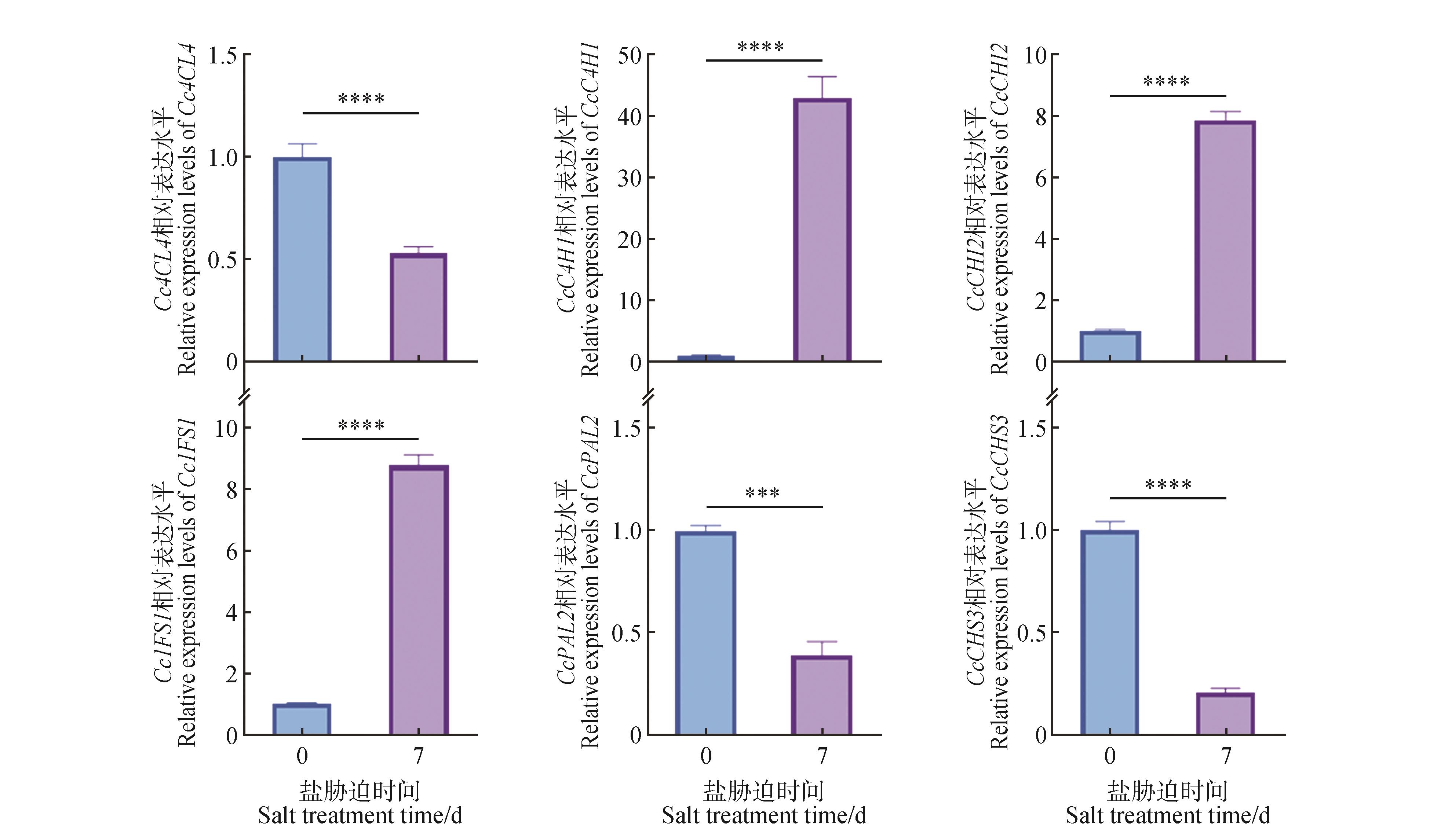
为系统阐明不同浓度盐胁迫条件下木豆(Cajanus cajan)幼苗的生长响应特征及其抗氧化酶活性与黄酮类代谢物积累的动态变化规律,采用生长一致的木豆幼苗作为材料,设置0、50、100、150、200 mmol⋅L-1 NaCl处理,在处理后1、3、5、7 d进行表型观察及根系扫描分析,测定根长、表面积、投影面积、体积及平均直径等根系形态指标,同时测定超氧化物歧化酶(SOD)和过氧化物酶(POD)活性,并在150 mmol⋅L-1 NaCl处理条件下选取不同时间点样品,利用超高效液相色谱-串联质谱(UPLC-MS/MS)技术对黄酮类代谢物进行定性与定量分析,并结合相关基因表达变化进行分析。结果表明:盐胁迫对木豆幼苗生长具有显著的浓度依赖性抑制作用。随着盐浓度升高及处理时间延长,幼苗表现为主根伸长受阻、侧根发育受限及地上部生长减缓,且在处理3 d后抑制效应明显增强。根系形态指标整体随时间呈增长趋势,但在100 mmol⋅L-1及更高盐浓度处理下增长幅度明显降低,50 mmol⋅L-1处理在部分观测时期对根系生长表现出一定促进作用;根系平均直径变化幅度较小,但在中高盐浓度条件下略有增加。SOD活性在中等盐浓度下显著升高并趋于稳定,POD活性随盐浓度增加及处理时间延长持续上升。在150 mmol⋅L-1 NaCl处理条件下,根系黄酮类代谢物呈现阶段性积累特征,木豆芪酸质量浓度整体呈上升趋势,异牡荆素质量浓度波动变化明显,染料木苷质量浓度呈诱导积累趋势,染料木素质量浓度在处理后期显著增加。基因表达分析结果显示,CcPAL2、Cc4CL4及CcCHS3表达量降低,CcC4H1表达显著上调,CcCHI2与CcIFS1表达量升高。研究表明,盐胁迫条件下,木豆幼苗生长受到抑制并表现出明显的时间与浓度效应,抗氧化酶活性及黄酮类代谢物含量随胁迫过程呈动态变化,黄酮生物合成通路关键基因表达存在差异性调控。
中图分类号:
姚耀源, 杨杰, 张悦新, 付玉杰. 盐胁迫诱导木豆幼苗形态、生理及黄酮代谢的多层次响应特征[J]. 植物研究, 2026, 46(4): 728-739.
Yaoyuan YAO, Jie YANG, Yuexin ZHANG, Yujie FU. Morpho-Physiological and Metabolic Responses and Expression Profiling of the CcTCP Gene Family in Pigeon Pea under Salt Stress[J]. Bulletin of Botanical Research, 2026, 46(4): 728-739.
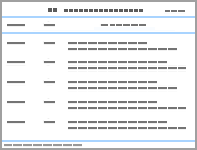
表1
荧光定量PCR引物
基因名称 Gene name | 上游引物(5′→3′) Forward primer(5′→3′) | 下游引物(5′→3′) Reverse primer(5′→3′) |
|---|---|---|
| qCcActin | AAGCTCAGTCCAAGAGAGGT | ACATGGCGGGGGTATTGAAG |
| qCcPAL2 | TGAACAACGGGACCGACAGT | AAAACCTGATGAGTTCCTTCTGC |
| qCc4CL4 | GCTGACGCACAAGAGTCTGATG | CAGCAACGCCCTAATCTCAA |
| qCcC4H1 | CCTATGGTCCCGTTTTCCTACT | TGAGTGGAGGACATGTGTGGC |
| qCcCHS3 | ACGCCAGGCAGGACATAGTA | ACTTTGGTTGACCCCATTCC |
| qCcCHI2 | CCTCCGCCAAGACCTATTTC | CGAGTGATTGGATGGCTTGA |
| qCcIFS1 | AGCCCTTCGCCACCTACCTAA | GGGAATAGTGGAGAAGGGGTTT |
图1
不同浓度NaCl处理下木豆幼苗在不同时间的表型变化
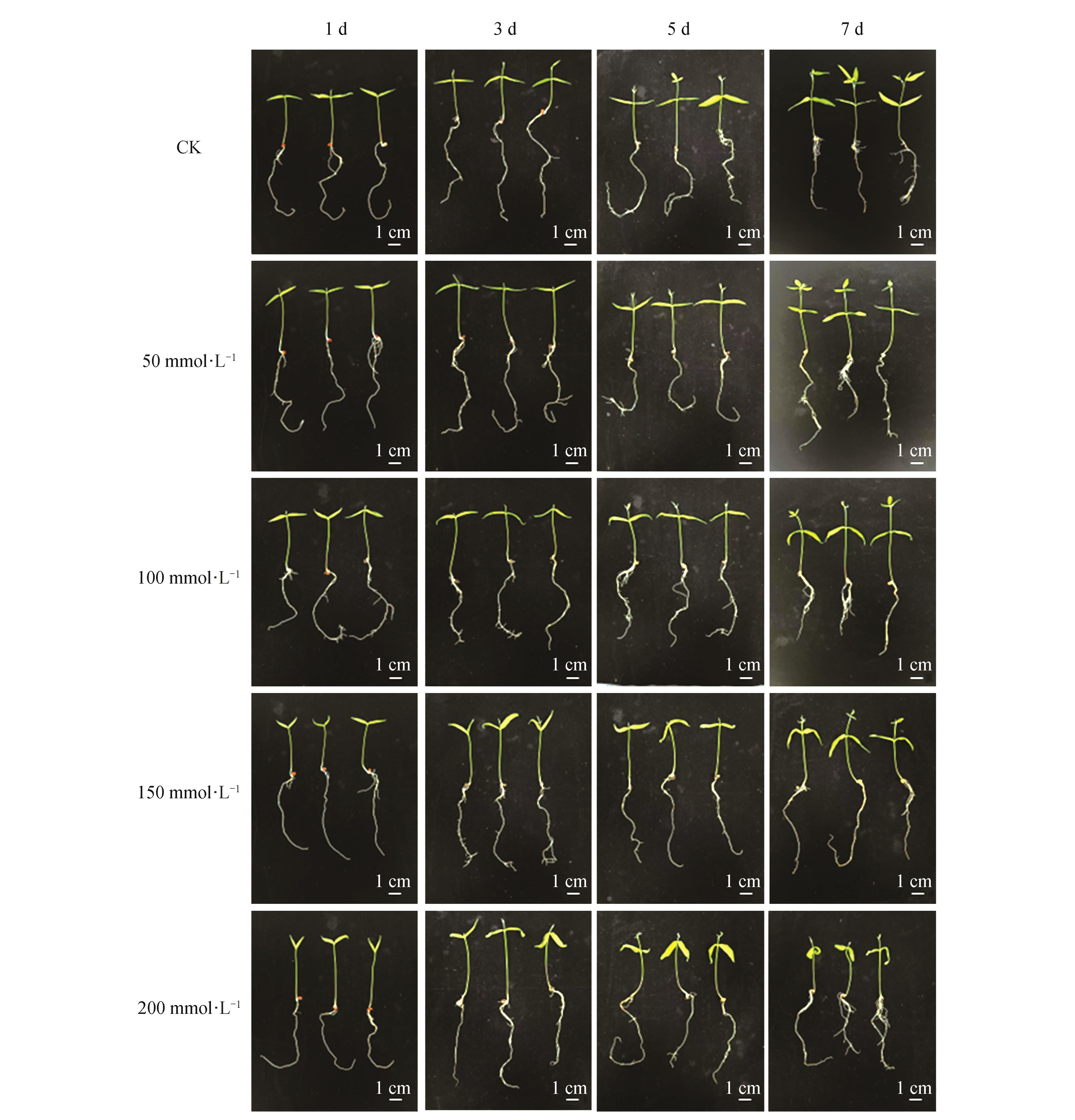
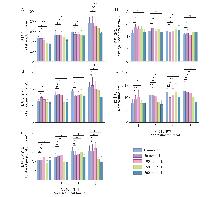
图2
不同浓度NaCl处理下木豆根系形态指标变化采用t检验判定统计学显著性。*. P<0.05,**. P<0.01,***. P<0.001。
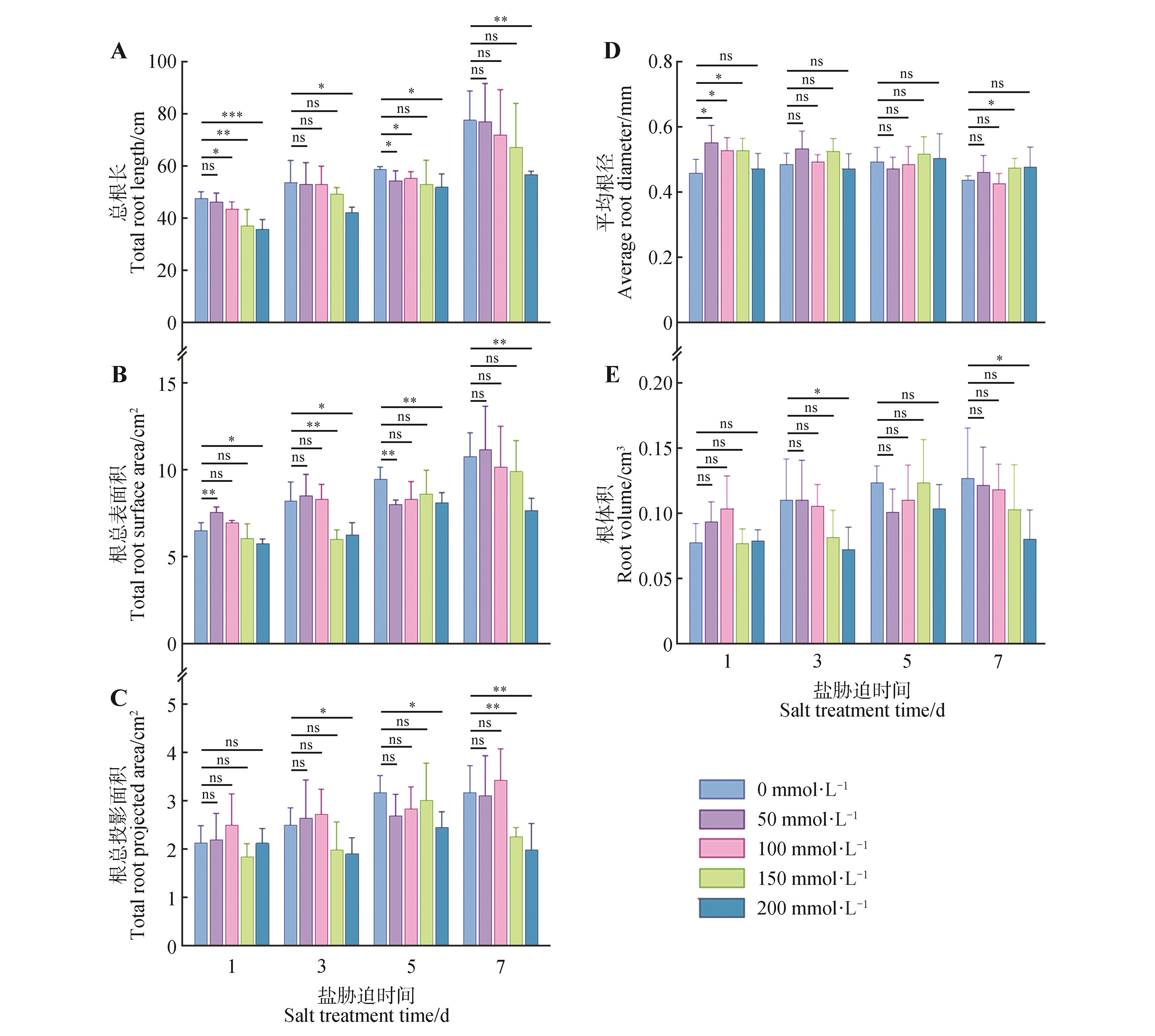
图3
不同浓度NaCl处理下木豆幼苗生理指标变化采用t检验判定统计学显著性。*. P<0.05,**. P<0.01,***. P<0.001。
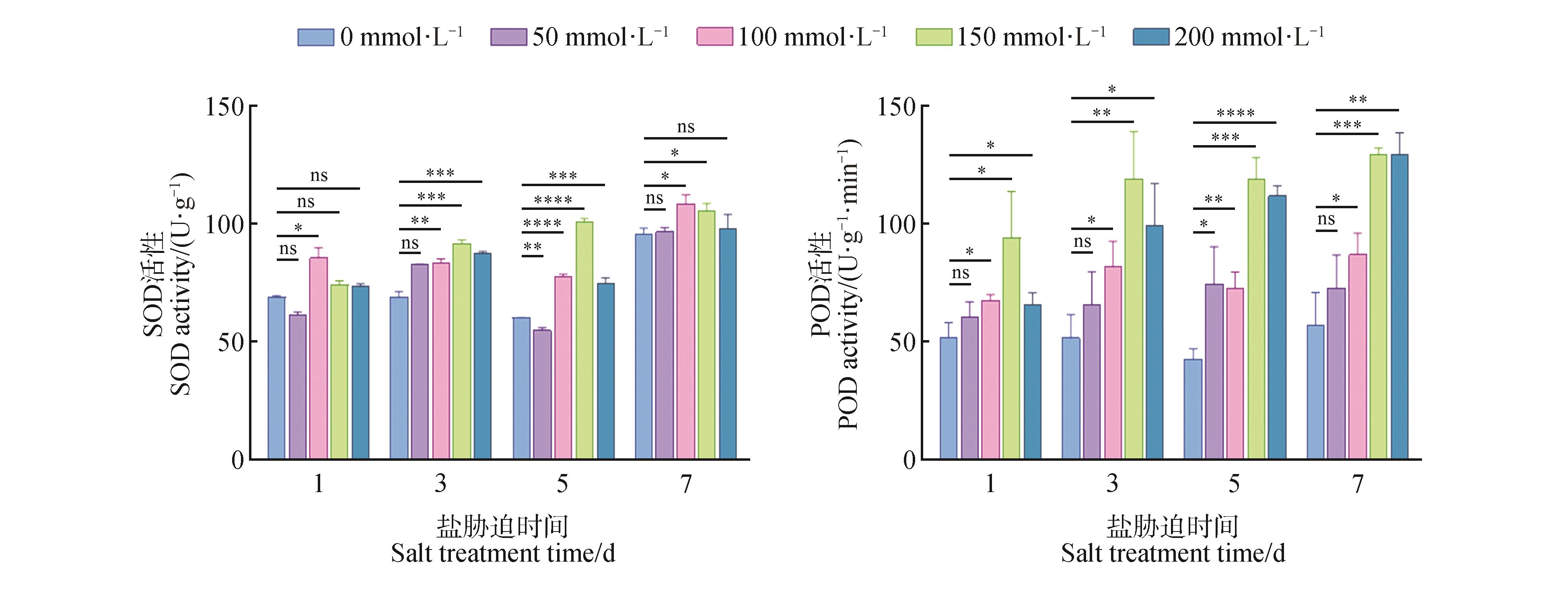
图4
150 mmol·L-1 NaCl处理下木豆黄酮积累量变化采用t检验判定统计学显著性。*. P<0.05,**. P<0.01,***. P<0.001,****. P<0.000 1。
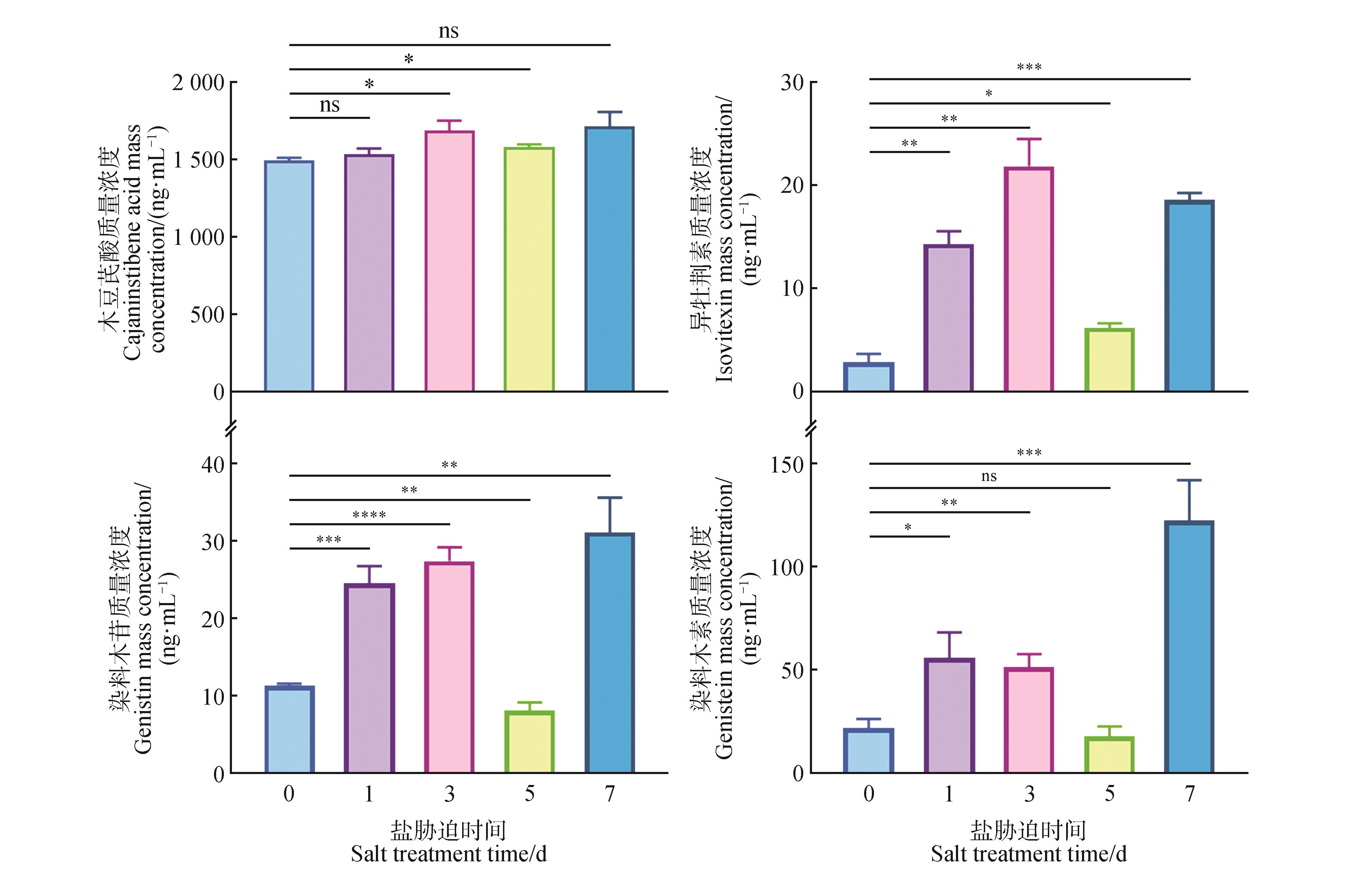
图5
木豆黄酮类代谢物水平和抗氧化酶活性的相关性分析
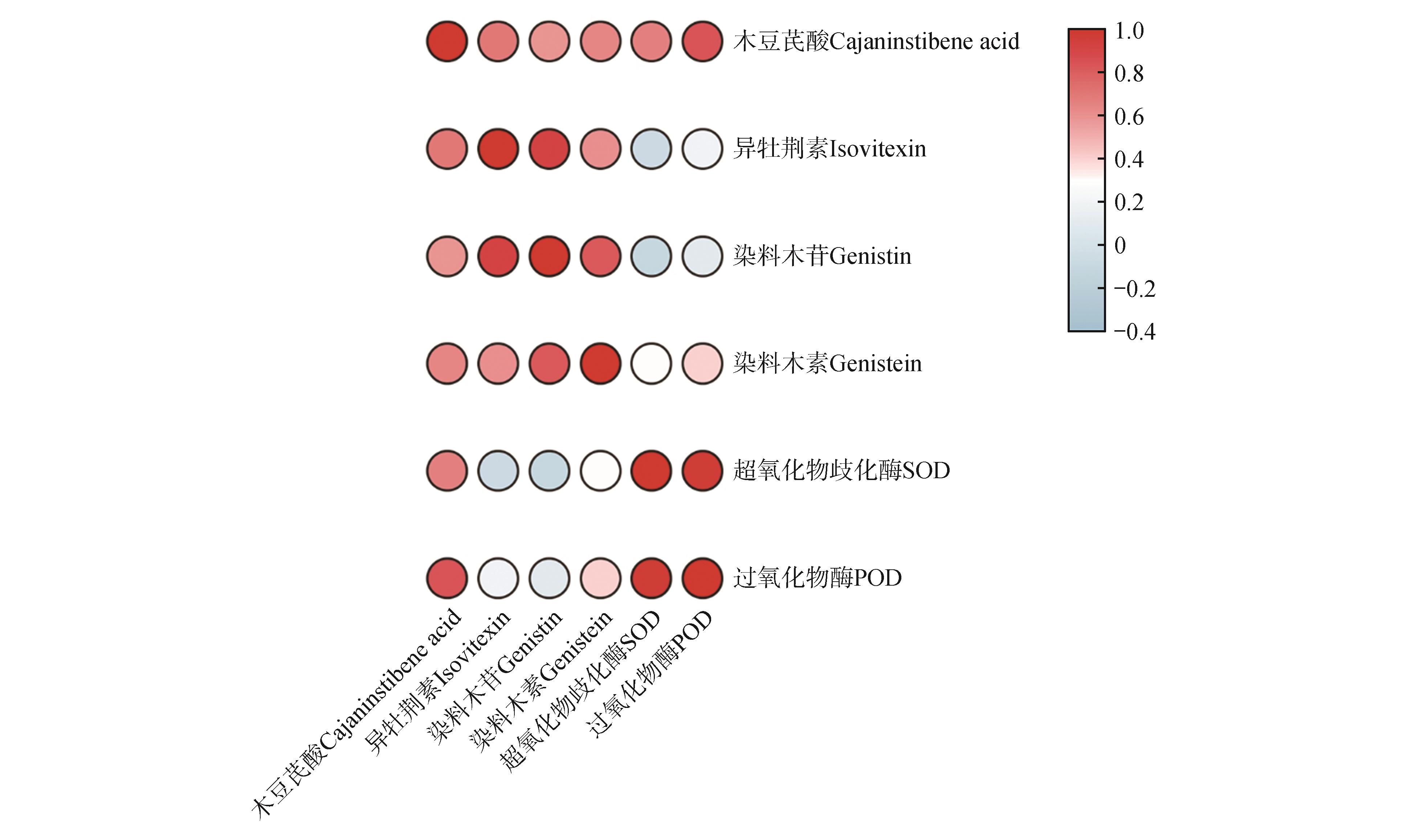
图6
150 mmol·L-1 NaCl处理木豆下黄酮途径基因相对表达量变化采用t检验判定统计学显著性。***. P<0.001,****. P<0.000 1。
| [1] | Hassani A, Azapagic A, Shokri N.Global predictions of primary soil salinization under changing climate in the 21st century[J].Nature Communications,2021,12:6663. |
| [2] | Shokri N, Hassani A, Sahimi M.Multi-scale soil salinization dynamics from global to pore scale:a review[J].Reviews of Geophysics,2024,62(4):e2023RG000804. |
| [3] | Zhou H P, Shi H F, Yang Y Q,et al.Insights into plant salt stress signaling and tolerance[J].Journal of Genetics and Genomics,2024,51(1):16-34. |
| [4] | Singh D.Juggling with reactive oxygen species and antioxidant defense system:a coping mechanism under salt stress[J].Plant Stress,2022,5:100093. |
| [5] | Wang H Q, Sun J, Ren H,et al.Inhibiting reactive oxygen species production mitigates endoplasmic reticulum damage in florets of developing maize ears under heat stress[J].The Plant Journal,2025,122(5):e70243. |
| [6] | Lu X, Chen G P, Ma L,et al.Integrated transcriptome and metabolome analysis reveals antioxidant machinery in grapevine exposed to salt and alkali stress[J].Physiologia Plantarum,2023,175(3):e13950. |
| [7] | Zhang X Y, He P Y, Guo R Y,et al.Effects of salt stress on root morphology,carbon and nitrogen metabolism,and yield of Tartary buckwheat[J].Scientific Reports,2023,13:12483. |
| [8] | Zhang L, Zhang Z J, Fang S Z,et al.Integrative analysis of metabolome and transcriptome reveals molecular regulatory mechanism of flavonoid biosynthesis in Cyclocarya paliurus under salt stress[J].Industrial Crops and Products,2021,170:113823. |
| [9] | Wang C L, Wei X T, Wang Y M,et al.Metabolomics and transcriptomic analysis revealed the response mechanism of maize to saline-alkali stress[J].Plant Biotechnology Journal,2025,23(12):5397-5416. |
| [10] | Su L T, Lv A M, Wen W W,et al.MsMYB206-MsMYB450-MsHY5 complex regulates alfalfa tolerance to salt stress via regulating flavonoid biosynthesis during the day and night cycles[J].The Plant Journal,2025,121(2):e17216. |
| [11] | Zheng X Y, Zhang X J, Zeng F K.The regulatory network composed of phytohormones,transcription factors and non-coding RNAs is involved in the flavonoids biosynthesis of fruits[J].Horticultural Plant Journal,2026,12(3):497-508. |
| [12] | Liu C, Tai Y L, Luo J J,et al.Integrated multi-omics analysis provides insights into genome evolution and phosphorus deficiency adaptation in pigeonpea (Cajanus cajan)[J].Horticulture Research,2022,9:uhac107. |
| [13] | Awana M, Jain N, Samota M K,et al.Protein and gene integration analysis through proteome and transcriptome brings new insight into salt stress tolerance in pigeonpea (Cajanus cajan L.)[J].International Journal of Biological Macromolecules,2020,164:3589-3602. |
| [14] | Du T T, Fan Y X, Cao H Y,et al.Transcriptome analysis revealed key genes involved in flavonoid metabolism in response to jasmonic acid in pigeon pea (Cajanus cajan (L.) Millsp.)[J].Plant Physiology and Biochemistry,2021,168:410-422. |
| [15] | Yang W L, Li N, Fan Y X,et al.Transcriptome analysis reveals abscisic acid enhancing drought resistance by regulating genes related to flavonoid metabolism in pigeon pea[J].Environmental and Experimental Botany,2021,191:104627. |
| [16] | Meng D, Dong B Y, Niu L L,et al.The pigeon pea CcCIPK14-CcCBL1 pair positively modulates drought tolerance by enhancing flavonoid biosynthesis[J].The Plant Journal,2021,106(5):1278-1297. |
| [17] | Giannopolitis C N, Ries S K.Superoxide dismutases:Ⅰ.occurrence in higher plants[J].Plant Physiology,1977,59(2):309-314. |
| [18] | Liu C X, Gu C Y, Huang W,et al.Targeted UPLC-MS/MS high-throughput metabolomics approach to assess the purine and pyrimidine metabolism[J].Journal of Chromatography B,2019,1113:98-106. |
| [19] | Livak K J, Schmittgen T D.Analysis of relative gene expression data using real-time quantitative PCR and the 2-ΔΔCT method[J].Methods,2001,25(4):402-408. |
| [20] | Khan F, Siddiqi T O,Mahmooduzzafar,et al.Morphological changes and antioxidant defence systems in soybean genotypes as affected by salt stress[J].Journal of Plant Interactions,2009,4(4):295-306. |
| [21] | Lan J Q, Qin G J.The regulation of CIN-like TCP transcription factors[J].International Journal of Molecular Sciences,2020,21(12):4498. |
| [22] | Gill S S, Tuteja N.Reactive oxygen species and antioxidant machinery in abiotic stress tolerance in crop plants[J].Plant Physiology and Biochemistry,2010,48(12):909-930. |
| [23] | Passardi F, Penel C, Dunand C.Performing the paradoxical:how plant peroxidases modify the cell wall[J].Trends in Plant Science,2004,9(11):534-540. |
| [24] | Mittova V, Tal M, Volokita M,et al.Salt stress induces up-regulation of an efficient chloroplast antioxidant system in the salt-tolerant wild tomato species Lycopersicon pennellii but not in the cultivated species[J].Physiologia Plantarum,2002,115(3):393-400. |
| [25] | Gharsallah C, Fakhfakh H, Grubb D,et al.Effect of salt stress on ion concentration,proline content,antioxidant enzyme activities and gene expression in tomato cultivars[J].AoB Plants,2016,8:plw055. |
| [26] | Demiral T, Türkan İ.Comparative lipid peroxidation,antioxidant defense systems and proline content in roots of two rice cultivars differing in salt tolerance[J].Environmental and Experimental Botany,2005,53(3):247-257. |
| [27] | Mittler R, Zandalinas S I, Fichman Y,et al.Reactive oxygen species signalling in plant stress responses[J].Nature Reviews Molecular Cell Biology,2022,23(10):663-679. |
| [28] | Miransari M, Smith D L.Alleviating salt stress on soybean (Glycine max (L.) Merr.)-Bradyrhizobium japonicum symbiosis,using signal molecule genistein[J].European Journal of Soil Biology,2009,45(2):146-152. |
| [29] | Wang Y B, Liu W, Li W,et al.Integrative analysis of metabolome and transcriptome reveals regulatory mechanisms of flavonoid biosynthesis in soybean under salt stress[J].Frontiers in Plant Science,2024,15:1415867. |
| [1] | 胡咏琪, 张瑞, 张艺森, 宋跃朋. PagTIP1;3基因调控84K杨盐胁迫响应的光合生理特性研究[J]. 植物研究, 2026, 46(4): 666-676. |
| [2] | 王思奇, 毕云杰, 李慧贤, 宋正宝, 刘润柯, 高瑞馨. 外源赤霉素对盐胁迫下藿香种子萌发的影响[J]. 植物研究, 2026, 46(3): 481-492. |
| [3] | 曹海艳, 田楷文, 贾晓宇, 郝雪峰, 金竹萍. 基于CRISPR/Cas9敲除阐明AtMST1通过H2S合成调控拟南芥耐盐性[J]. 植物研究, 2026, 46(2): 259-269. |
| [4] | 张力鹏, 武美, 王宏鹏, 李天宇. 大花红景天盐胁迫调控基因RcNAC22克隆及功能分析[J]. 植物研究, 2026, 46(2): 246-258. |
| [5] | 马秀英, 李金克, 周晓阳, 陈少良. Ca2+-ATPase参与植物耐盐性调控的研究进展[J]. 植物研究, 2024, 44(5): 641-654. |
| [6] | 张衡锋, 何阳武, 张焕朝, 韦庆翠. 紫薇响应盐胁迫和碱胁迫的代谢组分析[J]. 植物研究, 2024, 44(3): 420-430. |
| [7] | 方发之, 桂慧颖, 黎肇家, 张晓凤. 6种红树幼苗对不同盐度的生理适应性[J]. 植物研究, 2023, 43(6): 881-889. |
| [8] | 隋德宗, 王保松. 盐胁迫下乌桕无性系叶片的比较蛋白组学研究[J]. 植物研究, 2023, 43(5): 679-689. |
| [9] | 徐磊, 胥晓, 刘沁松. 外源水杨酸对盐胁迫下珙桐幼苗抗氧化系统和基因表达的影响[J]. 植物研究, 2023, 43(4): 572-581. |
| [10] | 刘森尧, 贾丰璘, 国庆, 樊高锋, 周博如, 姜廷波. 小黑杨转录因子PsnbHLH162基因在盐和低温胁迫下应答分析[J]. 植物研究, 2023, 43(2): 300-310. |
| [11] | 廖诗贤, 王宇婷, 董立本, 顾咏梅, 贾丰璘, 姜廷波, 周博如. 小黑杨转录因子PsnbZIP1应答盐胁迫功能分析[J]. 植物研究, 2023, 43(2): 288-299. |
| [12] | 岳莉然, 刘颖婕, 刘晨旭, 周蕴薇. 响应盐胁迫调控的露地菊miR398a的克隆及功能研究[J]. 植物研究, 2022, 42(6): 986-996. |
| [13] | 李登高, 林睿, 穆青慧, 周娜, 张焱如, 白薇. 马铃薯StNPR4基因的克隆与功能分析[J]. 植物研究, 2022, 42(5): 821-829. |
| [14] | 陈娇娆, 续旭, 胡章立, 杨爽. 植物感受盐胁迫及相关钙信号的研究进展[J]. 植物研究, 2022, 42(4): 713-720. |
| [15] | 程赫, 田双慧, 张洋, 刘聪, 夏德安, 魏志刚. 毛果杨nsLTP基因家族全基因组水平鉴定及其表达特性分析[J]. 植物研究, 2022, 42(3): 412-423. |
| 阅读次数 | ||||||
|
全文 |
|
|||||
|
摘要 |
|
|||||
