植物研究 ›› 2026, Vol. 46 ›› Issue (4): 579-583.doi: 10.7525/j.issn.1673-5102.2026.04.001
• 前瞻观点 • 下一篇
RODRÍGUEZ MARTÍN José Antonio
收稿日期:2026-02-20
出版日期:2026-07-20
发布日期:2026-07-22
通讯作者:
RODRíGUEZ MARTíN José Antonio
RODRÍGUEZ MARTÍN José Antonio
Received:2026-02-20
Online:2026-07-20
Published:2026-07-22
Contact:
RODRíGUEZ MARTíN José Antonio
About author:Dr. José Antonio Rodríguez Martín is a biologist (UAM) who obtained his Ph.D in Science from the School of Forest Engineering (UPM) in 2001. Since 2008, he has been a civil servant of the Spanish government and currently serves as senior scientist at the Department of the Environment of the National Institute for Agricultural and Food Research and Technology (INIA-CSIC). His research focuses on soil contamination, particularly the occurrence, distribution, and environmental behavior of heavy metals in terrestrial ecosystems. A central aspect of his work is the study of plant-soil interactions and the use of vegetation as bioindicators of environmental pollution across different environments, including urban, mining, and arid systems. He also applies geostatistical and spatial analysis techniques to assess the impact of land use and anthropogenic activities on soil quality. Dr. Rodríguez Martín has authored more than 120 scientific publications in the international peer-reviewed journals (e.g., Nature, Environmental Pollution, Soil BiologyandBiochemistry) and has extensive experience in international research projects, peer review, and scientific dissemination.Corresponding email: rmartin@inia.csic.es.
摘要:
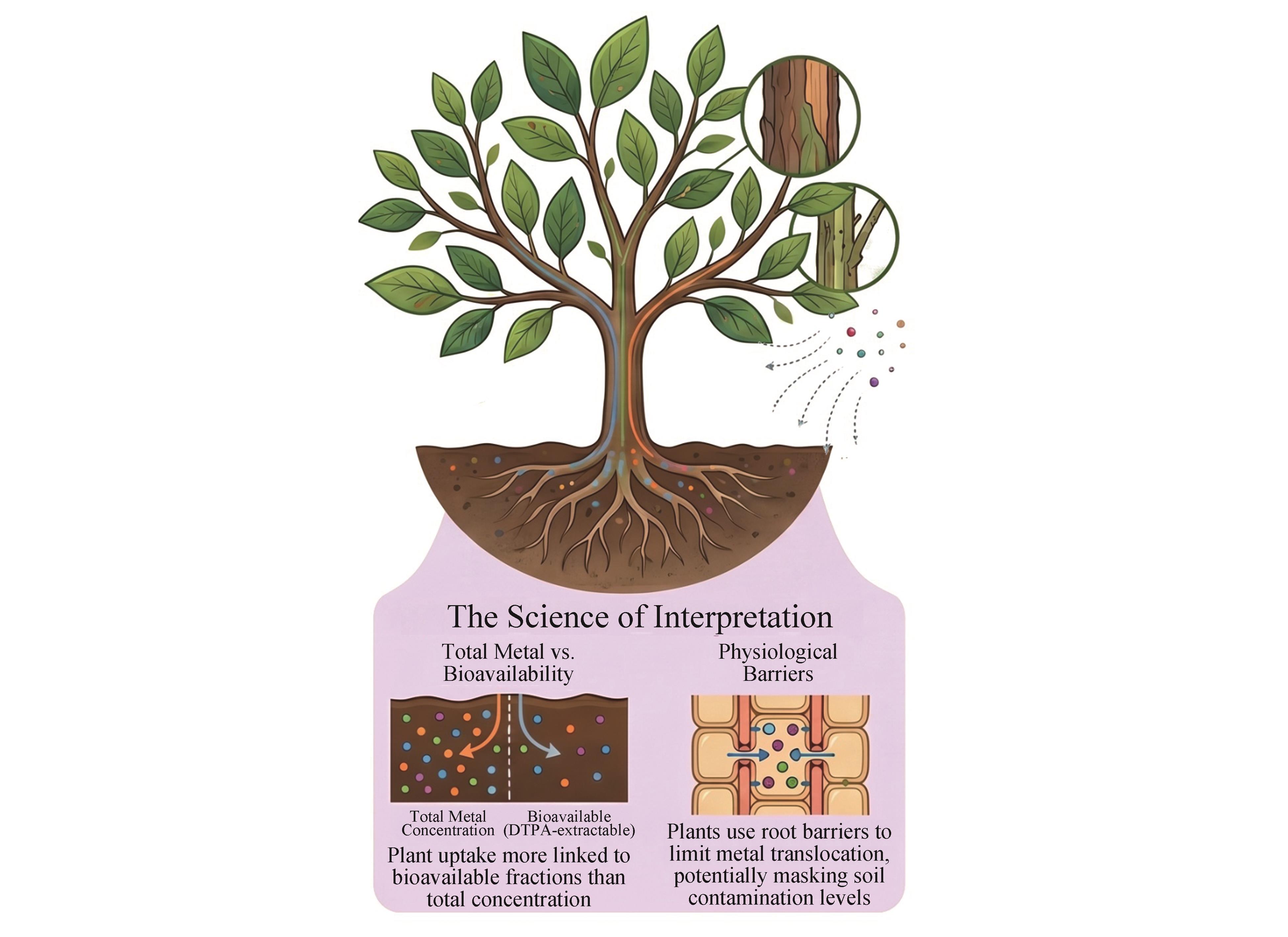
植被作为环境污染诊断工具已从描述性实践中不断发展和应用。植物长期被用作环境污染(尤其是重金属污染)的生物指示物。尽管分析技术的进步显著提升了我们对植物组织中微量元素的定量能力,但解析这些数据仍面临重大挑战。本文观点认为,植物不应被视为环境污染的被动记录者,而应理解为基于物种特异性生理机制和环境条件整合、转化并重新分配金属的动态系统。
中图分类号:
RODRÍGUEZ MARTÍN José Antonio. 植物作为重金属污染的生物指示物——从测量到机理理解的综合观点[J]. 植物研究, 2026, 46(4): 579-583.
RODRÍGUEZ MARTÍN José Antonio. Plants as Bioindicators of Heavy Metal Pollution: A Synthetic Viewpoint from Measurement to Mechanistic Understanding[J]. Bulletin of Botanical Research, 2026, 46(4): 579-583.
| [1] | Zamani-Ahmadmahmoodi R, Gharahi N, Rodríguez Martín J A,et al.Cd and Pb bioaccumulation in Eurasian watermilfoil (Myriophyllum spicatum) in relation to the role of metal contents in wetland sediments[J].Environmental Monitoring and Assessment,2020,192(8):518. |
| [2] | Rodríguez Martín J A, Gutiérrez C, Escuer M,et al.Trends in soil mercury stock associated with pollution sources on a Mediterranean island (Majorca,Spain)[J].Environmental Pollution,2021,283:117397. |
| [3] | Sakizadeh M, Rodríguez Martín J A.Spatial methods to analyze the relationship between Spanish soil properties and cadmium content[J].Chemosphere,2021,268:129347. |
| [4] | Alloway B J.Heavy metals in soils[M].Dordrecht:Springer Netherlands,1995. |
| [5] | Sánchez-Muros M J, Morote E, Gil C,et al.Mercury contents in relation to biometrics and proximal composition and nutritional levels of fish eaten from the Western Mediterranean Sea (Almería bay)[J].Marine Pollution Bulletin,2018,135:783-789. |
| [6] | Camacho A, Mora C, Picazo A,et al.Effects of soil quality on the microbial community structure of poorly evolved Mediterranean soils[J].Toxics,2022,10(1):14. |
| [7] | Ramos-Miras J J, Sánchez-Muros M J, Renteria P,et al.Potentially toxic element bioaccumulation in consumed indoor shrimp farming associated with diet,water and sediment levels[J].Environmental Science and Pollution Research,2023,30(58):121794-121806. |
| [8] | Roca-Pérez L, Boluda R, Rodríguez Martín J A,et al.Potentially harmful elements pollute soil and vegetation around the Atrevida mine (Tarragona,NE Spain)[J].Environmental Geochemistry and Health,2023,45(12):9215-9230. |
| [9] | Rodríguez Martín J A, Nanos N, Miranda J C,et al.Volcanic mercury in Pinus canariensis [J].Naturwissenschaften,2013,100(8):739-747. |
| [10] | Rodríguez Martín J A, De Arana C, Ramos-Miras J J,et al.Impact of 70 years urban growth associated with heavy metal pollution[J].Environmental Pollution,2015,196:156-163. |
| [11] | Nabais C, Freitas H, Hagemeyer J.Dendroanalysis:a tool for biomonitoring environmental pollution?[J].Science of the Total Environment,1999,232(1/2):33-37. |
| [12] | Rossini Oliva S, Mingorance M D.Assessment of airborne heavy metal pollution by aboveground plant parts[J].Chemosphere,2006,65(2):177-182. |
| [13] | Rodríguez Martín J A, Gutiérrez C, Torrijos M,et al.Wood and bark of Pinus halepensis as archives of heavy metal pollution in the Mediterranean Region[J].Environmental Pollution,2018,239:438-447. |
| [14] | Lageard J G A, Howell J A, Rothwell J J,et al.The utility of Pinus sylvestris L. in dendrochemical investigations:pollution impact of lead mining and smelting in Darley Dale,Derbyshire,UK[J].Environmental Pollution,2008,153(2):284-294. |
| [15] | Chiarantini L, Rimondi V, Benvenuti M,et al.Black pine (Pinus nigra) barks as biomonitors of airborne mercury pollution[J].Science of the Total Environment,2016,569/570:105-113. |
| [16] | Saarela K E, Harju L, Rajander J,et al.Elemental analyses of pine bark and wood in an environmental study[J].Science of the Total Environment,2005,343(1/2/3):231-241. |
| [17] | Sawidis T, Breuste J, Mitrovic M,et al.Trees as bioindicator of heavy metal pollution in three European cities[J].Environmental Pollution,2011,159(12):3560-3570. |
| [18] | Odabasi M, Tolunay D, Kara M,et al.Investigation of spatial and historical variations of air pollution around an industrial region using trace and macro elements in tree components[J].Science of the Total Environment,2016,550:1010-1021. |
| [19] | Odumo B O, Nanos N, Carbonell G,et al.Artisanal gold-mining in a rural environment:land degradation in Kenya[J].Land Degradation & Development,2018,29(10):3285-3293. |
| [20] | Odumo B O, Carbonell G, Angeyo H K,et al.Impact of gold mining associated with mercury contamination in soil,biota sediments and tailings in Kenya[J].Environmental Science and Pollution Research,2014,21(21):12426-12435. |
| [21] | Sakizadeh M, Rodríguez Martín J A, Zhang C S,et al.Trace elements concentrations in soil,desert-adapted and non-desert plants in central Iran:spatial patterns and uncertainty analysis[J].Environmental Pollution,2018,243(Part A):270-281. |
| [22] | Carbonell G, de Imperial R M, Torrijos M,et al.Effects of municipal solid waste compost and mineral fertilizer amendments on soil properties and heavy metals distribution in maize plants (Zea mays L.)[J].Chemosphere,2011,85(10):1614-1623. |
| [23] | Carbonell G, Torrijos M, Rodríguez J A, et al. Uptake and metal transfer from biosolid-amended soil to tomato (Solanum Lycopersicum Mill L.) plants[J]. Journal of Plant Chemistry and Ecophysiology, 2016, 1(1): 1002. |
| [24] | Podar D, Maathuis F J M.The role of roots and rhizosphere in providing tolerance to toxic metals and metalloids[J].Plant,Cell & Environment,2022,45(3):719-736. |
| [1] | 胡昕怡, 许黎明, 覃伯韬, 安倚东, 蒋国凤. 睡莲科植物叶与陆生草本植物叶供耗水特征差异[J]. 植物研究, 2025, 45(5): 675-685. |
| [2] | 童宝洁, 淡冬莹, 李佳蔚. 植物叶片高温耐受能力及调节策略研究进展[J]. 植物研究, 2025, 45(2): 171-180. |
| [3] | 黄子宏, 闫淑君, 于强, 关永鑫, 凌玲, 孙玉婷. 不同樱花品种当年生小枝茎结构对展叶效率的影响[J]. 植物研究, 2023, 43(6): 900-909. |
| [4] | 杨航美, 李丽萍, 孙梅, 陈弘毅, 李玲艳, 冯春慧. 香蒲叶功能性状对模拟增温和CO2浓度倍增的响应[J]. 植物研究, 2023, 43(5): 729-740. |
| [5] | 胡文海, 肖宜安. 基于叶绿素荧光成像及荧光参数分布特征的叶片光合异质性定量分析[J]. 植物研究, 2022, 42(6): 1052-1061. |
| [6] | 胡文海, 肖宜安, 闫小红, 叶子飘, 曾建军, 李晓红. 越冬期红叶石楠和桂花防御低温强光伤害的光保护机制[J]. 植物研究, 2021, 41(6): 938-946. |
| [7] | 王莹, 徐宏波, 王洋, 王梦茜, 汪成忠, 尹原森, 孙雪, 周辉, 卓丽环. 5种景天属植物耐受重金属锌胁迫差异性研究[J]. 植物研究, 2021, 41(6): 982-992. |
| [8] | 黄雪梅, 马永红, 董廷发. 河距对连香树雌雄植株分布、形态和叶片N、P重吸收效率的影响差异[J]. 植物研究, 2021, 41(5): 789-797. |
| [9] | 杨德丽, 王娟娟, 庞海龙, 孙坤, 冯汉青. 胞外ATP对壳聚糖诱导的ROS和PAL活性变化的影响[J]. 植物研究, 2021, 41(4): 588-595. |
| [10] | 梁玲, 江洁蓓, 张腾驹, 吕佳瑶, 陈小红. 不同色彩珙桐苞片与叶片的生理特性研究[J]. 植物研究, 2020, 40(4): 505-513. |
| [11] | 李冬林, 金雅琴, 崔梦凡, 黄琳曦, 裴文慧. 遮荫对香果树叶片生理特性及叶肉细胞超微结构的影响[J]. 植物研究, 2020, 40(1): 29-40. |
| [12] | 曹佳鑫, 达梦婷, 庞海龙, 贾凌云, 冯汉青. 胞外三磷酸腺苷对铅胁迫下植物细胞损伤和过氧化氢及其清除酶水平的调节[J]. 植物研究, 2020, 40(1): 85-92. |
| [13] | 谢志玉, 张文辉, 魏永涛. 黄河三角洲3种生境下的芦苇形态差异及生理生态特征研究[J]. 植物研究, 2019, 39(3): 372-379. |
| [14] | 谢佳佳, 芦丽娜, 石岱龙, 王庆文, 贾凌云, 冯汉青. 交替呼吸途径对CuCl2胁迫下菜豆叶片光系统Ⅱ的保护作用[J]. 植物研究, 2018, 38(1): 75-80. |
| [15] | 胡文海, 叶子飘, 闫小红, 杨旭升. 越冬期广玉兰阳生叶和阴生叶PSⅡ功能及捕光色素分子内禀特性的比较研究[J]. 植物研究, 2017, 37(2): 281-287. |
| 阅读次数 | ||||||
|
全文 |
|
|||||
|
摘要 |
|
|||||