
植物研究 ›› 2026, Vol. 46 ›› Issue (4): 688-699.doi: 10.7525/j.issn.1673-5102.2026.04.010
王亚飞, 丁晓菲, 贾黎明( )
)
收稿日期:2026-04-21
出版日期:2026-07-20
发布日期:2026-07-22
通讯作者:
贾黎明
E-mail:jlm@bjfu.edu.cn
作者简介:王亚飞(1996—),男,博士研究生,主要从事用材林培育理论与技术研究。
基金资助:
Yafei WANG, Xiaofei DING, Liming JIA()
Received:2026-04-21
Online:2026-07-20
Published:2026-07-22
Contact:
Liming JIA
E-mail:jlm@bjfu.edu.cn
摘要:
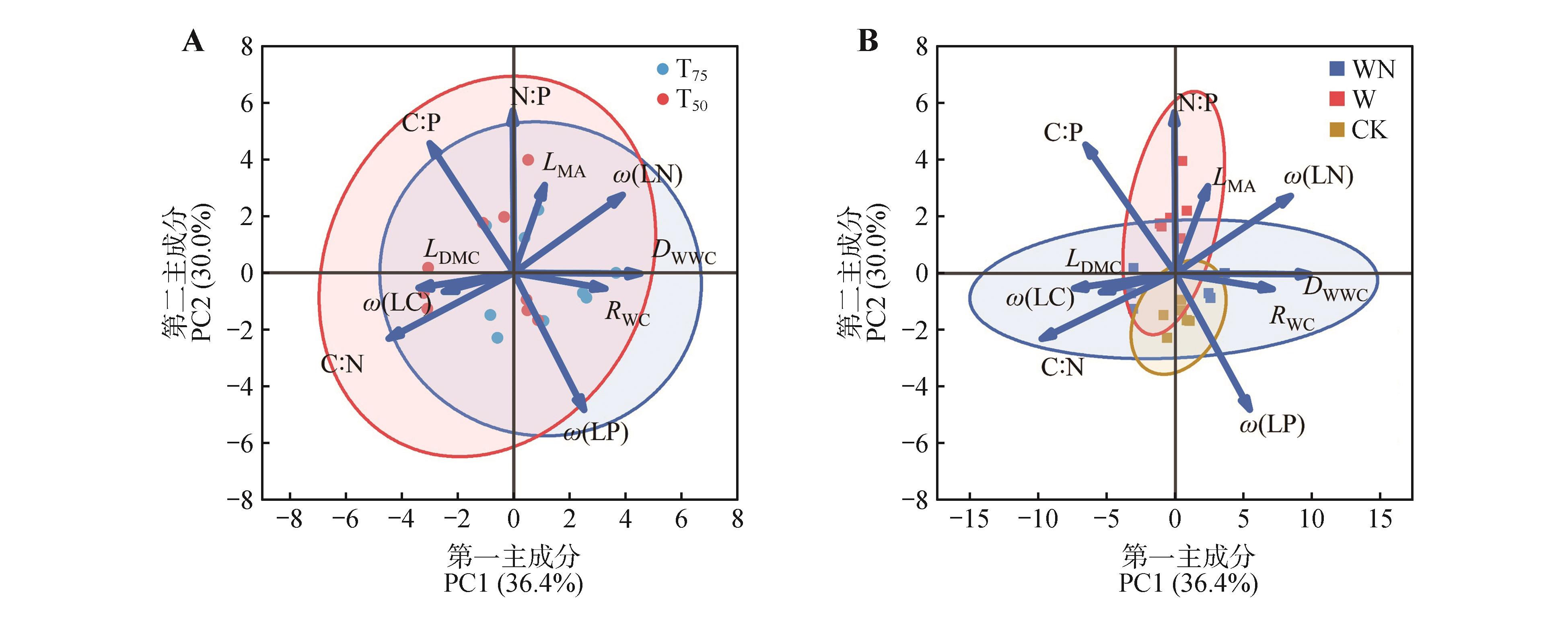
为系统揭示间伐强度与水氮添加对人工林叶片功能性状的协同调控机制,本研究以黄泛平原毛白杨(Populus tomentosa)人工林为对象,采用裂区试验设计,设置2种间伐强度(50%与75%)及3种水氮处理(水氮添加、单独水分添加和对照),从叶片水分状态、结构性状及养分化学计量3个维度解析其响应特征与耦合关系。结果表明:(1)叶片相对含水量整体稳定,而叶片干质量含水量对间伐及其与水氮处理的交互作用高度敏感,在75%间伐及水氮协同处理下显著提高43.05%;(2)结构性状整体未发生显著变化,叶片干物质含量相对稳定,而比叶质量表现出较高变异性,显示潜在可塑性;(3)养分性状中叶片碳含量相对稳定,而氮、磷含量及其化学计量比对处理响应显著,氮磷比(质量比)为11.06~18.46,平均为13.94,指示该区域毛白杨人工林处于氮限制状态;(4)多性状分析表明,叶片水分、结构与养分之间存在显著耦合关系,其中叶片干质量含水量与比叶质量是驱动养分分配的关键性状;(5)主成分分析显示,前2个主成分累计解释66.4%的变异。间伐75%处理促使叶片向高资源利用效率方向调整,间伐50%处理则维持保守策略;不同水氮处理主要沿养分结构维度分化,其中单独水分添加处理与养分比值性状紧密关联。总体来看,间伐与水氮调控通过改变资源可利用性,驱动叶片功能性状协同变化,并影响植物资源利用策略。
中图分类号:
王亚飞, 丁晓菲, 贾黎明. 不同间伐强度下水氮添加对毛白杨叶片功能性状的影响[J]. 植物研究, 2026, 46(4): 688-699.
Yafei WANG, Xiaofei DING, Liming JIA. Effects of Water and Nitrogen Addition on Leaf Functional Traits of Populus tomentosa under Different Thinning Intensities[J]. Bulletin of Botanical Research, 2026, 46(4): 688-699.
表1
2023年生长季始末林木生长情况
处理 Treatment | 2023年生长季前 Beginning of the 2023 growing season | 2023年生长季末 End of the 2023 growing season | ||
|---|---|---|---|---|
| 胸径DBH/cm | 树高H/m | 胸径DBH/cm | 树高H/m | |
| T50CK | 14.56±1.94 | 15.21±0.68 | 15.83±1.86ab | 17.36±1.17 |
| T50W | 14.23±0.24 | 15.38±1.76 | 15.64±0.32ab | 16.69±1.50 |
| T50WN | 14.54±1.88 | 16.59±0.36 | 16.00±1.79a | 17.55±2.12 |
| T75CK | 13.63±1.40 | 14.49±0.44 | 15.17±1.47b | 16.94±0.44 |
| T75W | 13.04±0.50 | 14.62±0.67 | 14.59±1.11b | 16.73±0.69 |
| T75WN | 13.61±0.99 | 15.15±0.44 | 15.73±0.98ab | 16.88±0.17 |
表2
间伐强度和水氮处理对叶片性状及化学计量特征影响的双因素方差分析
指标 Indexes | 变异来源 Source of variation | |||||
|---|---|---|---|---|---|---|
间伐强度 Thinning intensity(T) | 水氮添加处理 Water and nitrogen addition treatment(WNT) | 间伐强度×水氮添加处理 T×WNT | ||||
| F | P | F | P | F | P | |
| 叶片相对含水量RWC | 4.445 | 0.057 | 0.203 | 0.819 | 3.907 | 0.049 |
| 叶片干质量含水量DWWC | 6.117 | 0.029 | 0.620 | 0.554 | 16.204 | <0.001 |
| 叶片干物质含量LDMC | 0.027 | 0.872 | 0.172 | 0.844 | 2.527 | 0.121 |
| 比叶质量LMA | 0.738 | 0.407 | 2.836 | 0.098 | 0.171 | 0.845 |
| 叶片有机碳ω(LC) | 3.711 | 0.078 | 0.238 | 0.792 | 2.626 | 0.113 |
| 叶片全氮ω(LN) | 3.519 | 0.085 | 2.860 | 0.096 | 6.706 | 0.011 |
| 叶片全磷ω(LP) | 11.554 | 0.005 | 32.806 | <0.001 | 4.778 | 0.030 |
| C∶N | 8.145 | 0.015 | 2.224 | 0.151 | 11.813 | 0.001 |
| C∶P | 40.740 | <0.001 | 57.731 | <0.001 | 13.373 | <0.001 |
| N∶P | 2.058 | 0.177 | 32.741 | <0.001 | 0.741 | 0.497 |
图1
不同间伐强度和水氮处理下叶片水分状态变化不同大写字母表示相同水氮处理下不同间伐强度之间差异显著,不同小写字母表示相同间伐强度下不同水氮处理之间差异显著。
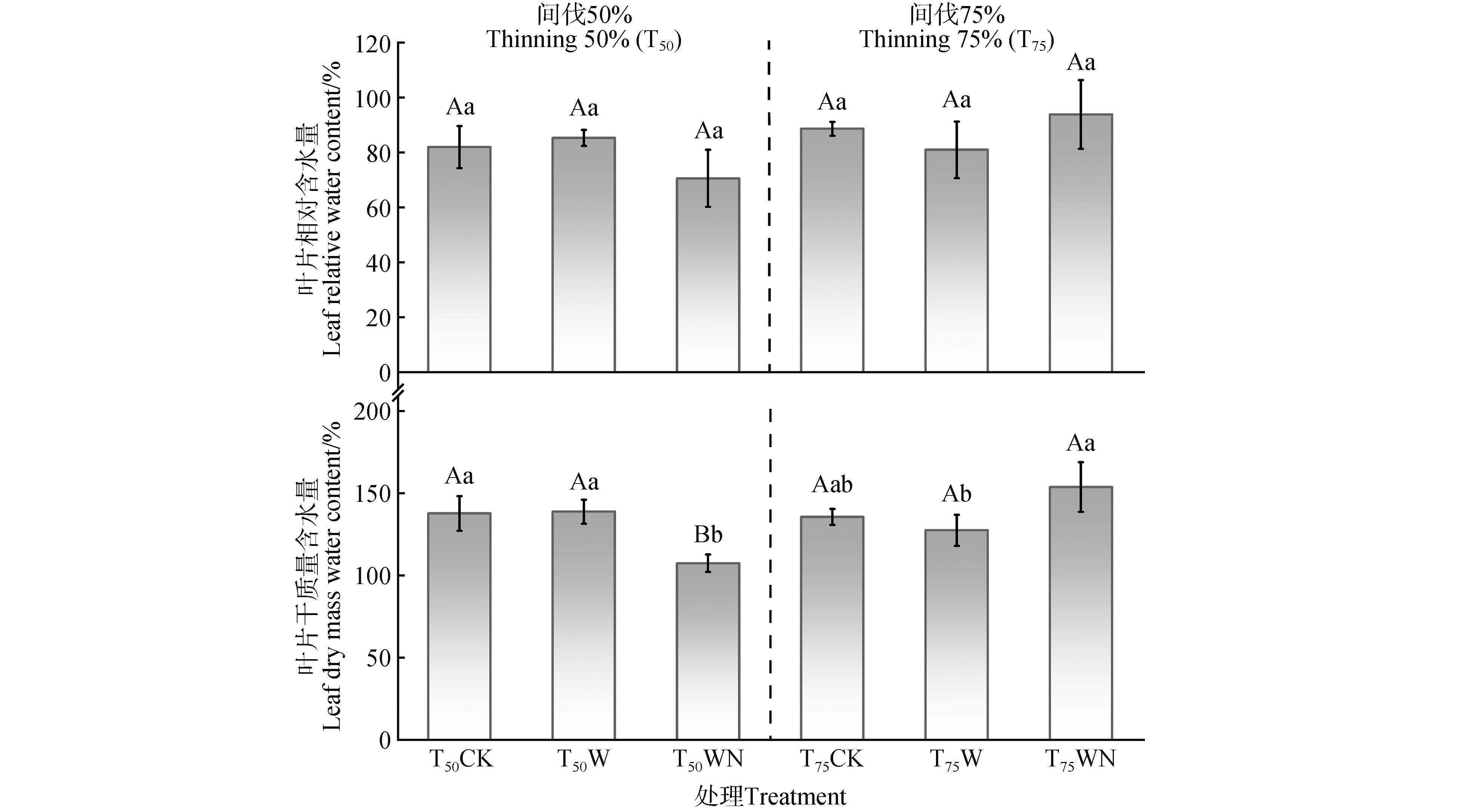
表3
不同间伐强度和水氮处理下叶片功能性状变异特征
叶片性状 Leaf traits | 变异系数 Coefficient of variation/% | |||||
|---|---|---|---|---|---|---|
| T50CK | T50W | T50WN | T75CK | T75W | T75WN | |
| 叶片相对含水量RWC | 9.34 | 3.37 | 14.74 | 2.85 | 12.70 | 13.32 |
| 叶片干质量含水量DWWC | 7.60 | 5.23 | 4.97 | 3.53 | 7.40 | 9.83 |
| 叶片干物质含量LDMC | 1.67 | 3.67 | 8.54 | 1.04 | 2.60 | 3.08 |
| 比叶质量LMA | 3.07 | 32.26 | 29.11 | 3.39 | 20.61 | 35.42 |
| 叶片有机碳ω(LC) | 6.70 | 3.69 | 3.96 | 6.03 | 2.45 | 6.94 |
| 叶片全氮ω(LN) | 6.39 | 7.65 | 3.21 | 2.47 | 11.61 | 5.20 |
| 叶片全磷ω(LP) | 9.89 | 7.67 | 6.82 | 4.79 | 8.02 | 2.38 |
| C∶N | 4.79 | 10.58 | 4.97 | 8.03 | 9.12 | 8.61 |
| C∶P | 5.21 | 3.90 | 3.35 | 9.15 | 5.89 | 6.08 |
| N∶P | 3.71 | 14.62 | 8.34 | 5.93 | 7.80 | 3.31 |
图2
不同间伐强度和水氮处理下叶片结构性状变化不同大写字母表示相同水氮处理下不同间伐强度之间差异显著,不同小写字母表示相同间伐强度下不同水氮处理之间差异显著。
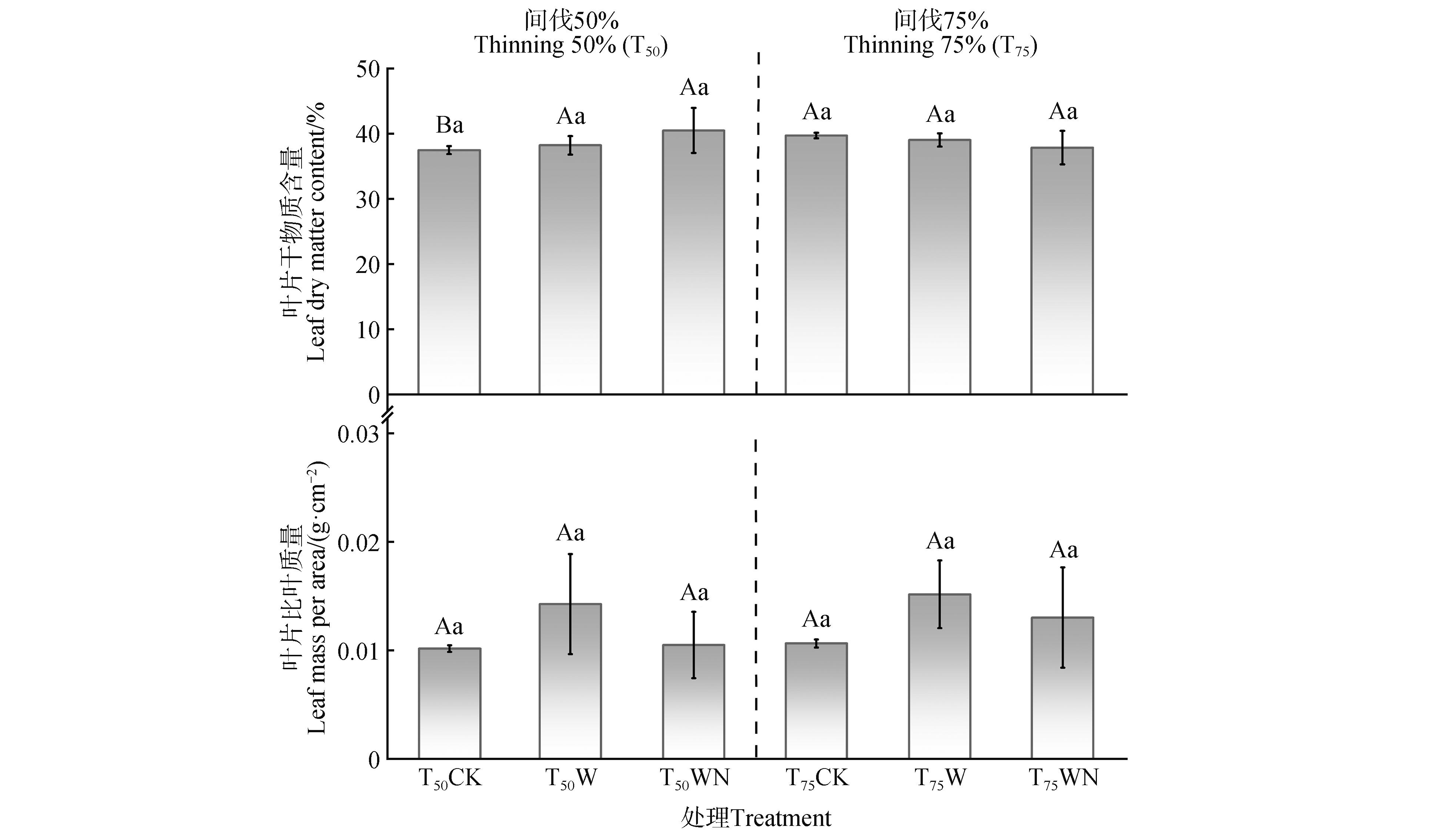
图3
不同间伐强度和水氮处理下叶片碳、氮、磷含量及化学计量特征T50表示间伐50%,T75表示间伐75%;WN表示水氮添加处理,W表示仅水分添加处理,CK表示无水氮添加处理。不同大写字母表示相同水氮处理下不同间伐强度之间差异显著,不同小写字母表示相同间伐强度下不同水氮处理之间差异显著。
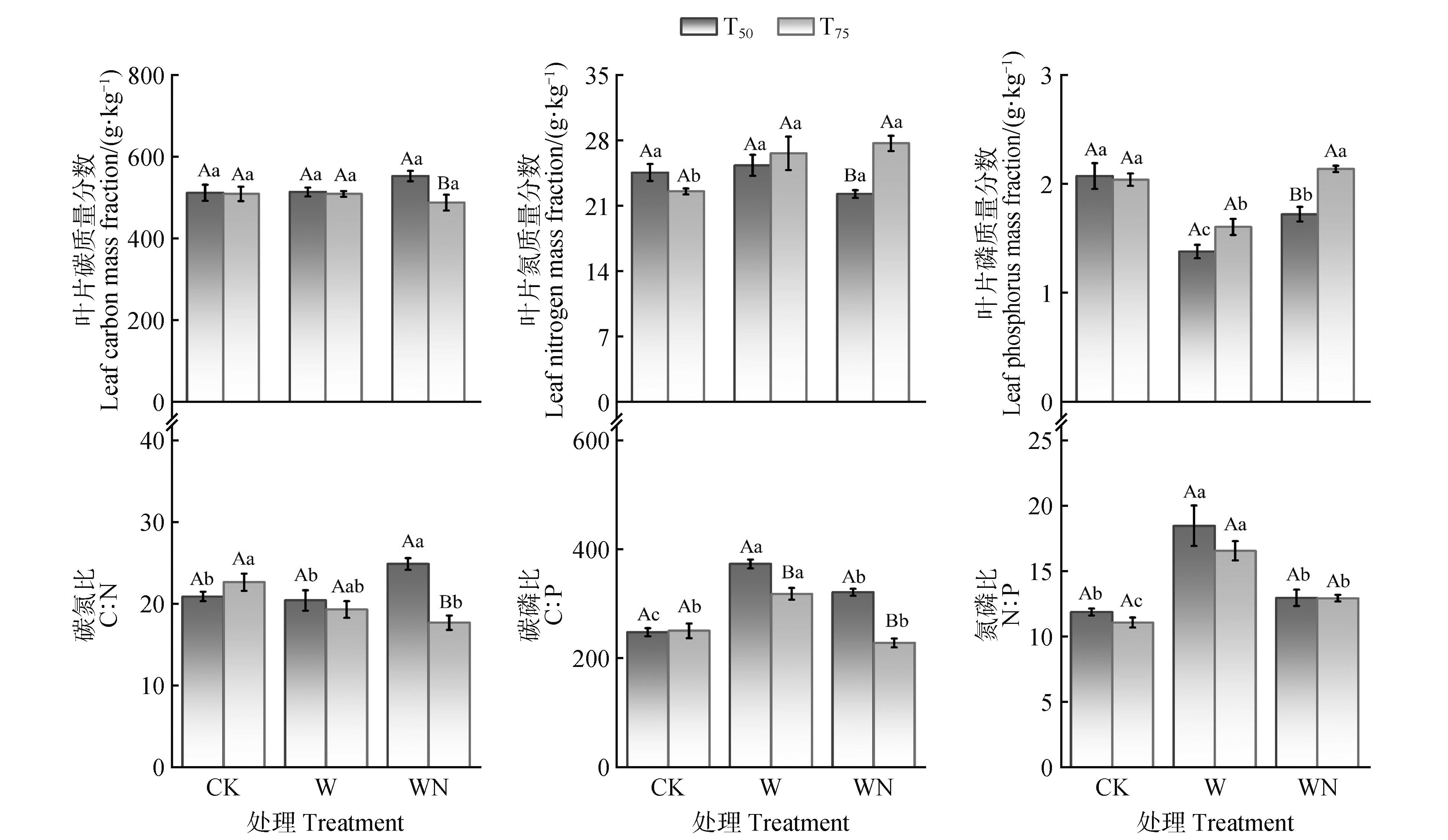
图4
叶片水分状态、结构性状与养分及化学计量特征的相关性*. P<0.05;***. P<0.001.
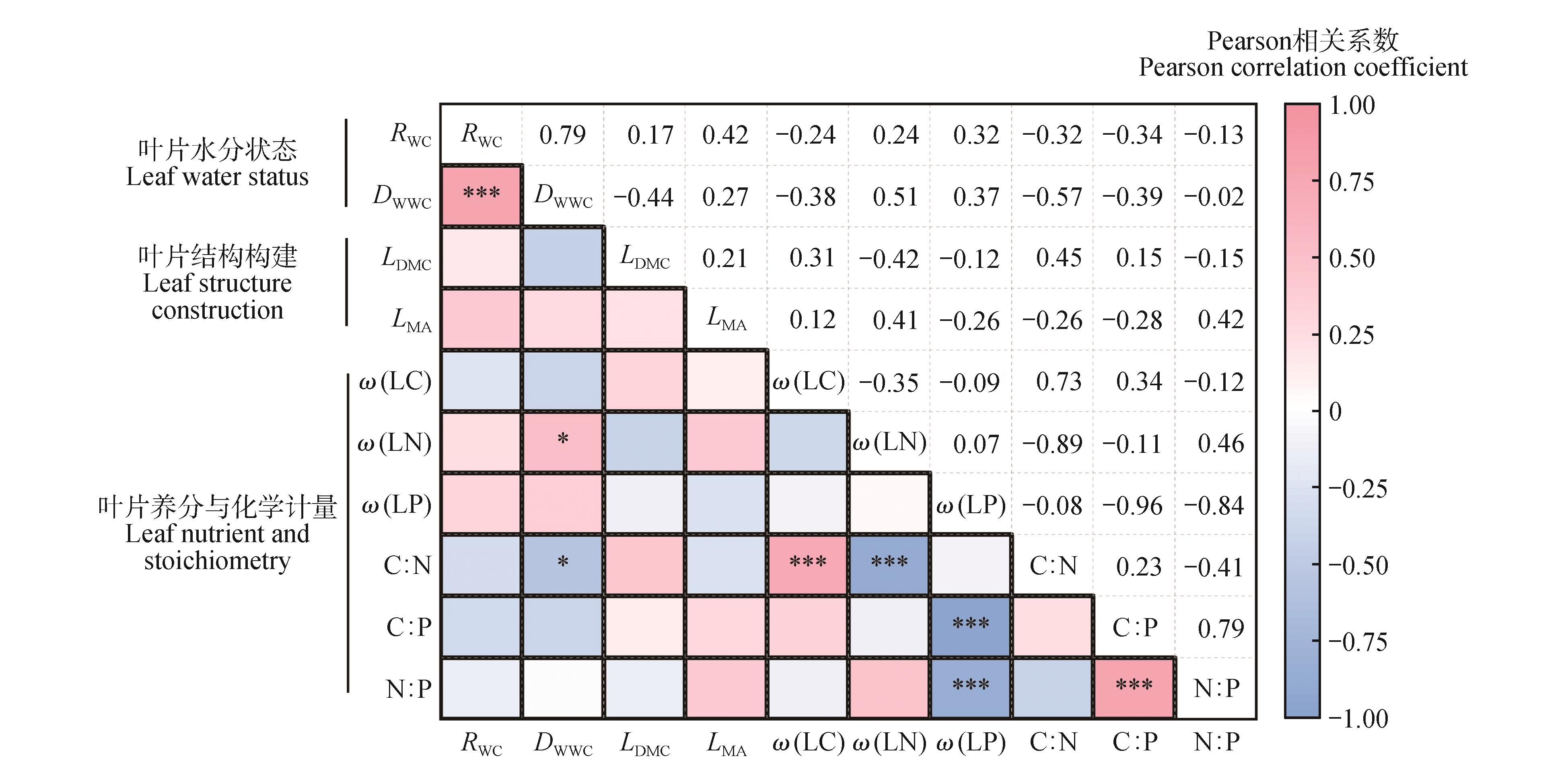
表4
叶片水分与结构性状对养分含量影响的通径分析
叶片养分 Leaf nutrient | 叶片水分/结构性状 Leaf moisture/structural traits | 直接通径系数 Direct path coefficient | 间接通径系数 Indirect path coefficient | ||
|---|---|---|---|---|---|
| DWWC | LDMC | LMA | |||
| ω(LC) | DWWC | -0.406 | -0.036 | 0.060 | |
| LDMC | 0.083 | 0.177 | 0.047 | ||
| LMA | 0.218 | -0.111 | 0.018 | ||
| ω(LN) | DWWC | 0.196 | 0.188 | 0.121 | |
| LDMC | -0.431 | -0.086 | 0.095 | ||
| LMA | 0.445 | 0.054 | -0.092 | ||
| ω(LP) | DWWC | 0.611 | -0.107 | -0.130 | |
| LDMC | 0.245 | -0.267 | -0.102 | ||
| LMA | -0.477 | 0.167 | 0.052 | ||
图5
不同处理下叶片功能性状的主成分分析
| [1] | Westoby M, Wright I J.Land-plant ecology on the basis of functional traits[J].Trends in Ecology & Evolution,2006,21(5):261-268. |
| [2] | Wright I J, Reich P B, Westoby M,et al.The worldwide leaf economics spectrum[J].Nature,2004,428(6985):821-827. |
| [3] | Xu T Y, Niu X, Wang B,et al.Variations in leaf functional traits and photosynthetic parameters of Cunninghamia lanceolata provenances[J].Forests,2023,14(9):1708. |
| [4] | 何念鹏,刘聪聪,张佳慧,等.植物性状研究的机遇与挑战:从器官到群落[J].生态学报,2018,38(19):6787-6796. |
| He Nianpeng, Liu Congcong, Zhang Jiahui,et al.Perspectives and challenges in plant traits:from organs to communities[J].Acta Ecologica Sinica,2018,38(19):6787-6796. | |
| [5] | 李跃,毕舒贻,万修福,等.紫花苜蓿幼苗生长及其叶片形态对水分胁迫的响应[J].草地学报,2017,25(6):1232-1238. |
| Li Yue, Bi Shuyi, Wan Xiufu,et al.Responses of the growth and leaf morphology of alfalfa seedlings to water stress[J].Acta Agrestia Sinica,2017,25(6):1232-1238. | |
| [6] | 刘明秀,梁国鲁.植物比叶质量研究进展[J].植物生态学报,2016,40(8):847-860. |
| Liu Mingxiu, Liang Guolu.Research progress on leaf mass per area[J].Chinese Journal of Plant Ecology,2016,40(8):847-860. | |
| [7] | 田地,严正兵,方精云.植物生态化学计量特征及其主要假说[J].植物生态学报,2021,45(7):682-713. |
| Tian Di, Yan Zhengbing, Fang Jingyun.Review on characteristics and main hypotheses of plant ecological stoichiometry[J].Chinese Journal of Plant Ecology,2021,45(7):682-713. | |
| [8] | Reich P B.The world-wide ‘fast-slow’ plant economics spectrum:a traits manifesto[J].Journal of Ecology,2014,102(2):275-301. |
| [9] | 何芸雨,郭水良,王喆.植物功能性状权衡关系的研究进展[J].植物生态学报,2019,43(12):1021-1035. |
| He Yunyu, Guo Shuiliang, Wang Zhe.Research progress of trade-off relationships of plant functional traits[J].Chinese Journal of Plant Ecology,2019,43(12):1021-1035. | |
| [10] | Chaves M M, Flexas J, Pinheiro C.Photosynthesis under drought and salt stress:regulation mechanisms from whole plant to cell[J].Annals of Botany,2009,103(4):551-560. |
| [11] | Poorter H, Niinemets Ü, Poorter L,et al.Causes and consequences of variation in leaf mass per area (LMA):a meta-analysis[J].New Phytologist,2009,182(3):565-588. |
| [12] | 杨雨薇,何宝辉,韩学娇,等.林龄对毛白杨功能性状和林下土壤理化性质的影响及其耦合关系[J].植物研究,2023,43(6):857-867. |
| Yang Yuwei, He Baohui, Han Xuejiao,et al.Effects of stand age on functional traits and understory soil physicochemical properties of Populus tomentosa and their coupling relationships[J].Bulletin of Botanical Research,2023,43(6):857-867. | |
| [13] | 杨乐梅,张宝刚,陈有超,等.毛竹林林下植物叶片功能性状的模拟氮沉降响应[J].林业科学,2025,61(12):61-71. |
| Yang Lemei, Zhang Baogang, Chen Youchao,et al.Leaf functional traits of understory plants in a moso bamboo forests in response to simulated nitrogen deposition[J].Scientia Silvae Sinicae,2025,61(12):61-71. | |
| [14] | 刘旻霞,李俐蓉,车应弟,等.高寒草甸不同演替阶段植物叶片功能性状研究[J].植物研究,2019,39(5):760-769. |
| Liu Minxia, Li Lirong, Che Yingdi,et al.Functional traits of plant leaves at different succession stages in alpine meadow[J].Bulletin of Botanical Research,2019,39(5):760-769. | |
| [15] | Benedetti-Ruiz S, Loewe-Muñoz V, Del Río R,et al.Effect of thinning on growth and shape of Castanea sativa adult tree plantations for timber production in Chile[J].Forest Ecology and Management,2023,530:120762. |
| [16] | Forrester D I, Collopy J J, Beadle C L,et al.Effect of thinning,pruning and nitrogen fertiliser application on transpiration,photosynthesis and water-use efficiency in a young Eucalyptus nitens plantation[J].Forest Ecology and Management,2012,266:286-300. |
| [17] | Forrester D I, Collopy J J, Beadle C L,et al.Interactive effects of simultaneously applied thinning,pruning and fertiliser application treatments on growth,biomass production and crown architecture in a young Eucalyptus nitens plantation[J].Forest Ecology and Management,2012,267:104-116. |
| [18] | Xi B Y, Clothier B, Coleman M,et al.Irrigation management in poplar (Populus spp.) plantations:a review[J].Forest Ecology and Management,2021,494:119330. |
| [19] | Mo Q F, Zou B, Li Y W,et al.Response of plant nutrient stoichiometry to fertilization varied with plant tissues in a tropical forest[J].Scientific Reports,2015,5:14605. |
| [20] | 李素新,张芸香,郭晋平.氮添加对华北落叶松叶片化学计量与养分重吸收效率的影响[J].水土保持学报,2021,35(5):249-254,263. |
| Li Suxin, Zhang Yunxiang, Guo Jinping.Effects of nitrogen addition on leaf stoichiometry and nutrients reabsorption efficiency of Larix principis-rupprechtii [J].Journal of Soil and Water Conservation,2021,35(5):249-254,263. | |
| [21] | 王亚飞,杨红青,周欧,等.水氮耦合下高密度毛白杨纸浆林树木各器官化学计量特征[J].北京林业大学学报,2023,45(12):68-79. |
| Wang Yafei, Yang Hongqing, Zhou Ou,et al.Chemical stoichiometry characteristics of various organs of trees in high-density Populus tomentosa pulp forests under water-nitrogen coupling[J].Journal of Beijing Forestry University,2023,45(12):68-79. | |
| [22] | Liu J Q, Li D D, Fernández J E,et al.Variations in water-balance components and carbon stocks in poplar plantations with differing water inputs over a whole rotation:implications for sustainable forest management under climate change[J].Agricultural and Forest Meteorology,2022,320:108958. |
| [23] | He Y L, Xi B Y, Li G D,et al.Influence of drip irrigation,nitrogen fertigation,and precipitation on soil water and nitrogen distribution,tree seasonal growth and nitrogen uptake in young triploid poplar (Populus tomentosa) plantations[J].Agricultural Water Management,2021,243:106460. |
| [24] | Xi B Y, Bloomberg M, Watt M S,et al.Modeling growth response to soil water availability simulated by HYDRUS for a mature triploid Populus tomentosa plantation located on the North China Plain[J].Agricultural Water Management,2016,176:243-254. |
| [25] | Wang Y, Xi B Y, Bloomberg M,et al.Response of diameter growth,biomass allocation and N uptake to N fertigation in a triploid Populus tomentosa plantation in the North China Plain:ontogenetic shift does not exclude plasticity[J].European Journal of Forest Research,2015,134(5):889-898. |
| [26] | Chaves M M, Maroco J P, Pereira J S.Understanding plant responses to drought: from genes to the whole plant[J].Functional Plant Biology,2003,30(3):239-264. |
| [27] | Liu Y, Li Y, Gao G Y,et al.Effects of thinning on soil water content and water use characteristics of artificial forest in the Loess Plateau of China[J].Catena,2025,254:108997. |
| [28] | Hipps N A, Davies M J, Dunn J M,et al.Effects of two contrasting canopy manipulations on growth and water use of London plane(Platanus×acerifolia) trees[J].Plant and Soil,2014,382(1):61-74. |
| [29] | Poorter H, Niklas K J, Reich P B,et al.Biomass allocation to leaves,stems and roots:meta-analyses of interspecific variation and environmental control[J].The New Phytologist,2012,193(1):30-50. |
| [30] | 赵航,贾彦龙,王秋凤.中国地带性森林和农田生态系统C-N-P化学计量统计特征[J].第四纪研究,2014, 34(4):803-814. |
| Zhao Hang, Jia Yanlong, Wang Qiufeng.Statistical characteristics of C-N-P stoichiometry in Chinese zonal forest and farmland ecosystems[J].Quaternary Sciences,2014,34(4):803-814. | |
| [31] | Schreeg L A, Santiago L S, Wright S J,et al.Stem,root,and older leaf N∶P ratios are more responsive indicators of soil nutrient availability than new foliage[J].Ecology,2014,95(8):2062-2068. |
| [32] | Yuan Z Y, Chen H Y H, Reich P B.Global-scale latitudinal patterns of plant fine-root nitrogen and phosphorus[J].Nature Communications,2011,2:344. |
| [33] | 马玉珠,钟全林,靳冰洁,等.中国植物细根碳、氮、磷化学计量学的空间变化及其影响因子[J].植物生态学报,2015,39(2):159-166. |
| Ma Yuzhu, Zhong Quanlin, Jin Bingjie,et al.Spatial changes and influencing factors of fine root carbon,nitrogen and phosphorus stoichiometry of plants in China[J].Chinese Journal of Plant Ecology,2015,39(2):159-166. | |
| [34] | Elser J J, Fagan W F, Denno R F,et al.Nutritional constraints in terrestrial and freshwater food webs[J].Nature,2000,408(6812):578-580. |
| [35] | Han W X, Fang J Y, Guo D L,et al.Leaf nitrogen and phosphorus stoichiometry across 753 terrestrial plant species in China[J].New Phytologist,2005,168(2):377-385. |
| [36] | 任书杰,于贵瑞,陶波,等.中国东部南北样带654种植物叶片氮和磷的化学计量学特征研究[J].环境科学,2007,28(12):2665-2673. |
| Ren Shujie, Yu Guirui, Tao Bo,et al.Leaf nitrogen and phosphorus stoichiometry across 654 terrestrial plant species in NSTEC[J].Environmental Science,2007,28(12):2665-2673. | |
| [37] | Elser J J, Dobberfuhl D R, MacKay N A,et al.Organism size,life history,and N:P stoichiometry[J].BioScience,1996,46(9):674-684. |
| [38] | Güsewell S.N∶P ratios in terrestrial plants:variation and functional significance[J].New Phytologist,2004,164(2):243-266. |
| [39] | He J S, Wang L, Flynn D F B,et al.Leaf nitrogen∶phosphorus stoichiometry across Chinese grassland biomes[J].Oecologia,2008,155(2):301-310. |
| [40] | Qiu X C, Wang H B, Peng D L,et al.Thinning drives C∶N∶P stoichiometry and nutrient resorption in Larix principis-rupprechtii plantations in North China[J].Forest Ecology and Management,2020,462:117984. |
| [41] | Osnas J L D, Lichstein J W, Reich P B,et al.Global leaf trait relationships:mass,area,and the leaf economics spectrum[J].Science,2013,340(6133):741-744. |
| [1] | 温海瑞, 杨雨春, 刘月, 矫春晶, 王君, 王芳, 杨叶磊, 李依桐, 王杰. 红松不同器官非结构性碳水化合物和化学计量特征对疏伐的响应[J]. 植物研究, 2026, 46(2): 348-360. |
| [2] | 段文标, 王郅臻, 高嘉怡, 陈立新, 付琰芮. 小兴安岭不同演替阶段森林地上凋落物碳密度及碳氮磷计量特征[J]. 植物研究, 2025, 45(5): 769-782. |
| [3] | 李艺雪, 叶冬梅, 郝龙飞, 刘婷岩, 段嘉靖, 聂正英. 土壤灭菌、AM真菌接种与氮添加对柠条根际土壤的影响[J]. 植物研究, 2024, 44(4): 590-601. |
| [4] | 徐晶, 崔莹, 王福森, 李开隆, 曲冠证, 赵曦阳. 东北地区不同间伐强度青山杨人工林生长及木材性状变异[J]. 植物研究, 2024, 44(2): 248-258. |
| [5] | 欧美景, 李红燕, 赵秋菊, 李佳蔚. 不同测定方法下叶片穿透力与叶片功能性状之间的关系[J]. 植物研究, 2023, 43(6): 910-922. |
| [6] | 李鸿博, 陈诗, 黄耀华, 康定旭, 伍建榕, 马焕成. 横断山脉亚高山带高山栎叶片生态化学计量及内稳性特征[J]. 植物研究, 2023, 43(6): 923-931. |
| [7] | 杨雨薇, 何宝辉, 韩学娇, 时海香, 张贵民, 路兴慧. 林龄对毛白杨功能性状和林下土壤理化性质的影响及其耦合关系[J]. 植物研究, 2023, 43(6): 857-867. |
| [8] | 任天梦, 鲍雨, 苏亚勋, 陈庆斌, 魏立颖, 纪若璇, 于笑, 夏新莉, 尹伟伦, 刘超. 不同修枝处理对10年生三倍体毛白杨生长和光合特性的影响[J]. 植物研究, 2023, 43(6): 846-856. |
| [9] | 闫景明, 张世航, 汪漫, 杭伟, 钱申, 邱东, 陶冶. 濒危植物大别山五针松枝叶NPK化学计量特征季节动态[J]. 植物研究, 2021, 41(3): 395-407. |
| [10] | 马可心, 张梅, 方馨, 唐丽丽, 韩建华, 杨丽芳, 石福臣. 入侵植物曼陀罗对本地植物功能性状和土壤碳、氮、磷化学计量特征的影响[J]. 植物研究, 2020, 40(6): 867-875. |
| [11] | 万雪冰, 王庆贵, 闫国永, 邢亚娟. 天然次生林植物叶片生态化学计量特征及光合特性对长期N沉降的响应[J]. 植物研究, 2019, 39(3): 407-420. |
| [12] | 李春利;王孝敬;丁强强;吴寒*. 毛白杨叶片再繁和遗传转化体系的优化[J]. 植物研究, 2016, 36(2): 177-183. |
| [13] | 李春明1,2;严冬1;夏辉1;梁德洋1;司冬晶1;尹绍鹏1;刘殿昆1;赵国辉3;赵曦阳1,3*. 毛白杨种内杂交无性系苗期生长量及叶片性状变异研究[J]. 植物研究, 2016, 36(1): 62-67. |
| [14] | 梁晶;王庆成*;许丽娟;吴文娟. 抚育对长白山两种林分凋落物分解及土壤的影响[J]. 植物研究, 2015, 35(2): 297-303. |
| [15] | 梁晶1,2;王庆成1*;许丽娟1;吴文娟1. 抚育对长白山西坡杨桦幼龄林土壤呼吸及碳储量密度的影响[J]. 植物研究, 2015, 35(1): 110-116. |
| 阅读次数 | ||||||
|
全文 |
|
|||||
|
摘要 |
|
|||||
