
Bulletin of Botanical Research ›› 2026, Vol. 46 ›› Issue (4): 584-598.doi: 10.7525/j.issn.1673-5102.2026.04.002
• Review Article • Previous Articles Next Articles
Chao KANG1, Qiuyu YANG1, Meng DUAN1, Yafei LI1, Wanxi WANG2( ), Qiangsheng WU2()
Received:2026-03-05
Online:2026-07-20
Published:2026-07-22
Contact:
Wanxi WANG, Qiangsheng WU
E-mail:342701127@qq.com;wuqiangsh@163.com
CLC Number:
Chao KANG, Qiuyu YANG, Meng DUAN, Yafei LI, Wanxi WANG, Qiangsheng WU. Advances in Response Mechanisms and Regulatory Strategies of Cinnamomum camphora to Temperature Stress[J]. Bulletin of Botanical Research, 2026, 46(4): 584-598.
Fig.1
Mechanism and regulation strategy of temperature stress in Cinnamomum camphora
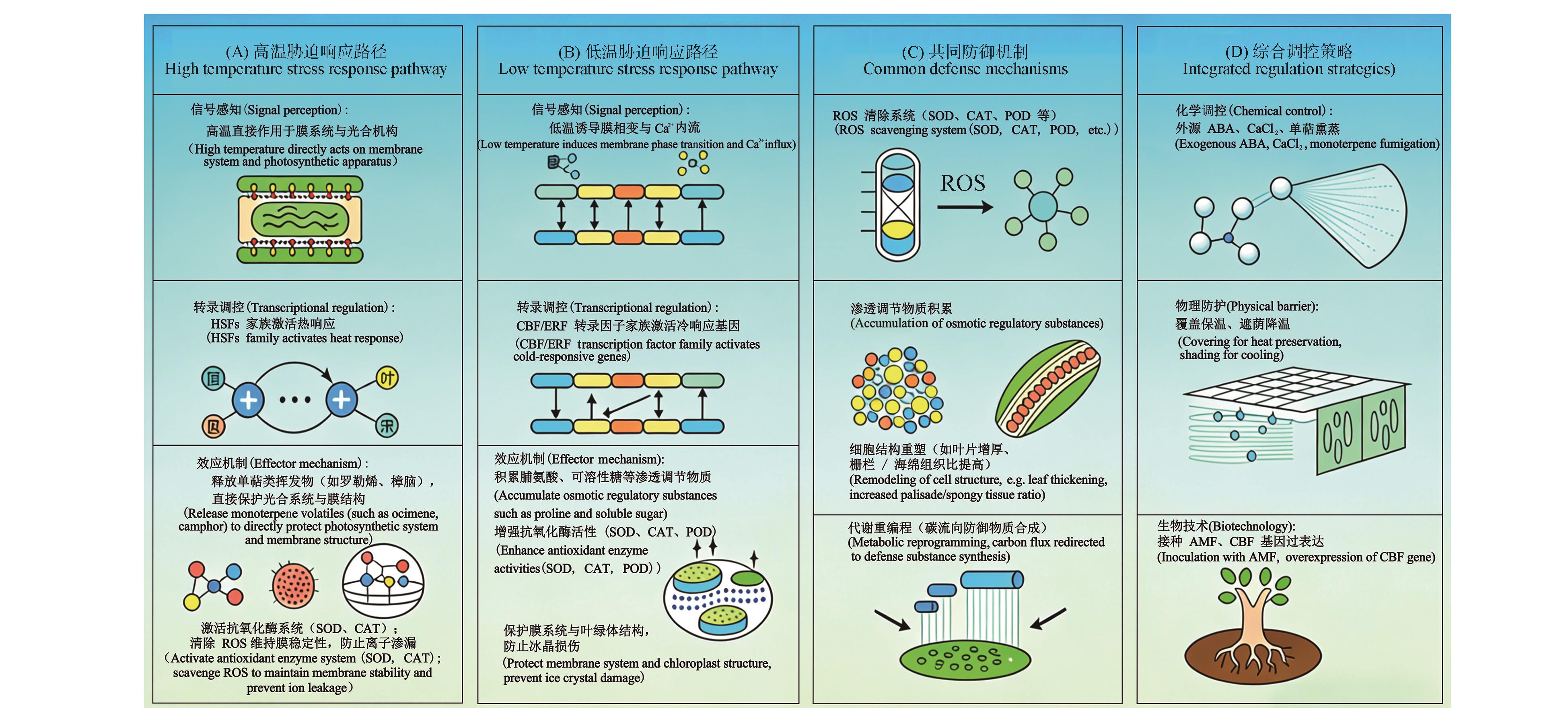

Table 1
Anthropogenic regulatory strategies for Cinnamomum camphora trees under low- and high-temperature stresses
技术措施类别 Categories of technical measures | 处理方法 Treatment method | 靶定植物/胁迫类型 Target plants/Stress type | 生理机制与效果支持度评估 Assessment of physiological mechanisms and effect support degree |
|---|---|---|---|
外源化学物质施用 Exogenous chemical application | ABA喷施 | 香樟幼苗/低温胁迫 | 中 有研究指出ABA能提高植物抗寒力,但尚缺乏在香樟中的实证 |
| CaCl₂处理 | 香樟幼苗/低温胁迫 | 中 原理阐述清晰,有在其他植物(水稻)上的机制研究作为参考,但尚缺乏香樟抗寒的具体数据 | |
| 外源蔗糖处理 | 香樟幼苗/低温胁迫 | 中高 有明确的生理机制阐述 | |
| 植物生长调节剂喷施 | 植物(通用)/低温胁迫 | 低 缺乏针对香樟的具体试验 | |
| 单萜熏蒸(如樟脑、芳樟醇) | 香樟/高温胁迫 | 高 有系统的试验数据支持,明确了其对光合、代谢、细胞结构的保护作用及基于基因表达的分子机制,并提出了信号分子功能的新证据 | |
栽培与物理防护 Cultivation and physical protection | 及时清雪 | 香樟/低温胁迫(雪压) | 高 防止物理机械损伤(雪压断枝)和减轻积雪覆盖导致的低温冻害 |
| 树干包裹与覆盖保墒胸径5 cm以上苗木(移栽后) | 香樟/干旱、高温、低温 | 高 降低气孔导度以减少水分流失 | |
| 合理修剪 | 香樟/低温胁迫(倒春寒) | 高 直接移除受冻害组织,减少养分消耗和病原侵染风险,并调控发育节律以避开晚霜危害 | |
| 外物保温(树干包裹、遮盖树冠等) | 香樟/低温胁迫 | 中高 通过物理隔绝减少树体热量散失和冷风直接侵袭 | |
生物措施 Biological measures | 接种丛枝菌根真菌(AMF) | 香樟幼苗/低温胁迫 | 高 有盆栽试验证据,AMF通过促进生长、调整生物量分配及激活抗氧化系统和渗透调节系统来增强抗寒性 |
| [1] | Intergovernmental Panel on Climate Change.Climate change 2022:impacts,adaptation and vulnerability:working group Ⅱ contribution to the sixth assessment report of the intergovernmental panel on climate change[M].Cambridge:Cambridge University Press,2023. |
| [2] | Ding Y L, Shi Y T, Yang S H.Advances and challenges in uncovering cold tolerance regulatory mechanisms in plants[J].The New Phytologist,2019,222(4):1690-1704. |
| [3] | Bita C E, Gerats T.Plant tolerance to high temperature in a changing environment:scientific fundamentals and production of heat stress-tolerant crops[J].Frontiers in Plant Science,2013,4:273. |
| [4] | 陈有民.园林树木学[M].北京:中国林业出版社,1990. |
| Chen Youmin.Garden dendrology[M].Beijing:China Forestry Publishing House,1990. | |
| [5] | 韩浩章,张丽华,王晓立,等.自然越冬过程中3种表型香樟抗寒性比较[J].西南林业大学学报(自然科学),2017,37(2):12-18. |
| Han Haozhang, Zhang Lihua, Wang Xiaoli,et al.Study on the comparison of 3 Cinnamomum camphora phenotypes hardiness during natural overwintering[J].Journal of Southwest Forestry University(Natural Sciences),2017,37(2):12-18. | |
| [6] | 胡园春,张红艳.枣庄地区香樟冻害类型及主要气象因子影响分析[J].农业工程,2018,8(10):126-129. |
| Hu Yuanchun, Zhang Hongyan.Freeze injury types of camphor tree and influence analysis of primary meteorological factors in Zaozhuang area[J].Agricultural Engineering,2018,8(10):126-129. | |
| [7] | 王雅青.城市环境中香樟光合特性对极端高温干旱的响应[D].长沙:中南林业科技大学,2023. |
| Wang Yaqing.Response of photosynthetic characteristics of Cinnamomum camphora to extreme heat and drought in urban environments[D].Changsha:Central South University of Forestry & Technology,2023. | |
| [8] | 张诚.香樟叶片功能性状对城市干热环境的响应与适应机制[D].合肥:安徽农业大学,2023. |
| Zhang Cheng.Response and adaptation mechanism of leaf functional traits in Cinnamomum camphora to urban hot and arid environment[D].Hefei:Anhui Agricultural University,2023. | |
| [9] | 王彬,田正凤,应彬彬,等.高温胁迫对樟树光合性能的影响[J].浙江农林大学学报,2019,36(1):47-53. |
| Wang Bin, Tian Zhengfeng, Ying Binbin,et al.Photosynthetic abilities in Cinnamomum camphora with high temperature stress[J].Journal of Zhejiang A & F University,2019,36(1):47-53. | |
| [10] | 周帅.非生物胁迫对香樟挥发物及荧光特性的影响[D].杭州:浙江农林大学,2012. |
| Zhou Shuai.The effect of abiotic stresses on volatile organic compounds and chlorophyll fluorescence in Cinnamomum camphora [D].Hangzhou:Zhejiang A & F University,2012. | |
| [11] | 商天其.短时高温、CO2浓度倍增以及叶片生长阶段对香樟(Cinnamomum camphora)单萜释放和光合生理的影响[D].杭州:浙江农林大学,2018. |
| Shang Tianqi.Effects of short-term high temperature,doubled CO2 concentration and foliar ontogeny stages on release of monoterpenes and photosynthetic physiology on Cinnamomum camphora [D].Hangzhou:Zhejiang A & F University,2018. | |
| [12] | 胡义,胡庭兴,陈洪,等.干旱胁迫及复水对香樟幼树生理特性及生长的影响[J].西北植物学报,2015,35(2):294-301. |
| Hu Yi, Hu Tingxing, Chen Hong,et al.Physiological properties and growth of Cinnamomum camphora saplings under drought stress and rewatering[J].Acta Botanica Boreali-Occidentalia Sinica,2015,35(2):294-301. | |
| [13] | 刘玉凤.香樟幼苗对CaCl2及自然低温的响应[D].新乡:河南科技学院,2025. |
| Liu Yufeng.Response of Cinnamomum camphora seedlings to CaCl2 and natural low temperatures[D].Xinxiang:Henan Institute of Science and Technology,2025. | |
| [14] | 姬钰.香樟解剖结构对Na2SO4胁迫及自然降温的响应[D].新乡:河南科技学院,2023. |
| Ji Yu.Response of anatomical structure of Cinnamomum camphora to Na2SO4 stress and natural cooling[D].Xinxiang:Henan Institute of Science and Technology,2023. | |
| [15] | 尤扬,陈仕均,张晓云,等.低温对香樟叶肉含晶细胞和溶酶体的影响[J].植物生理学报,2018,54(7):1239-1244. |
| You Yang, Chen Shijun, Zhang Xiaoyun,et al.Effects of low temperature on the mesophyal crystal idioblasts and lysosomes of Cinnamomum camphora [J].Plant Physiology Communications,2018,54(7):1239-1244. | |
| [16] | 朱渊铭,张培兰,林宇清,等.香樟bZIP基因家族鉴定及表达分析[J].扬州大学学报(农业与生命科学版),2024,45(3):44-54,81. |
| Zhu Yuanming, Zhang Peilan, Lin Yuqing,et al.Identification and functional analysis of the bZIP gene family of Cinnamomum camphora [J].Journal of Yangzhou University(Agricultural and Life Science Edition),2024,45(3):44-54,81. | |
| [17] | 张佳佳,张力维,李勇鹏,等.不同非生物胁迫下香樟实时定量PCR内参基因的选择[J].生物技术通报,2016,32(10):205-211. |
| Zhang Jiajia, Zhang Liwei, Li Yongpeng,et al.Evaluation of candidate reference genes for normalization of quantitative RT-PCR in Cinnamomum camphora under various abiotic stresses[J].Biotechnology Bulletin,2016,32(10):205-211. | |
| [18] | 吴春玉,蒋长洪,谢佩耘,等.干旱胁迫对接种AMF的香樟幼苗生物量分配及生长的影响[J].重庆师范大学学报(自然科学版),2015,32(6):109-115. |
| Wu Chunyu, Jiang Changhong, Xie Peiyun,et al.Effects of campora seedlings on biomass allocation and growth under drought stress and inoculated AMF[J].Journal of Chongqing Normal University(Natural Science),2015,32(6):109-115. | |
| [19] | 侯颖,张立伟,王立涛,等.丛枝菌根真菌对香樟幼苗生长和抗寒生理指标的影响[J].东北林业大学学报,2023,51(9):95-100. |
| Hou Ying, Zhang Liwei, Wang Litao,et al.Effects of arbuscular mycorrhiza fungi on seedlings growth and physiological indexes of cold resistance in Cinnamomum Camphora [J].Journal of Northeast Forestry University,2023,51(9):95-100. | |
| [20] | 苏丹,张春明,许榕凡,等.江西乐安古樟林香樟根系及根际土壤AM真菌[J].菌物学报,2025,44(6):42-54. |
| Su Dan, Zhang Chunming, Xu Rongfan,et al.AM fungi in the roots and rhizosphere soil of Cinnamomum camphora in ancient camphor forest of Le’an,Jiangxi Province[J].Mycosystema,2025,44(6):42-54. | |
| [21] | Tian Z F, Luo Q Y, Li Y,et al.Terpinene and β-pinene acting as signaling molecules to improve Cinnamomum camphora thermotolerance[J].Industrial Crops and Products,2020,154:112641. |
| [22] | 李悦鹏,张晓兰,于雷,等.MAPK级联途径激酶结构特点及其信号转导途径在园艺作物逆境中的作用[J].植物生理学报,2018,54(8):1305-1315. |
| Li Yuepeng, Zhang Xiaolan, Yu Lei,et al.Structural characteristics of MAPK cascade kinase and the function of signal transduction pathway in adversity stress of horticultural crop[J].Plant Physiology Communications,2018,54(8):1305-1315. | |
| [23] | Huang L Q, Yang C, Iqbal A,et al.Jasmonate pathway regulates sphingolipid desaturation during cold stress[J].New Phytologist,2025,247(1):191-208. |
| [24] | 孙永江,王琪,邵琪雯,等.高温胁迫对植物光合作用的影响研究进展[J].植物学报,2023,58(3):486-498. |
| Sun Yongjiang, Wang Qi, Shao Qiwen,et al.Research advances on the effect of high temperature stress on plant photosynthesis[J].Chinese Bulletin of Botany,2023, 58(3):486-498. | |
| [25] | 刘亚珂,姜霞,苏春花.石漠化区香樟不同叶龄光合特性及其主要环境因子的关系分析[J].福建农业科技,2023,54(7):48-58. |
| Liu Yake, Jiang Xia, Su Chunhua.Analysis on the relationship between the photosynthetic characteristics of Cinnamomum camphora at different leaf ages and its main environmental factors in rocky desertification areas[J].Fujian Agricultural Science and Technology,2023,54(7):48-58. | |
| [26] | Strasserf R J, Srivastava A,Govindjee.Polyphasic chlorophyll a fluorescence transient in plants and Cyanobacteria[J].Photochemistry and Photobiology,1995,61(1):32-42. |
| [27] | Takahashi S, Murata N.How do environmental stresses accelerate photoinhibition?[J].Trends in Plant Science,2008,13(4):178-182. |
| [28] | Crafts-Brandner S J, Salvucci M E.Rubisco activase constrains the photosynthetic potential of leaves at high temperature and CO2 [J].Proceedings of the National Academy of Sciences of the United States of America,2000,97(24):13430-13435. |
| [29] | 李自阳.优选樟树光合特性的初步研究[D].郑州:河南农业大学,2011. |
| Li Ziyang.The preliminary research on the photosynthetic characteristics in optimizing Cinnamomum camphora [D].Zhengzhou:Henan Agricultural University,2011. | |
| [30] | Müller P, Li X P, Niyogi K K.Non-photochemical quenching.A response to excess light energy[J].Plant Physiology,2001,125(4):1558-1566. |
| [31] | 宋娇阳.冬夏季节香樟叶片BVOCs释放及其光合能量转换利用效率关系研究[D].杭州:浙江农林大学,2024. |
| Song Jiaoyang.Studies on BVOCs emission variation associated with photosynthetic energy utilization effency in Cinnamomum camphora during winter and summer[D].Hangzhou:Zhejiang A & F University,2024. | |
| [32] | 王涛,冯敬磊,张翠.高温胁迫影响玉米生长发育的分子机制研究进展[J].植物学报,2024,59(6):963-977. |
| Wang Tao, Feng Jinglei, Zhang Cui.Research progress on molecular mechanisms of heat stress affecting the growth and development of maize[J].Bulletin of Botany,2024,59(6):963-977. | |
| [33] | Liu Y K, He C Z.A review of redox signaling and the control of MAP kinase pathway in plants[J].Redox Biology,2017,11:192-204. |
| [34] | Mo S R, Qian Y, Zhang W J,et al.Mitogen-activated protein kinase action in plant response to high-temperature stress:a mini review[J].Protoplasma,2021,258(3):477-482. |
| [35] | Kang X M, Zhao L Q, Liu X T. Calcium signaling and the response to heat shock in crop plants[J]. International Journal of Molecular Sciences, 2024, 25(1):324. |
| [36] | Wang Y Y, Qian Q X, Xu H Z,et al.Dynamic physiological responses of Cinnamomum camphora with monoterpene protection under high temperature shock[J].Forests,2023,14(10):2005. |
| [37] | Bi B, Shao L M, Xu T,et al.Transcriptomic analysis reveals calcium and ethylene signaling pathway genes in response to cold stress in Cinnamomum camphora [J].Horticulturae,2024,10(9):995. |
| [38] | Sardoei A S, Fazeli-Nasab B.Physiological and molecular mechanisms of freezing in plants[J].Phyton,2025,94(6):1601-1630. |
| [39] | Feng Y, Li Z Q, Kong X J,et al.Plant coping with cold stress:molecular and physiological adaptive mechanisms with future perspectives[J].Cells,2025,14(2):110. |
| [40] | Chen J H, Tang M, Jin X Q,et al.Regulation of Calvin-Benson cycle enzymes under high temperature stress[J].aBIOTECH,2022,3(1):65-77. |
| [41] | Li H X, Wang X Y, Liu Y,et al.Cysteine thiol-based oxidative post-translational modifications fine-tune protein functions in plants[J].Agronomy,2024,14(12):2757. |
| [42] | 赵清贺.香樟抗寒抗盐生理特性的研究[D].郑州:河南农业大学,2009. |
| Zhao Qinghe.Studies on characteristics of physiological of Cinnamomum camphora under chilling stress and salt stress[D].Zhengzhou:Henan Agricultural University,2009. | |
| [43] | 丁锦平,宋涛,朱新玉,等.栽培时间对香樟半致死温度及抗寒性的影响[J].东北林业大学学报,2023,51(11):40-44. |
| Ding Jinping, Song Tao, Zhu Xinyu,et al.Effects of cultivation time on semi-lethal temperature and cold resistance evaluation of Cinnamomum camphora [J].Journal of Northeast Forestry University,2023,51(11):40-44. | |
| [44] | Takahashi S, Badger M R.Photoprotection in plants:a new light on photosystem II damage[J].Trends in Plant Science,2011,16(1):53-60. |
| [45] | 李金涛,景莉清,逯丹阳,等.植物抵御冷胁迫的分子机制研究进展[J].信阳师范大学学报(自然科学版),2025,38(3):354-361. |
| Li Jintao, Jing Liqing, Lu Danyang,et al.Molecular mechanisms of plant resistance to cold stress[J].Journal of Xinyang Normal University (Natural Science Edition),2025,38(3):354-361. | |
| [46] | 周婵.香樟胚性愈伤组织诱导、增殖及抗寒性鉴定体系的建立[D].南阳:南阳师范学院,2019. |
| Zhou Chan.Study on embryogenic callus induction,proliferation for camphor tree and establishment of its cold-resistance verification system[D].Nanyang:Nanyang Normal University,2019. | |
| [47] | Serrano M, Coluccia F, Torres M,et al.The cuticle and plant defense to pathogens[J].Frontiers in Plant Science,2014,5:274. |
| [48] | Lunn D, Kannan B, Germon A,et al.Greater aperture counteracts effects of reduced stomatal density on water use efficiency:a case study on sugarcane and meta-analysis[J].Journal of Experimental Botany,2024,75(21):6837-6849. |
| [49] | He N P, Liu C C, Tian M,et al.Variation in leaf anatomical traits from tropical to cold-temperate forests and linkage to ecosystem functions[J].Functional Ecology,2018,32(1):10-19. |
| [50] | Fontanier C, Moss J Q, Gopinath L,et al.Lipid composition of three bermudagrasses in response to chilling stress[J].Journal of the American Society for Horticultural Science,2020,145(2):95-103. |
| [51] | Wang J L, Wang Y L, Jin H T,et al.Research progress on responses and regulatory mechanisms of plants under high temperature[J].Current Issues in Molecular Biology,2025,47(8):601. |
| [52] | Kratsch H A, Wise R R.The ultrastructure of chilling stress[J].Plant,Cell & Environment,2000,23(4):337-350. |
| [53] | Samtani H, Sharma A, Khurana J P,et al.Thermosensing in plants:deciphering the mechanisms involved in heat sensing and their role in thermoresponse and thermotolerance[J].Environmental and Experimental Botany,2022,203:105041. |
| [54] | Hu S S, Ding Y F, Zhu C.Sensitivity and responses of chloroplasts to heat stress in plants[J].Frontiers in Plant Science,2020,11:375. |
| [55] | Jiang R H, Chen X L, Liao X Z,et al.A chromosome-level genome of the camphor tree and the underlying genetic and climatic factors for its top-geoherbalism[J].Frontiers in Plant Science,2022,13:827890. |
| [56] | 倪辉,孙维红,丁乐,等.香樟全基因组WRKY基因家族的鉴定与分析[J].植物科学学报,2022,40(4):513-523. |
| Ni Hui, Sun Weihong, Ding Le,et al.Identification and analysis of the WRKY gene family in whole genome of Cinnamomum camphora (L.) Presl[J].Plant Science Journal,2022,40(4):513-523. | |
| [57] | Gao J, Chen Y C, Gao M,et al.LcWRKY17,a WRKY transcription factor from Litsea cubeba,effectively promotes monoterpene synthesis[J].International Journal of Molecular Sciences,2023,24(8):7210. |
| [58] | Xie Q J, Dong W F, Wang M Y,et al.BpWRKY6 regulates insect resistance by affecting jasmonic acid and terpenoid synthesis in Betula platyphylla [J].Plant Biotechnology Journal,2025,23(9):3682-3696. |
| [59] | Xu C Y, Wang B, Luo Q Y,et al.The uppermost monoterpenes improving Cinnamomum camphora thermotolerance by serving signaling functions[J].Frontiers in Plant Science,2022,13:1072931. |
| [60] | Cai Y Y, Xu C Y, Zheng T F,et al.Thermal protection function of camphor on Cinnamomum camphora cell membrane by acting as a signaling molecule[J].Plant Physiology and Biochemistry,2023,198:107672. |
| [61] | Cai Y Y, Xu H Z, Xu C Y,et al.Adjusting function of camphor on primary metabolism in Cinnamomum camphora stressed by high temperature[J].Plant Science,2024,339:111956. |
| [62] | Steponkus P L, Lynch D V, Uemura M,et al.The influence of cold acclimation on the lipid composition and cryobehaviour of the plasma membrane of isolated rye protoplasts [J].Philosophical Transactions of the Royal Society of London:Series B,Biological Sciences,1990,326(1237):571-583. |
| [63] | Brownlee C, Wheeler G L.Cellular calcium homeostasis and regulation of its dynamic perturbation[J].Quantitative Plant Biology,2025,6:e5. |
| [64] | 李敏,伍国强,魏明,等.植物CDPK在响应逆境胁迫中的作用及机制[J].生物工程学报,2024,40(10):3337-3359. |
| Li Min, Wu Guoqiang, Wei Ming,et al.Functions and mechanisms of CDPKs in plant responses to abiotic stress[J].Chinese Journal of Biotechnology,2024,40(10):3337-3359. | |
| [65] | Ludwig A A, Saitoh H, Felix G,et al.Ethylene-mediated cross-talk between calcium-dependent protein kinase and MAPK signaling controls stress responses in plants[J].Proceedings of the National Academy of Sciences of the United States of America,2005,102(30):10736-10741. |
| [66] | Khan S, Alvi A F, Saify S,et al.The ethylene biosynthetic enzymes,1-aminocyclopropane-1-carboxylate(ACC) synthase(ACS) and ACC oxidase(ACO):the less explored players in abiotic stress tolerance[J].Biomolecules,2024,14(1):90. |
| [67] | Chen Y F, Randlett M D, Findell J L,et al.Localization of the ethylene receptor ETR1 to the endoplasmic reticulum of Arabidopsis [J].Journal of Biological Chemistry,2002,277(22):19861-19866. |
| [68] | Shi Y T, Tian S W, Hou L Y,et al.Ethylene signaling negatively regulates freezing tolerance by repressing expression of CBF and type-a ARR genes in Arabidopsis [J].The Plant Cell,2012,24(6):2578-2595. |
| [69] | Wen X, Zhang C L, Ji Y S,et al.Activation of ethylene signaling is mediated by nuclear translocation of the cleaved EIN2 carboxyl terminus[J].Cell Research,2012,22(11):1613-1616. |
| [70] | Solano R, Stepanova A, Chao Q M,et al.Nuclear events in ethylene signaling:a transcriptional cascade mediated by ETHYLENE-INSENSITIVE3 and ETHYLENE-RESPONSE-FACTOR1[J].Genes & Development,1998,12(23):3703-3714. |
| [71] | Xu L, Yang L J, Li A P,et al.An AP2/ERF transcription factor confers chilling tolerance in rice[J].Science Advances,2024,10(35):eado4788. |
| [72] | Kidokoro S, Yoneda K, Takasaki H,et al.Different cold-signaling pathways function in the responses to rapid and gradual decreases in temperature[J].The Plant Cell,2017,29(4):760-774. |
| [73] | 李勇鹏.香樟CBF类似基因的克隆及其在植物转基因抗寒育种中的潜在应用[D].南阳:南阳师范学院,2015. |
| Li Yongpeng.Cloning of CBF-like gene in Cinnamomum Camphora L. and its application on improving cold tolerance of plants via genetic transformation[D].Nanyang:Nanyang Normal University,2015. | |
| [74] | Song Y, Zhang X Y, Li M Z,et al.The direct targets of CBFs:in cold stress response and beyond[J].Journal of Integrative Plant Biology,2021,63(11):1874-1887. |
| [75] | Fowler S, Thomashow M F. Arabidopsis transcriptome profiling indicates that multiple regulatory pathways are activated during cold acclimation in addition to the CBF cold response pathway[J].The Plant Cell,2002,14(8):1675-1690. |
| [76] | Kumar D, Hazra S, Datta R,et al.Transcriptome analysis of Arabidopsis mutants suggests a crosstalk between ABA,ethylene and GSH against combined cold and osmotic stress[J].Scientific Reports,2016,6:36867. |
| [77] | Kim S H, Kim H S, Bahk S,et al.Phosphorylation of the transcriptional repressor MYB15 by mitogen-activated protein kinase 6 is required for freezing tolerance in Arabidopsis [J].Nucleic Acids Research,2017,45(11):6613-6627. |
| [78] | 王卫红.香樟幼树越冬死亡的原因及对策[J].现代农村科技,2024(8):84. |
| Wang Weihong.Causes and countermeasures of wintering death of Cinnamomum camphora young trees[J].Modern Agricultural Science and Techology,2024(8):84. | |
| [79] | 黄志强.香樟栽培技术[J].特种经济动植物,2023,26(5):148-150. |
| Huang Zhiqiang.Cultivation techniques of Cinnamomum camphora [J].Special Economic Animals and Plants,2023,26(5):148-150. | |
| [80] | 关信,郑洋群,张亚东,等.干旱胁迫下外源ABA对香樟R2R3-MYB亚家族转录因子表达的影响[J].西北林学院学报,2025,40(2):51. |
| Guan Xin, Zheng Yangqun, Zhang Yadong,et al.Effects of exogenous ABA on the expression of R2R3-MYB subfamily transcription factors in Cinnamomum camphora under drought stress[J].Journal of Northwest Forestry University,2025,40(2):51. | |
| [81] | 曾伟伟,李一凡,朱渊铭,等.香樟NAC基因家族的全基因组鉴定及盐胁迫下的表达分析[J].西南农业学报,2024,37(7):1393-1408. |
| Zeng Weiwei, Li Yifan, Zhu Yuanming,et al.Genome-wide identification and expression analysis of NAC gene family under salt stress in Cinnamomum camphora [J].Southwest China Journal of Agricultural Sciences,2024,37(7):1393-1408. | |
| [82] | 梅海军.自然降温过程中优选樟树的耐寒性研究[D].郑州:河南农业大学,2011. |
| Mei Haijun.Study on cold tolerance mechanism of Cinnamomum camphora as temperature fell[D].Zhengzhou:Henan Agricultural University,2011. |
| [1] | Peize GUAN, Peijing KUANG, Yuting WEI, Zihan GUAN, Ke ZHAO, Yubo CUI. Physiological Responses and Molecular Regulatory Characteristics of Suaeda salsa under Fluoroquinolone Antibiotic Stress [J]. Bulletin of Botanical Research, 2026, 46(4): 712-727. |
| [2] | Pingan BAO, Boxin LIU, Yaxin HE, Pengyue FU, Shuo YU, Jingshuang SUN, Wenjun MA, Guanzheng QU, Junhui WANG, Ruiyang HU. Identification of NAC Gene Family and Screening of Cold Stress-Responsive Genes in Catalpa bungei [J]. Bulletin of Botanical Research, 2026, 46(3): 434-448. |
| [3] | Shang LIU, Jinhua WANG, Hasi YU, Chang LIU. Effects of Constitutive Overexpression of PagPYL4 Gene on Drought Tolerance and Growth of 84K poplar [J]. Bulletin of Botanical Research, 2025, 45(5): 722-730. |
| [4] | Jing ZHANG, Weixi ZHANG, Changjun DING, Zhengsai YUAN, Lirui DAI, Xiaohua SU, Yingbai SHEN, Guanzheng QU. Comparative Analysis of Growth, Photosynthetic Physiology and Root Tip Ion Flow Characteristics of Five Poplar Varieties [J]. Bulletin of Botanical Research, 2024, 44(1): 96-106. |
| [5] | Senyao LIU, Fenglin JIA, Qing GUO, Gaofeng FAN, Boru ZHOU, Tingbo JIANG. Response Analysis of Transcription Factor PsnbHLH162 Gene in Populus simonii × P. nigra under Salt Stress and Low Temperature Stress [J]. Bulletin of Botanical Research, 2023, 43(2): 300-310. |
| [6] | Tingting LI, Liu YANG, Xiaoxia LI, Yisong WANG, Xiuwei WANG. Different Nitrogen Forms on the Photosynthetic Characteristics and Growth of Fraxinus mandshurica and Quercus mongolica [J]. Bulletin of Botanical Research, 2023, 43(2): 207-217. |
| [7] | Mengshuo LI, Yingze LIU, Huan LU, Sheng QIANG. Photosynthetic Capacity Differentiation and Gene Transcription in Different Geographical Populations of Arabidopsis thaliana under Common Garden conditions [J]. Bulletin of Botanical Research, 2023, 43(1): 90-99. |
| [8] | Xiwu DU, Jun QIN, Kang YE, Yonghong HU, Yiwei TAO, Yongzheng PENG, Yanxiang SHEN, Yan LIANG, Li ZENG. Effects of Flooding Stress on Photosynthetic Characteristics of Yulania stellata and Its Cultivars [J]. Bulletin of Botanical Research, 2022, 42(3): 483-491. |
| [9] | Dongmei HUANG, Ying CHEN, Lu BAI, Di’an NI, Yiyang XU, Zhiguo ZHANG, Qiaoping QIN. Transcriptome Analysis of Hemerocallis fulva Leaves Respond to Low Temperature Stress [J]. Bulletin of Botanical Research, 2022, 42(3): 424-436. |
| [10] | Dong ZHANG, Yan LIU, Han ZHANG, Zi-Jian ZHANG, Yang WANG, Mei-Cen LIU. Response of Photosynthesis and Leaf Morphological Characteristics to Drought Stress in Glycyrrhiza uralensis [J]. Bulletin of Botanical Research, 2021, 41(3): 449-457. |
| [11] | Xin-Dan HU, Yao LI, Xiao-Hua ZHANG, Juan-Hong LIANG, Teng-Guo ZHANG. Effect of Exogenous ATP on Cold Tolerance of Brassica campestris Seedlings [J]. Bulletin of Botanical Research, 2021, 41(2): 302-311. |
| [12] | Fang WANG, Zhi-Min LU, Jun WANG, Shi-Kai ZHANG, Yu-Xi LI, Shao-Chen LI, Jian-Qiu ZHANG, Yu-Chun YANG. Photosynthetic and Stomatal Characteristics of Pinus koraiensis and P.sibirica under Low Temperature Stress [J]. Bulletin of Botanical Research, 2021, 41(2): 205-212. |
| [13] | Yun-Hao ZHU, Meng-Jia ZHANG, Cheng-Ming DONG. Effects of Exogenous MeJA on Antioxidant System and Stress Genes of Pinellia ternata under High Temperature Stress [J]. Bulletin of Botanical Research, 2021, 41(1): 67-73. |
| [14] | Lin LU, Shang-Yu YANG, Wei-Dong LIU, Li-Ming LU. To Explore the Transcription Factor in Response to Low Temperature Stress in Nicotiana alata by Transcriptome Sequencing [J]. Bulletin of Botanical Research, 2021, 41(1): 119-129. |
| [15] | ZHAO Chun-Jian, LI Yu-Zheng, GUAN Jia-Jing, SU Wei-Ran, TIAN Yao, WANG Ting-Ting, LI Shen, LI Chun-Ying. Effect of Interplanting Taxus cuspidata with Ficus carica on Growth of Two Plants and Activities of Soil Enzymes [J]. Bulletin of Botanical Research, 2020, 40(5): 679-685. |
| Viewed | ||||||
|
Full text |
|
|||||
|
Abstract |
|
|||||
