
Bulletin of Botanical Research ›› 2026, Vol. 46 ›› Issue (4): 626-641.doi: 10.7525/j.issn.1673-5102.2026.04.005
• Original Paper • Previous Articles Next Articles
Xiang WAN1,2, Xiaoke HU1,3,4( ), Ping WU1,2, Fangyin HE1,3, Shujuan LIU1,2, Chenglin YUAN5,6
Received:2026-04-16
Online:2026-07-20
Published:2026-07-22
Contact:
Xiaoke HU
E-mail:huxiaoke525@163.com
CLC Number:
Xiang WAN, Xiaoke HU, Ping WU, Fangyin HE, Shujuan LIU, Chenglin YUAN. Differences in Multidimensional Functional Traits of Haloxylon ammodendron after Different Stubble Treatments in a Desert-Oasis Ecotone[J]. Bulletin of Botanical Research, 2026, 46(4): 626-641.
Fig.1
Differences in architectural traits of H. ammodendron under different stubble treatmentsA-E represented basal diameter(DB), plant height(HP), mean crown width(WMC), number of living branches(NLB), and dead branch rate (RDB), respectively. NS,50% HS-BN,50% HS-H and CS represented no stubble,half stubble by branch number(50%),half stubble by height(50%) and complete stubble, respectively. Data were mean±SE(n=8). Different lowercase letters indicated significant differences among treatments(P<0.05).
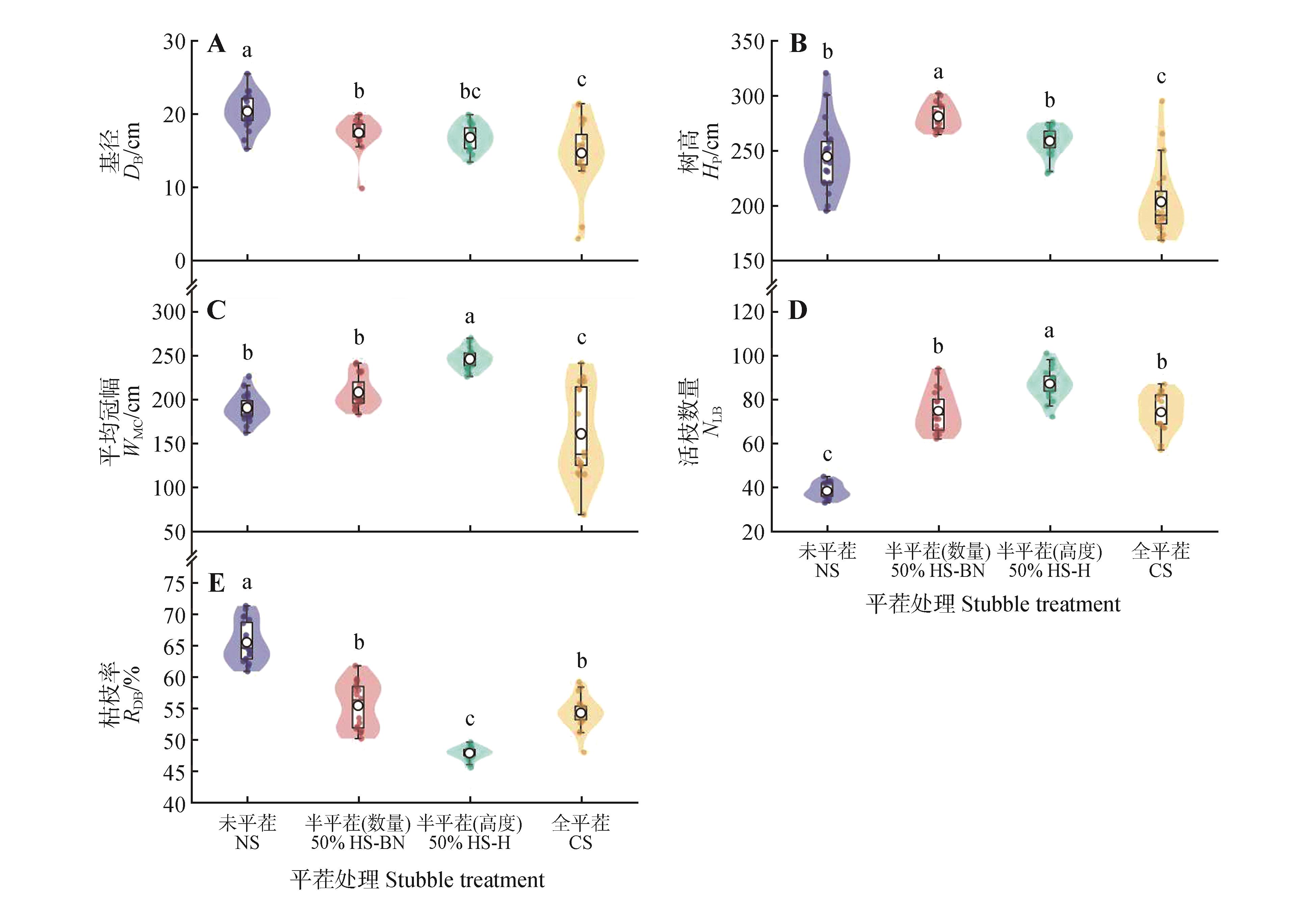
Fig.2
Differences in hydraulic efficiency- and hydraulic safety-related traits of H.ammodendron under different stubble treatmentsA-F represented sapwood-specific hydraulic conductivity(Ks), leaf-specific hydraulic conductivity(Kl), predawn water potential(Ψpd), midday water potential(Ψmd), percentage loss of conductivity(PLC) and hydraulic safety margin(HSM), respectively. NS, 50% HS-BN, 50% HS-H and CS represented no stubble, half stubble by branch number(50%), half stubble by height(50%) and complete stubble, respectively. Data were mean±SE(n=8). Different lowercase letters indicated significant differences among treatments(P<0.05).
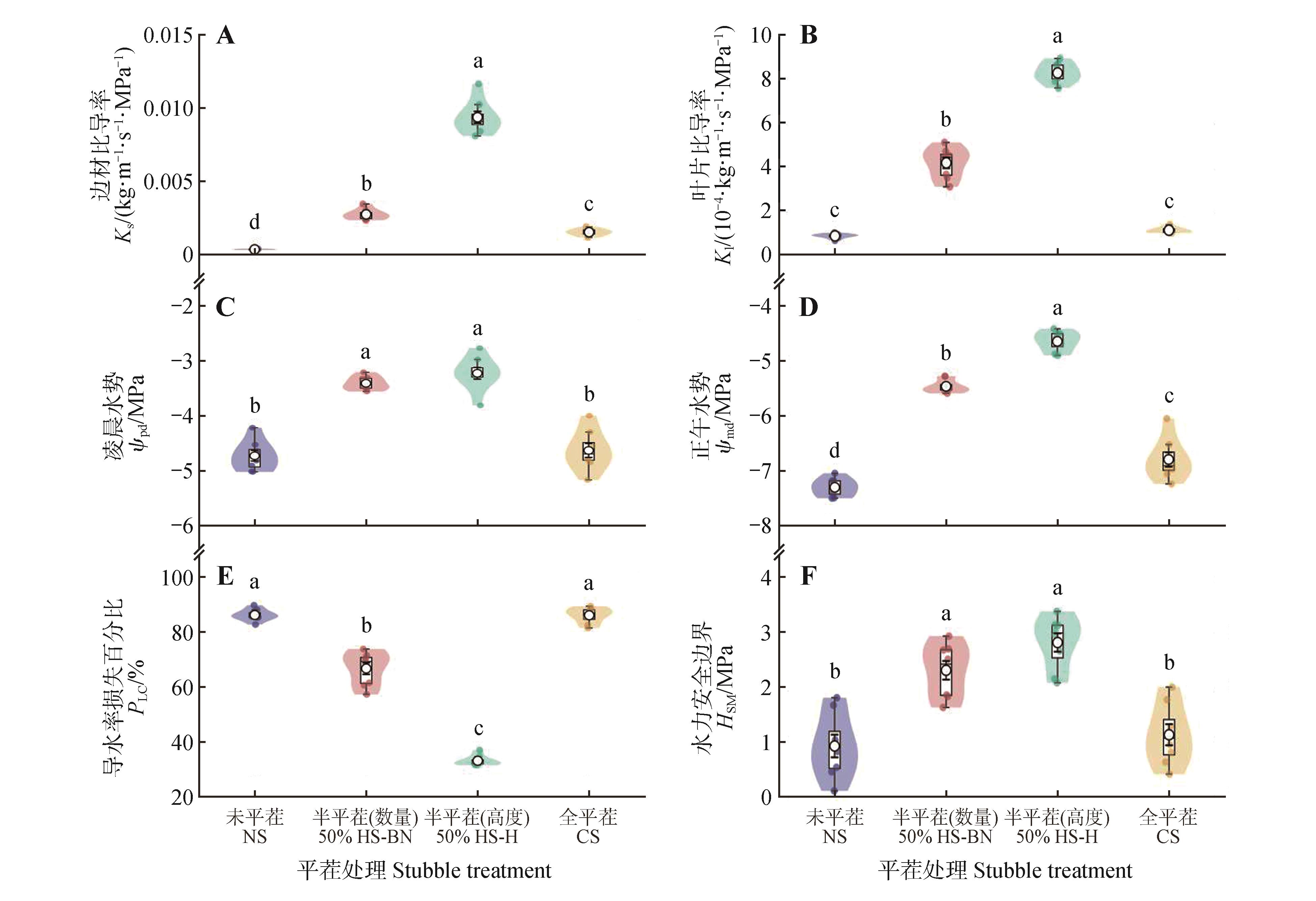
Fig.3
Differences in carbon acquisition traits of H. ammodendron under different stubble treatmentsA-E represented net photosynthetic rate(Pn), stomatal conductance(Gs), transpiration rate(Tr), intrinsic water use efficiency(WUEi) and chlorophyll mass fraction(ω(Chl)), respectively. NS, 50% HS-BN, 50% HS-H and CS represented no stubble, half stubble by branch number(50%), half stubble by height(50%) and complete stubble, respectively. Data were mean±SE(n=8). Different lowercase letters indicated significant differences among treatments(P<0.05).
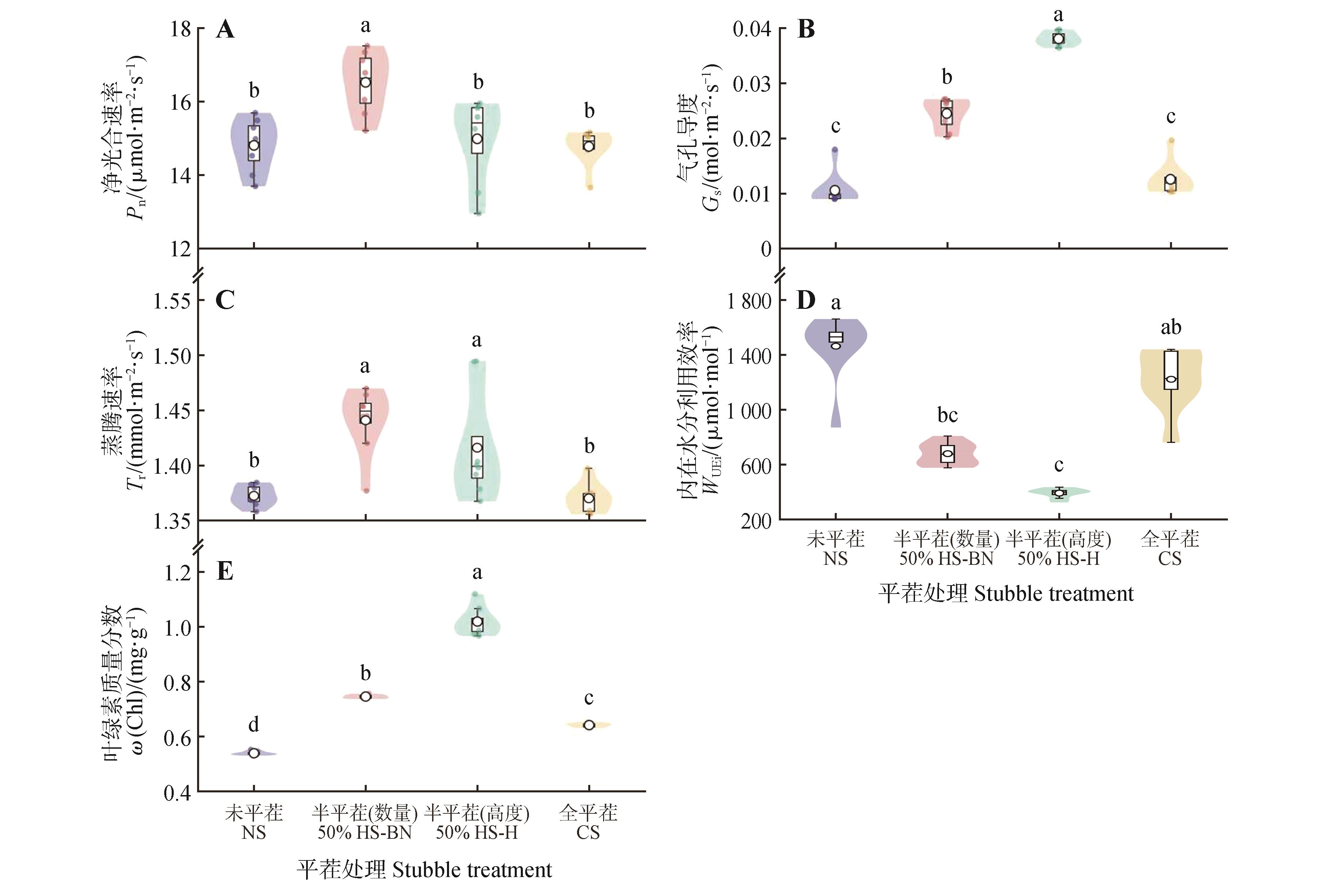
Fig.4
Differences in fine-root segment traits from the 80-90 cm soil layer and growing-season NSC contents of H. ammodendron under different stubble treatmentsA-F represented fine-root segment length(LR) in the 80-90 cm soil layer, root dry mass(MRD), specific root length(SRL), root NSC content(NSCroot), stem and leaf (assimilating-shoot) NSC content (NSCstem,NSCleaf), respectively. NS, 50% HS-BN, 50% HS-H and CS represented no stubble, half stubble by branch number(50%), half stubble by height(50%) and complete stubble, respectively. Data were mean±SE(n=8). Different lowercase letters indicated significant differences among treatments(P<0.05).
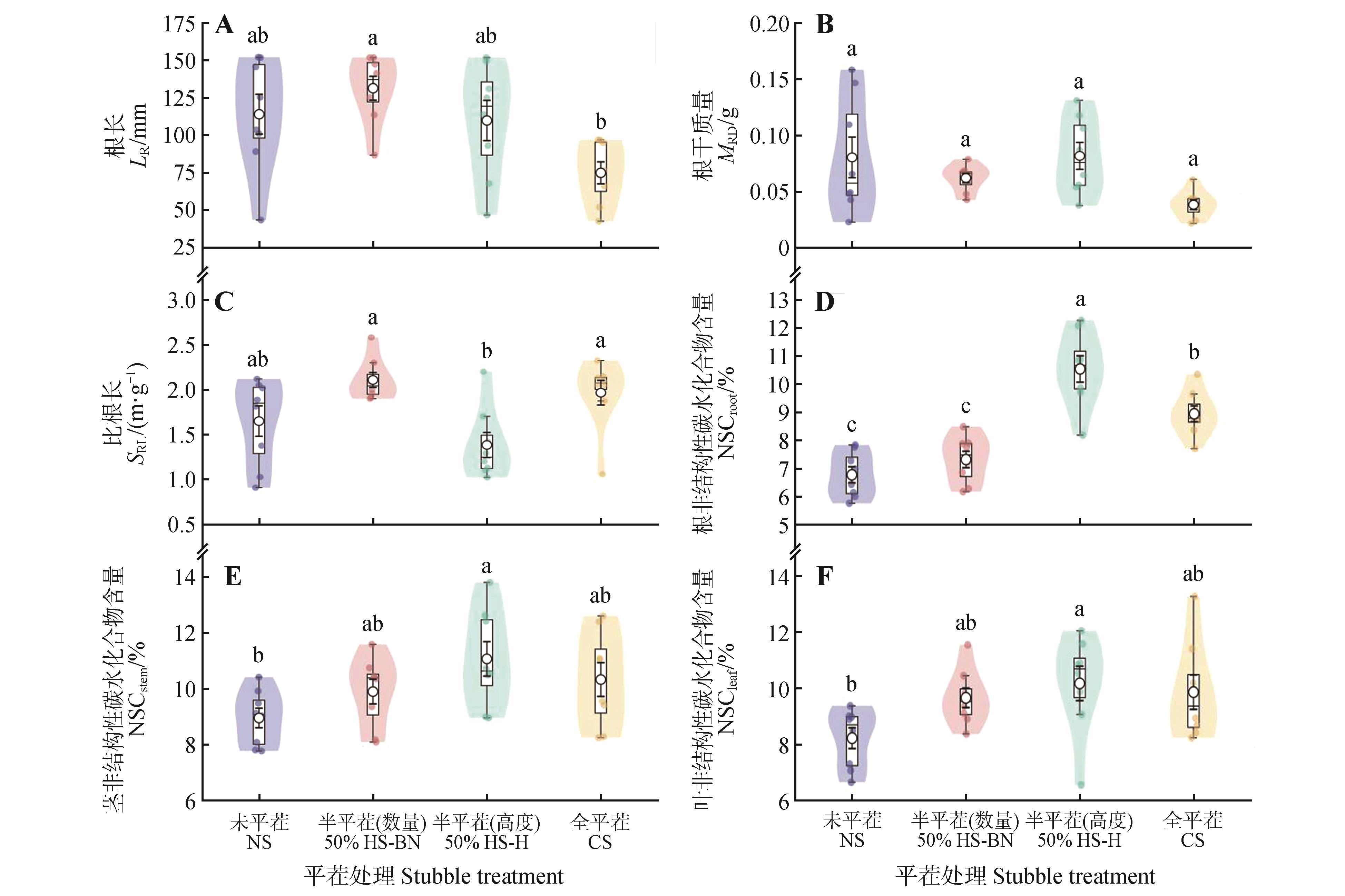
Fig.5
Principal component analysis of multidimensional functional traits of H.ammodendron under different stubble treatmentsPoints represented individual observations, ellipses represented 95% confidence ellipses for different treatment groups, and arrows indicated the loading directions of traits in the principal component space. NS, 50% HS-BN, 50% HS-H and CS represented no stubble, half stubble by branch number(50%), half stubble by height(50%) and complete stubble, respectively.
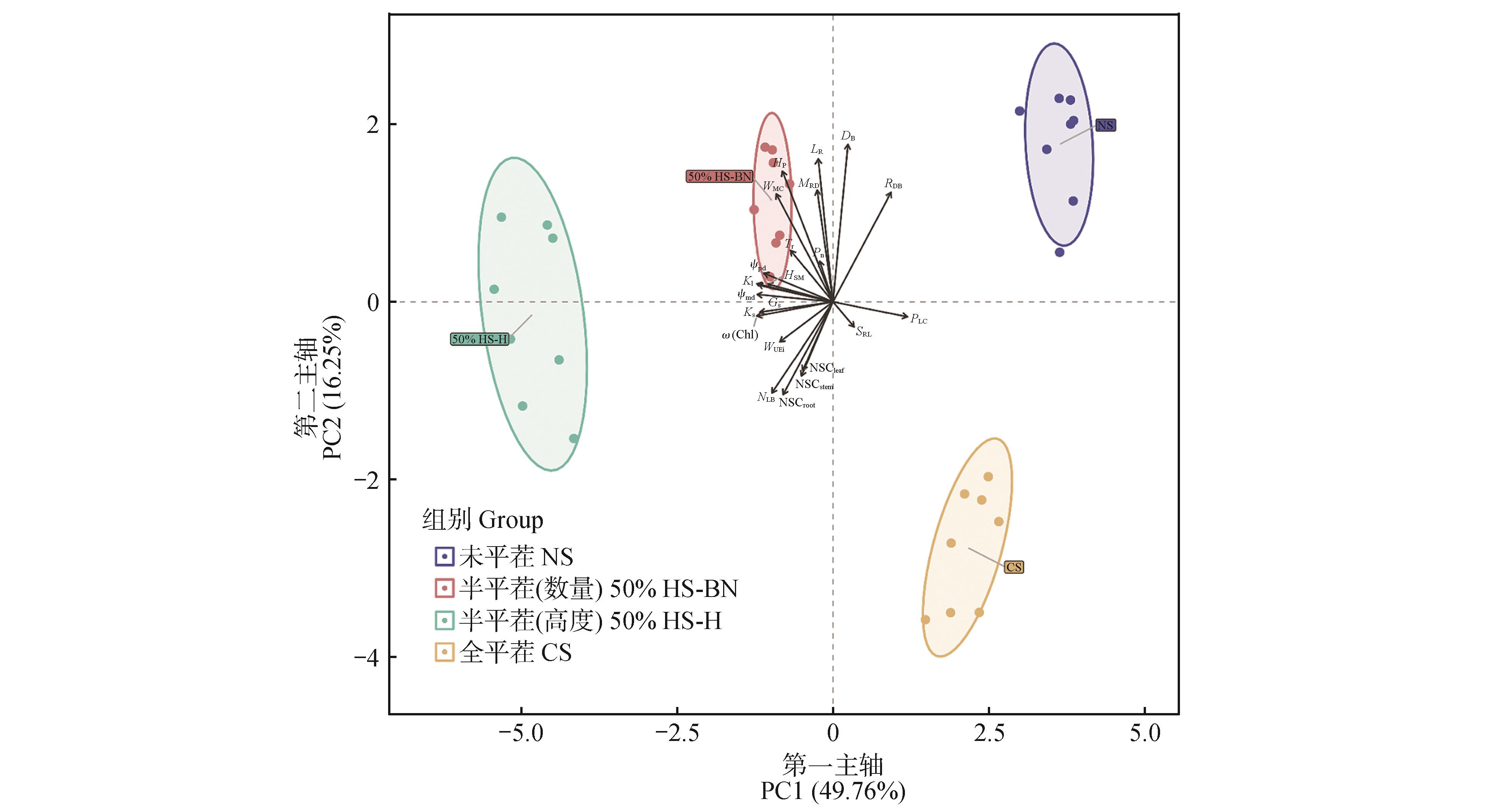
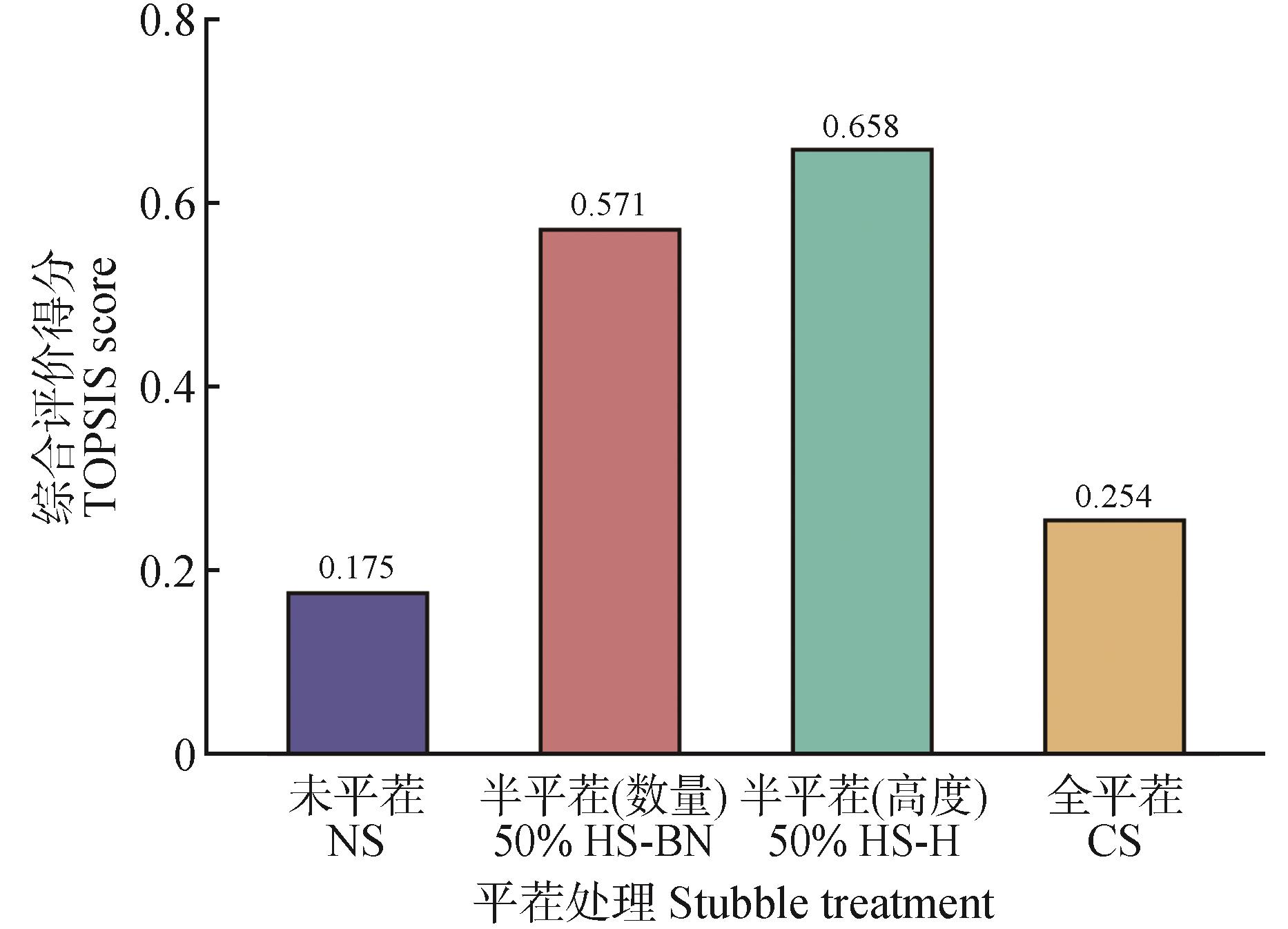
Fig.6
Comprehensive evaluation of functional perform-ance of H.ammodendron under different stubble treatmentsValues above bars indicated comprehensive evaluation scores. NS, 50% HS-BN, 50% HS-H and CS represented no stubble, half stubble by branch number(50%), half stubble by height(50%) and complete stubble, respectively.
| [1] | Lavorel S, Garnier E.Predicting changes in community composition and ecosystem functioning from plant traits:revisiting the Holy Grail[J].Functional Ecology,2002,16(5):545-556. |
| [2] | McGill B J, Enquist B J, Weiher E,et al.Rebuilding community ecology from functional traits[J].Trends in Ecology & Evolution,2006,21(4):178-185. |
| [3] | Berdugo M, Delgado-Baquerizo M, Soliveres S,et al.Global ecosystem thresholds driven by aridity[J].Science,2020,367(6479):787-790. |
| [4] | Gazol A, Pizarro M, Hammond W M,et al.Droughts preceding tree mortality events have increased in duration and intensity,especially in dry biomes[J].Nature Communications,2025,16:5779. |
| [5] | Díaz S, Kattge J, Cornelissen J H C,et al.The global spectrum of plant form and function[J].Nature,2016,529(7585):167-171. |
| [6] | Funk J L, Larson J E, Ames G M,et al.Revisiting the Holy Grail:using plant functional traits to understand ecological processes[J].Biological Reviews,2017,92(2):1156-1173. |
| [7] | Violle C, Navas M L, Vile D,et al.Let the concept of trait be functional![J].Oikos,2007,116(5):882-892. |
| [8] | Reich P B.The world-wide ‘fast-slow’ plant economics spectrum:a traits manifesto[J].Journal of Ecology,2014,102(2):275-301. |
| [9] | He N P, Liu C C, Piao S L,et al.Ecosystem traits linking functional traits to macroecology[J].Trends in Ecology & Evolution,2019,34(3):200-210. |
| [10] | Luo W T, Shi Y, Wilkins K,et al.Plant traits modulate grassland stability during drought and post-drought periods[J].Functional Ecology,2023,37(10):2611-2620. |
| [11] | Wright I J, Reich P B, Westoby M,et al.The worldwide leaf economics spectrum[J].Nature,2004,428(6985):821-827. |
| [12] | Carmona C P, Bueno C G, Toussaint A,et al.Fine-root traits in the global spectrum of plant form and function[J].Nature,2021,597(7878):683-687. |
| [13] | Freschet G T, Roumet C, Comas L H,et al.Root traits as drivers of plant and ecosystem functioning:current understanding,pitfalls and future research needs[J].New Phytologist,2021,232(3):1123-1158. |
| [14] | Lozano Y M, Aguilar-Trigueros C A, Flaig I C,et al.Root trait responses to drought are more heterogeneous than leaf trait responses[J].Functional Ecology,2020,34(11):2224-2235. |
| [15] | Díaz S, Kattge J, Cornelissen J H C,et al.The global spectrum of plant form and function:enhanced species-level trait dataset[J].Scientific Data,2022,9:755. |
| [16] | Beccari E, Carmona C P.Aboveground and belowground sizes are aligned in the unified spectrum of plant form and function[J].Nature Communications,2024,15:9199. |
| [17] | 王飞,郭树江,樊宝丽,等.民勤绿洲—荒漠过渡带植物叶性状的研究[J].植物研究,2022,42(1):71-80. |
| Wang Fei, Guo Shujiang, Fan Baoli,et al.Plant leaf traits in Minqin oasis-desert transition zone[J].Bulletin of Botanical Research,2022,42(1):71-80. | |
| [18] | 赵昌丽,周立威,周可柔,等.铃铛刺叶性状居群变异及其与环境因子的相关性[J].植物研究,2025,45(2):277-286. |
| Zhao Changli, Zhou Liwei, Zhou Kerou,et al.Population variation of leaf traits and its correlation with environmental factors of Caragana halodendron [J].Bulletin of Botanical Research,2025,45(2):277-286. | |
| [19] | Maestre F T, Eldridge D J, Soliveres S,et al.Structure and functioning of dryland ecosystems in a changing world[J].Annual Review of Ecology,Evolution,and Systematics,2016,47:215-237. |
| [20] | Hisano M, Ghazoul J, Chen X L,et al.Functional diversity enhances dryland forest productivity under long-term climate change[J].Science Advances,2024,10(17):eadn4152. |
| [21] | Choat B, Jansen S, Brodribb T J,et al.Global convergence in the vulnerability of forests to drought[J].Nature,2012,491(7426):752-755. |
| [22] | 杨立学,刘士林,付瀚萱,等.植被控制对人工更新紫椴幼树根系性状的影响[J].植物研究,2024,44(2):267-278. |
| Yang Lixue, Liu Shilin, Fu Hanxuan,et al.Effects of vegetation control on root traits of artificial regeneration of Tilia amurensis saplings[J].Bulletin of Botanical Research,2024,44(2):267-278. | |
| [23] | 杜华栋,范鹏辉,毕银丽,等.干旱砾漠区不同地貌单元植物群落特征及其与环境因子的关系[J].植物研究,2024,44(3):459-469. |
| Du Huadong, Fan Penghui, Bi Yinli,et al.Plant community characteristics and their relationship with environmental factors in different geomorphic units in arid gravel desert[J].Bulletin of Botanical Research,2024,44(3):459-469. | |
| [24] | 李志波,李平衡,王权,等.梭梭和多枝柽柳的末端小枝异速生长特征研究[J].植物研究,2013,33(3):274-281,286. |
| Li Zhibo, Li Pingheng, Wang Quan,et al.Allometric characteristics of terminal twigs of Tamarix ramosissima and Haloxylon ammodendron [J].Bulletin of Botanical Research,2013,33(3):274-281,286. | |
| [25] | 李宁,周海,任珩,等.不同地下水位处梭梭(Haloxylon ammodendron)水分来源特征[J].中国沙漠,2021,41(4):79-86. |
| Li Ning, Zhou Hai, Ren Heng,et al.Water sources of Haloxylon ammodendron under different groundwater depths[J].Journal of Desert Research,2021,41(4):79-86. | |
| [26] | 王子婷,刘继亮,罗永忠,等.荒漠绿洲过渡带梭梭(Haloxylon ammodendron)林建植对表层土壤碳氮磷化学计量特征及储量的长期影响[J].中国沙漠,2025,45(5):241-252. |
| Wang Ziting, Liu Jiliang, Luo Yongzhong,et al.Long-term effects of Haloxylon ammodendron plantations on topsoil carbon,nitrogen,phosphorus stoichiometry and stocks in the desert-oasis ecotone[J].Journal of Desert Research,2025,45(5):241-252. | |
| [27] | 罗青红,宁虎森,陈启民.人工梭梭(Haloxylon ammodendron)林固沙过程中植被与土壤耦合关系[J].中国沙漠,2018,38(4):780-790. |
| Luo Qinghong, Ning Husen, Chen Qimin.Relation between vegetation and soil of Haloxylon ammodendron plantation in the process of sand-fixation[J].Journal of Desert Research,2018,38(4):780-790. | |
| [28] | 赵长明,魏小平,尉秋实,等.民勤绿洲荒漠过渡带植物白刺和梭梭光合特性[J].生态学报,2005,25(8):1908-1913. |
| Zhao Changming, Wei Xiaoping, Yu Qiushi,et al.Photosynthetic characteristics of Nitraria tangutorum and Haloxylon ammodendron in the ecotone between oasis and desert in Minqin,Region,Country[J].Acta Ecologica Sinica,2005,25(8):1908-1913. | |
| [29] | 高松,苏培玺,严巧娣. 荒漠植物梭梭群体和叶片水平气体交换对不同土壤水分的响应[J]. 中国科学:生命科学,2011,41(3):226-237. |
| Gao Song, Su Peixi, Yan Qiaodi. Canopy and leaf gas exchange of Haloxylon ammodendron under different soil moisture regimes[J].Scientia Sinica:Vitae,2011,41(3):226-237. | |
| [30] | 田媛,唐立松,乔瑞平. 梭梭幼苗个体生长规律与死亡率关系研究[J]. 植物研究,2016,36(1):84-89. |
| Tian Yuan, Tang Lisong, Qiao Ruiping.Relationships between the mortality and morphoallaxis of Haloxylon ammodendron seedling[J]. Bulletin of Botanical Research,2016,36(1):84-89. | |
| [31] | McDowell N, Pockman W T, Allen C D,et al.Mechanisms of plant survival and mortality during drought:why do some plants survive while others succumb to drought?[J].New Phytologist,2008,178(4):719-739. |
| [32] | Adams H D, Zeppel M J B, Anderegg W R L,et al.A multi-species synthesis of physiological mechanisms in drought-induced tree mortality[J].Nature Ecology & Evolution,2017,1(9):1285-1291. |
| [33] | Anderegg W R L, Klein T, Bartlett M,et al.Meta-analysis reveals that hydraulic traits explain cross-species patterns of drought-induced tree mortality across the globe[J].Proceedings of the National Academy of Sciences of the United States of America,2016,113(18):5024-5029. |
| [34] | Li X M, Xi B Y, Wu X C,et al.Unlocking drought-induced tree mortality:physiological mechanisms to modeling[J].Frontiers in Plant Science,2022,13:835921. |
| [35] | Sapes G, Roskilly B, Dobrowski S,et al.Plant water content integrates hydraulics and carbon depletion to predict drought-induced seedling mortality[J].Tree Physiology,2019,39(8):1300-1312. |
| [36] | Hartmann H, Moura C F, Anderegg W R L,et al.Research frontiers for improving our understanding of drought-induced tree and forest mortality[J].New Phytologist,2018,218(1):15-28. |
| [37] | Blumstein M, Oseguera M, Caso-McHugh T,et al.Nonstructural carbohydrate dynamics’ relationship to leaf development under varying environments[J].New Phytologist,2024,241(1):102-113. |
| [38] | Zhang P P, Ding J X, Wang Q T,et al.Contrasting coordination of non-structural carbohydrates with leaf and root economic strategies of alpine coniferous forests[J].New Phytologist,2024,243(2):580-590. |
| [39] | Zhang G Q, Mao Z, Maillard P,et al.Not all sweetness and light:non-structural carbohydrate storage capacity in tree stems is decoupled from leaf but not from root economics[J].Functional Ecology,2024,38(3):668-678. |
| [40] | Mitchell P J, O’Grady A P, Tissue D T,et al.Drought response strategies define the relative contributions of hydraulic dysfunction and carbohydrate depletion during tree mortality[J].New Phytologist,2013,197(3):862-872. |
| [41] | Zheng C C, Bochmann H, Liu Z G,et al.Plant root plasticity during drought and recovery:what do we know and where to go?[J].Frontiers in Plant Science,2023,14:1084355. |
| [42] | Bond W J, Midgley J J.Ecology of sprouting in woody plants:the persistence niche[J].Trends in Ecology & Evolution,2001,16(1):45-51. |
| [43] | Guo J J, Gong X W, Li X H,et al.Coupled hydraulics and carbon economy underlie age-related growth decline and revitalisation of sand-fixing shrubs after crown removal[J].Plant,Cell & Environment,2024,47(8):2999-3014. |
| [44] | Luo W T, Muraina T O, Griffin-Nolan R J,et al.High below-ground bud abundance increases ecosystem recovery from drought across arid and semiarid grasslands[J].Journal of Ecology,2023,111(9):2038-2048. |
| [45] | Luo W T, Ma W, Song L,et al.Compensatory dynamics drive grassland recovery from drought[J].Journal of Ecology,2023,111(6):1281-1291. |
| [46] | Cheng L, Yang H L, Zhang H X,et al.Comparative analysis of hydraulics and water-use strategies in shrubs under controlled drought conditions for ecosystem restoration[J].Journal of Plant Ecology,2025,18(3):rtaf030. |
| [47] | Castro H, Dias M C, Sousa J P,et al.Functional groups response to water deficit in Mediterranean ecosystems[J].Plants,2023,12(7):1471. |
| [48] | Taleb M H, Majidi M M, Pirnajmedin F,et al.Plant functional trait responses to cope with drought in seven cool-season grasses[J].Scientific Reports,2023,13:5285. |
| [49] | 陈图强,徐贵青,刘深思,等.干旱胁迫下梭梭水力性状调整与非结构性碳水化合物动态[J].植物生态学报,2023,47(10):1407-1421. |
| Chen Tuqiang, Xu Guiqing, Liu Shensi,et al.Hydraulic traits adjustments and nonstructural carbohydrate dynamics of Haloxylon ammodendron under drought stress[J].Chinese Journal of Plant Ecology,2023,47(10):1407-1421. | |
| [50] | 刘深思,徐贵青,陈图强,等.地下水埋深对幼龄梭梭功能性状的影响[J].应用生态学报,2022,33(3):733-741. |
| Liu Shensi, Xu Guiqing, Chen Tuqiang,et al.Effects of groundwater depth on functional traits of young Haloxylon ammodendron [J].Chinese Journal of Applied Ecology,2022,33(3):733-741. | |
| [51] | 贺晓慧,司建华,周冬蒙,等.不同林龄梭梭(Haloxylon ammodendron)的光合特性和水分利用效率[J].中国沙漠,2023,43(1):20-26. |
| He Xiaohui, Si Jianhua, Zhou Dongmeng,et al.Photosynthetic properties and leaf-scale water use efficiency of Haloxylon ammodendron in different stand ages[J].Journal of Desert Research,2023,43(1):20-26. | |
| [52] | Hammond W M, Yu K L, Wilson L A,et al.Dead or dying?Quantifying the point of no return from hydraulic failure in drought-induced tree mortality[J].New Phytologist,2019,223(4):1834-1843. |
| [53] | Shao J J, Zhou X H, Zhang P P,et al.Embolism resistance explains mortality and recovery of five subtropical evergreen broadleaf trees to persistent drought[J].Ecology,2023,104(2):e3877. |
| [54] | Xu G Q, Chen T Q, Liu S S,et al.Within-crown plasticity of hydraulic properties influence branch dieback patterns of two woody plants under experimental drought conditions[J].Science of the Total Environment,2023,854:158802. |
| [55] | Su P X, Cheng G D, Yan Q D,et al.Photosynthetic regulation of C4 desert plant Haloxylon ammodendron under drought stress[J].Plant Growth Regulation,2007,51(2):139-147. |
| [1] | Xiaoke HU, Chenglin YUAN, Xiaona QIU, Zhaokang AN, Na LI, Fanglin WANG. Coordinated Adaptation Mechanism of Hydraulic Safety and Thermal Tolerance in Five Tamarix Species [J]. Bulletin of Botanical Research, 2026, 46(4): 613-625. |
| [2] | ZHANG Qing, YU Rui-De, ZHENG Hong-Wei, YANG Mei-Lin, GAN Miao. Response Analysis of Larix sibirica to Climate Warming at Different Elevations in the Eastern Tianshan Mountains [J]. Bulletin of Botanical Research, 2018, 38(1): 14-25. |
| [3] | MA Chuang;ZHANG Wen-Hui;LIU Xin-Cheng*. Effects of Iso-osmotic Potential Salt and Water Stress on the Seed Germination of Periploca sepium Bge [J]. Bulletin of Botanical Research, 2008, 28(4): 465-470. |
| Viewed | ||||||
|
Full text |
|
|||||
|
Abstract |
|
|||||
