
Bulletin of Botanical Research ›› 2026, Vol. 46 ›› Issue (4): 599-612.doi: 10.7525/j.issn.1673-5102.2026.04.003
• Review Article • Previous Articles Next Articles
Hongxia LIN1,2,3, Jinyuan XIONG1,2,3, Yuqian ZHANG1,2,3, Qian NIU1,2,3, Jiangming WANG1,2,3, Xi ZHANG1,2,3, Yuanyuan ZHAO1,2,3( )
)
Received:2026-03-06
Online:2026-07-20
Published:2026-07-22
Contact:
Yuanyuan ZHAO
E-mail:yyzhao@bjfu.edu.cn
CLC Number:
Hongxia LIN, Jinyuan XIONG, Yuqian ZHANG, Qian NIU, Jiangming WANG, Xi ZHANG, Yuanyuan ZHAO. Development, Function, and Environmental Plasticity of the Root Endodermal Diffusion Barrier: from the Casparian Strip to the Suberin Lamellae[J]. Bulletin of Botanical Research, 2026, 46(4): 599-612.
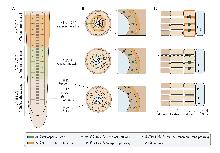
Fig.1
Development and structure of the endodermis, and radial transport pathways for nutrients in rootsA. Developmental stages of the root endodermis; B. Schematic cross-section of root structure with enlarged endodermis section; C. Radial nutrient transport pathways at each developmental stage.
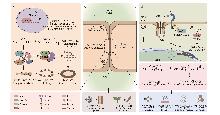
Fig.2
Two synergistic pathways ensure the formation and sealing of Casparian stripA. MYB36 transcription regulatory module(Casparian strip autonomous lignification pathway); B. Schengen monitoring and repair pathway(Casparian strip integrity monitoring pathway).

Table 1
Summary of factors related to the plasticity of the Casparian strip and suberin lamellae in plant root systems
物种 Species | 基因/蛋白名称 Gene/protein name | 分子类别/定位 Molecular category/localization | 功能注释 Function notes |
|---|---|---|---|
拟南芥 Arabidopsis thaliana | SHR[ | GRAS转录因子/细胞核; 可移动信号 | 促进内皮层分化与径向组织模式建立,为后续屏障结构形成奠定基础;shr突变体内皮层缺失或结构异常 |
| SCR[ | GRAS转录因子/细胞核 | 调控内皮层与皮层之间的不对称分裂;scr突变体缺失组织、内皮层分化受损 | |
| PER64[ | 过氧化物酶/细胞壁 | 催化凯氏带位点木质素聚合,促进凯氏带快速形成与强化;功能缺陷导致木质素聚合不足或形成延迟 | |
| SGN1[ | RLCK类激酶/质膜内侧 | 连接受体与ROS/木质化输出模块,介导Schengen通路信号传递并促进缺口处修复性木质化沉积;sgn1突变体检测信号输出能力减弱 | |
| ABCG2/6/20[ | ABCG类半转运体/质膜 | 介导木栓质前体跨膜输出以构建有效屏障;abcg2/6/20三重突变体木栓质含量降低、屏障通透性升高 | |
| CYP86A1/B1、KCS、GPAT5[ | 脂肪酸合成相关酶/内质网等 | 决定脂肪族单体的组成谱及供给水平,影响木栓质沉积强度与屏蔽能力;突变改变单体组成并削弱屏障特性 | |
水稻 Oryza sativa | MYB41/53/92/93[ | 转录因子/细胞核 | 调控水稻根内皮层木栓质片层形成与非局部木质化;4个基因敲除导致木栓质片层缺失,过表达可诱导提早木栓化并增强盐耐受性 |
| OsMYB36a/b/c[ | 转录因子/细胞核 | 调控根内皮层凯氏带形成,直接激活OsCASP1、OsESB1等凯氏带形成相关基因;3个基因敲除导致突变体内皮层凯氏带缺失并扰乱矿质元素选择性吸收 | |
| OsCASP1[ | 膜结构域蛋白/凯氏带膜结构域 | 定位于凯氏带膜域,是水稻根内皮层凯氏带形成所必需的支架蛋白;缺失导致凯氏带发育异常,并影响Ca、Si等矿质元素的选择性吸收 | |
| OsDIR55[ | 细胞壁相关蛋白/细胞壁 | 参与根扩散屏障形成与重塑;盐和ABA诱导其表达,过表达可增强根屏障并提高耐盐性 | |
| OsCIF1/2-OsSGN3[ | 小肽/中柱 LRR受体激酶/内皮层质膜 | 构成水稻Schengen型小肽-受体激酶监测通路,调控内皮层及非内皮层细胞的凯氏带形成,并协调多种凯氏带形成相关基因表达 | |
OsGAPLESS1[ (GAPLESS家族) | 细胞壁定位蛋白 (与支架蛋白OsCASP1复合) | 介导CSD处膜-壁连接,提高“类紧密连接”密封能力并影响养分稳态;缺失削弱栓系与屏障功能 | |
| ONAC005[ | NAC转录因子/根中柱与内皮层 | 在根中柱和内皮层高表达,直接上调OsTPS8,促进根内皮层木栓质沉积和凯氏带发育;缺失突变体Na⁺积累增加、盐敏感,过表达则增强根疏水屏障形成并提高耐盐性 | |
玉米 Zea mays | ZmSTL1/ZmESBL[ | 引导蛋白/细胞壁 | 编码定位于凯氏带域的引导蛋白,调控凯氏带厚度与木质素沉积;突变导致Na⁺经质外体跨内皮层运输增加并降低盐耐性 |
高粱 Sorghum bicolor | SbCASP-LP1C1[ | CASP-like蛋白/根内皮层质膜 | 于拟南芥异源表达后可降低中柱碘化丙啶染料的渗透、减少根和地上部Na⁺积累,并提高MYB36和ESB1编码基因的表达,提示其参与凯氏带木质素聚合与质外体屏障增强 |
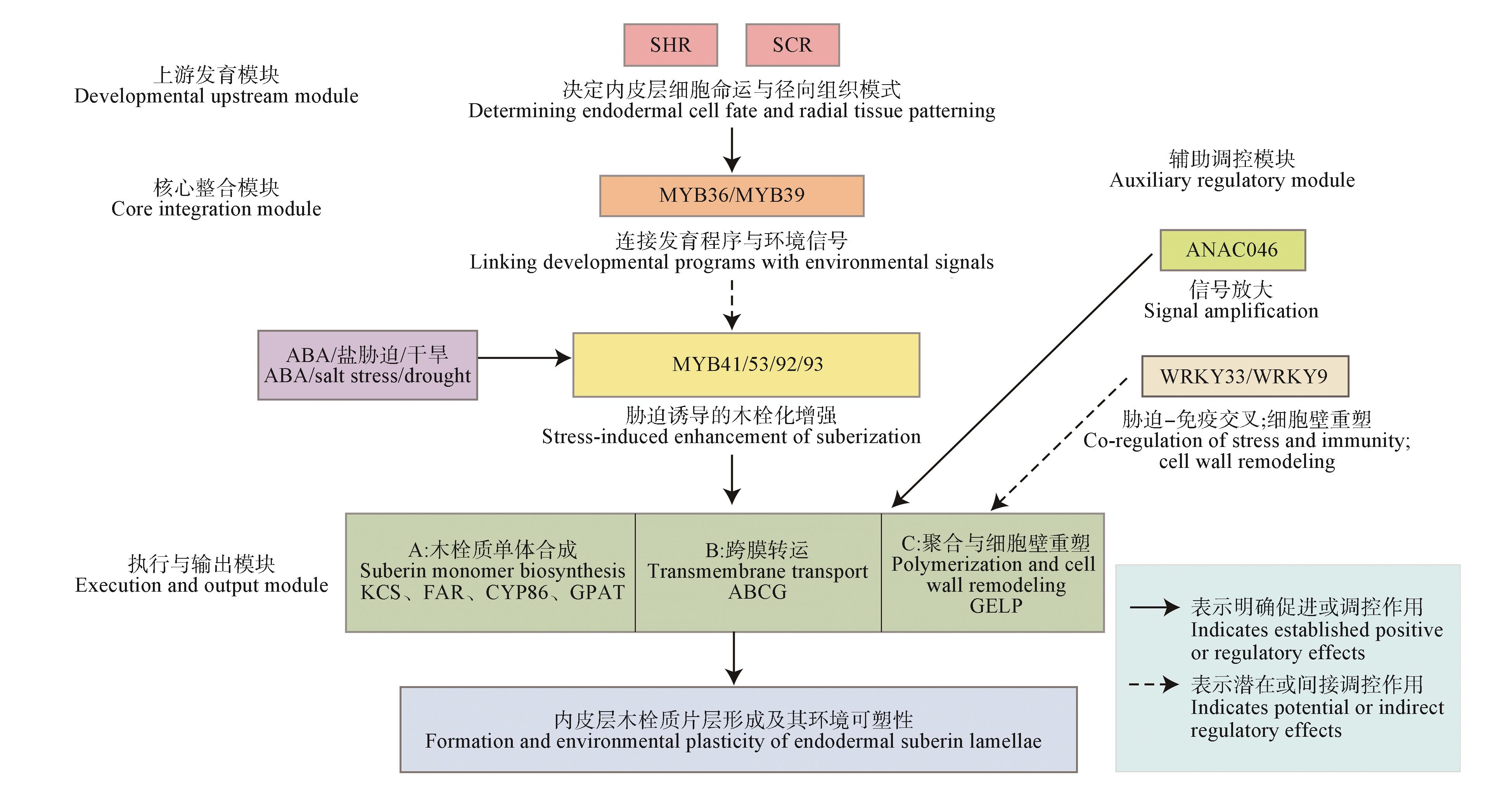
Fig.3
Hierarchical transcriptional cascade regulating endodermal suberization
| [1] | Ramakrishna P, Barberon M.Polarized transport across root epithelia[J].Current Opinion in Plant Biology,2019,52:23-29. |
| [2] | Barberon M, Vermeer J E M, De Bellis D,et al.Adaptation of root function by nutrient-induced plasticity of endodermal differentiation[J].Cell,2016,164(3):447-459. |
| [3] | Barberon M.The endodermis as a checkpoint for nutrients[J].New Phytologist,2017,213(4):1604-1610. |
| [4] | Barberon M, Geldner N.Radial transport of nutrients:the plant root as a polarized epithelium[J].Plant Physiology,2014,166(2):528-537. |
| [5] | Barbosa I C R, Rojas-Murcia N, Geldner N.The Casparian strip:one ring to bring cell biology to lignification?[J].Current Opinion in Biotechnology,2019,56:121-129. |
| [6] | Holbein J, Franke R B, Marhavý P,et al.Root endodermal barrier system contributes to defence against plant-parasitic cyst and root-knot nematodes[J].The Plant Journal,2019,100(2):221-236. |
| [7] | Hose E, Clarkson D T, Steudle E,et al.The exodermis:a variable apoplastic barrier[J].Journal of Experimental Botany,2001,52(365):2245-2264. |
| [8] | Doblas V G, Geldner N, Barberon M.The endodermis,a tightly controlled barrier for nutrients[J].Current Opinion in Plant Biology,2017,39:136-143. |
| [9] | Caspary M R.Remarks on the protective sheath and on the formation of the stem of the root[J].Annals and Magazine of Natural History,1865,16(95):382-383. |
| [10] | Schreiber L, Breiner H W, Riederer M,et al.The Casparian strip of Clivia miniata Reg.roots:isolation,fine structure and chemical nature[J].Botanica Acta,1994,107(5):353-361. |
| [11] | 崔亚宁,满奕,宋程威,等.植物凯氏带化学成分、生理功能及相关调控机制的研究进展[J].中国科学:生命科学,2020(2):102-110. |
| Cui Yaning, Man Yi, Song Chengwei,et al.Chemical components,physiological functions and regulation mechanism of plant Casparian strips[J].Scientia Sinica:Vitae,2020(2):102-110. | |
| [12] | Naseer S, Lee Y, Lapierre C,et al.Casparian strip diffusion barrier in Arabidopsis is made of a lignin polymer without suberin[J].Proceedings of the National Academy of Sciences of the United States of America,2012,109(25):10101-10106. |
| [13] | Kamiya T, Borghi M, Wang P,et al.The MYB36 transcription factor orchestrates Casparian strip formation[J].Proceedings of the National Academy of Sciences of the United States of America,2015,112(33):10533-10538. |
| [14] | Fujita S, De Bellis D, Edel K H,et al.SCHENGEN receptor module drives localized ROS production and lignification in plant roots[J].The EMBO Journal,2020,39(9):EMBJ2019103894. |
| [15] | Liberman L M, Sparks E E, Moreno-Risueno M A,et al.MYB36 regulates the transition from proliferation to differentiation in the Arabidopsis root[J].Proceedings of the National Academy of Sciences of the United States of America,2015,112(39):12099-12104. |
| [16] | Rojas-Murcia N, Hématy K, Lee Y,et al.High-order mutants reveal an essential requirement for peroxidases but not laccases in Casparian strip lignification[J].Proceedings of the National Academy of Sciences of the United States of America,2020,117(46):29166-29177. |
| [17] | Doblas V G, Smakowska-Luzan E, Fujita S,et al.Root diffusion barrier control by a vasculature-derived peptide binding to the SGN3 receptor[J].Science,2017,355(6322):280-284. |
| [18] | Nakayama T, Shinohara H, Tanaka M,et al.A peptide hormone required for Casparian strip diffusion barrier formation in Arabidopsis roots[J].Science,2017,355(6322):284-286. |
| [19] | Ma Y, Flueckiger I, Nicolet J,et al.Comparisons of two receptor-MAPK pathways in a single cell-type reveal mechanisms of signalling specificity[J].Nature Plants,2024,10(9):1343-1362. |
| [20] | Shen D F, Wippel K, Remmel S,et al.The Arabidopsis SGN3/GSO1 receptor kinase integrates soil nitrogen status into shoot development[J].The EMBO Journal,2024,43(12):2486-2505. |
| [21] | Alassimone J, Naseer S, Geldner N,et al.A developmental framework for endodermal differentiation and polarity[J].Proceedings of the National Academy of Sciences of the United States of America,2010,107(11):5214-5219. |
| [22] | Barbosa I C R, De Bellis D, Flückiger I,et al.Directed growth and fusion of membrane-wall microdomains requires CASP-mediated inhibition and displacement of secretory foci[J].Nature Communications,2023,14:1626. |
| [23] | Song T, Tian Y Q, Liu C B,et al.A new family of proteins is required for tethering of Casparian strip membrane domain and nutrient homoeostasis in rice[J].Nature Plants,2023,9(10):1749-1759. |
| [24] | Gao Y Q, Huang J Q, Reyt G,et al.A dirigent protein complex directs lignin polymerization and assembly of the root diffusion barrier[J].Science,2023,382(6669):464-471. |
| [25] | Zhang B L, Sun X Q, Meng C M,et al.The GAPLESS-OsCASP complex mediates Casparian strip formation for proper localization and abundance of endodermal proteins in rice[J].Science Advances,2026,12(13):eaeb7840. |
| [26] | Li P X, Yang M N, Chang J,et al.Spatial expression and functional analysis of Casparian strip regulatory genes in endodermis reveals the conserved mechanism in tomato[J].Frontiers in Plant Science,2018,9:832. |
| [27] | Wang Z G, Yamaji N, Huang S,et al.OsCASP1 is required for Casparian strip formation at endodermal cells of rice roots for selective uptake of mineral elements[J].The Plant Cell,2019,31(11):2636-2648. |
| [28] | Xue B P, Duan W, Gong L P,et al.The OsDIR55 gene increases salt tolerance by altering the root diffusion barrier[J].The Plant Journal,2024,118(5):1550-1568. |
| [29] | Wang Y Y, Cao Y B, Liang X Y,et al.A dirigent family protein confers variation of Casparian strip thickness and salt tolerance in maize[J].Nature Communications,2022,13:2222. |
| [30] | Chen A L, Liu T, Wang Z,et al.Plant root suberin:a layer of defence against biotic and abiotic stresses[J].Frontiers in Plant Science,2022,13:1056008. |
| [31] | Wang C H, Wang H, Li P X,et al.Developmental programs interact with abscisic acid to coordinate root suberization in Arabidopsis [J].The Plant Journal,2020,104(1):241-251. |
| [32] | Holbein J, Shen D F, Andersen T G.The endodermal passage cell:just another brick in the wall?[J].New Phytologist,2021,230(4):1321-1328. |
| [33] | Serra O, Geldner N.The making of suberin[J].New Phytologist,2022,235(3):848-866. |
| [34] | Gully K, Berhin A, De Bellis D,et al.The GPAT4/6/8 clade functions in Arabidopsis root suberization nonredundantly with the GPAT5/7 clade required for suberin lamellae[J].Proceedings of the National Academy of Sciences of the United States of America,2024,121(21):e2314570121. |
| [35] | De Bellis D, Kalmbach L, Marhavy P,et al.Extracellular vesiculo-tubular structures associated with suberin deposition in plant cell walls[J].Nature Communications,2022,13:1489. |
| [36] | Ursache R,De Jesus Vieira Teixeira C, Dénervaud Tendon V,et al.GDSL-domain proteins have key roles in suberin polymerization and degradation[J].Nature Plants,2021,7(3):353-364. |
| [37] | Kosma D K, Murmu J, Razeq F M,et al.AtMYB41 activates ectopic suberin synthesis and assembly in multiple plant species and cell types[J].The Plant Journal,2014,80(2):216-229. |
| [38] | Xu H M, Liu P, Wang C H,et al.Transcriptional networks regulating suberin and lignin in endodermis link development and ABA response[J].Plant Physiology,2022,190(2):1165-1181. |
| [39] | Cohen H, Fedyuk V, Wang C H,et al.SUBERMAN regulates developmental suberization of the Arabidopsis root endodermis[J].The Plant Journal,2020,102(3):431-447. |
| [40] | Mahmood K, Zeisler-Diehl V V, Schreiber L,et al.Overexpression of ANAC046 promotes suberin biosynthesis in roots of Arabidopsis thaliana [J].International Journal of Molecular Sciences,2019,20(24):6117. |
| [41] | Krishnamurthy P, Vishal B, Ho W J,et al.Regulation of a cytochrome P450 gene CYP94B1 by WRKY33 transcription factor controls apoplastic barrier formation in roots to confer salt tolerance[J].Plant Physiology,2020,184(4):2199-2215. |
| [42] | Kraska L, Melia J M, Nakano R T,et al.MYB68 regulates radial endodermal differentiation and suberin patterning[J].Cell Reports,2025,44(6):115794. |
| [43] | Molina D, Horvath S, Zhang X D,et al.Members of the MYB68 subclade orchestrate cork differentiation by regulating stem cell proliferation and suberin deposition[J].Cell Reports,2025,44(8):116048. |
| [44] | Helariutta Y, Fukaki H, Wysocka-Diller J,et al.The SHORT-ROOT gene controls radial patterning of the Arabidopsis root through radial signaling[J].Cell,2000,101(5):555-567. |
| [45] | Di Laurenzio L, Wysocka-Diller J, Malamy J E,et al.The SCARECROW gene regulates an asymmetric cell division that is essential for generating the radial organization of the Arabidopsis root[J].Cell,1996,86(3):423-433. |
| [46] | Alassimone J, Fujita S, Doblas V G,et al.Polarly localized kinase SGN1 is required for Casparian strip integrity and positioning[J].Nature Plants,2016,2:16113. |
| [47] | Yadav V, Molina I, Ranathunge K,et al.ABCG transporters are required for suberin and pollen wall extracellular barriers in Arabidopsis [J].The Plant Cell,2014,26(9):3569-3588. |
| [48] | Beisson F, Li Y H, Bonaventure G,et al.The acyltransferase GPAT5 is required for the synthesis of suberin in seed coat and root of Aribidopsis [J].The Plant Cell,2007,19(1):351-368. |
| [49] | Compagnon V, Diehl P, Benveniste I,et al.CYP86B1 is required for very long chain omega-hydroxyacid and alpha,omega-dicarboxylic acid synthesis in root and seed suberin polyester[J].Plant Physiology,2009,150(4):1831-1843. |
| [50] | Chen X X, Liu K, Luo T T,et al.Four MYB transcription factors regulate suberization and nonlocalized lignification at the root endodermis in rice[J].The Plant Cell,2024,37(1):koae278. |
| [51] | Wang Z G, Zhang B L, Chen Z W,et al.Three OsMYB36 members redundantly regulate Casparian strip formation at the root endodermis[J].The Plant Cell,2022,34(8):2948-2968. |
| [52] | Zhang B L, Xin B N, Sun X Q,et al.Small peptide signaling via OsCIF1/2 mediates Casparian strip formation at the root endodermal and nonendodermal cell layers in rice[J].The Plant Cell,2024,36(2):383-403. |
| [53] | Kim Y, Kim B, Kang J K,et al.ONAC005 enhances salt stress tolerance by promoting suberin deposition in root endodermis[J].The Plant Journal,2025,123(5):e70469. |
| [54] | Liu L L, Wei X C, Yang Z,et al.SbCASP-LP1C1 improves salt exclusion by enhancing the root apoplastic barrier[J].Plant Molecular Biology,2023,111(1):73-88. |
| [55] | 徐黎,胡海琳,王晨璨,等.植物根内皮层的发育与功能研究进展[J].科学通报,2023,68(8):901-914. |
| Xu Li, Hu Hailin, Wang Chencan,et al.Advances in the development and function of plant root endodermis[J].Chinese Science Bulletin,2023,68(8):901-914. | |
| [56] | Gao Y Q, Su Y, Chao D Y.Exploring the function of plant root diffusion barriers in sealing and shielding for environmental adaptation[J].Nature Plants,2024,10(12):1865-1874. |
| [57] | Karahara I, Ikeda A, Kondo T,et al.Development of the Casparian strip in primary roots of maize under salt stress[J].Planta,2004,219(1):41-47. |
| [58] | Yang H, Yu H Y, Wang S W,et al.Root radial apoplastic transport contributes to shoot cadmium accumulation in a high cadmium-accumulating rice line[J].Journal of Hazardous Materials,2023,460:132276. |
| [59] | Chao Z F, Chao D Y.Barriers and carriers for transition metal homeostasis in plants[J].Plant Communications,2025,6(2):101235. |
| [60] | 张思懿,崔博文,王佳玲,等.非生物胁迫下植物根系的生理与分子响应研究进展[J].浙江农业学报,2024,36(10):2391-2401. |
| Zhang Siyi, Cui Bowen, Wang Jialing,et al.Research progress on physiological and molecular responses of plant roots under abiotic stress[J].Acta Agriculturae Zhejiangensis,2024,36(10):2391-2401. | |
| [61] | Andersen T G, Naseer S, Ursache R,et al.Diffusible repression of cytokinin signalling produces endodermal symmetry and passage cells[J].Nature,2018,555(7697):529-533. |
| [62] | Li M, Li P X, Wang C H,et al.Brassinosteroid signaling restricts root lignification by antagonizing SHORT-ROOT function in Arabidopsis [J].Plant Physiology,2022,190(2):1182-1198. |
| [63] | Fröschel C, Komorek J, Attard A,et al.Plant roots employ cell-layer-specific programs to respond to pathogenic and beneficial microbes[J].Cell Host & Microbe,2021,29(2):299-310.e7. |
| [64] | Dölfors F, Ilbäck J, Bejai S,et al.Nitrate transporter protein NPF5.12 and major latex-like protein MLP6 are important defense factors against Verticillium longisporum [J].Journal of Experimental Botany,2024,75(13):4148-4164. |
| [65] | Tsai H H, Tang Y J, Jiang L M,et al.Localized glutamine leakage drives the spatial structure of root microbial colonization[J].Science,2025,390(6768):eadu4235. |
| [66] | Salas-González I, Reyt G, Flis P,et al.Coordination between microbiota and root endodermis supports plant mineral nutrient homeostasis[J].Science,2021,371(6525):eabd0695. |
| [67] | Shen D F, Micic N, Venado R E,et al.Apoplastic barriers are essential for nodule formation and nitrogen fixation in Lotus japonicus [J].Science,2025,387(6740):1281-1286. |
| [68] | Niklas K J, Cobb E D, Matas A J.The evolution of hydrophobic cell wall biopolymers:from algae to angiosperms[J].Journal of Experimental Botany,2017,68(19):5261-5269. |
| [69] | Su Y, Feng T, Liu C B,et al.The evolutionary innovation of root suberin lamellae contributed to the rise of seed plants[J].Nature Plants,2023,9(12):1968-1977. |
| [70] | Renault H, Alber A, Horst N A,et al.A phenol-enriched cuticle is ancestral to lignin evolution in land plants[J].Nature Communications,2017,8:14713. |
| [71] | Aragón-Raygoza A, Vasco A, Blilou I,et al.Development and cell cycle activity of the root apical meristem in the fern Ceratopteris richardii [J].Genes,2020,11(12):1455. |
| [72] | Danila F R, Thakur V, Chatterjee J,et al.Bundle sheath suberisation is required for C4 photosynthesis in a Setaria viridis mutant[J].Communications Biology,2021,4:254. |
| [73] | 张倩倩,林晓艳,顾钰峰,等.木贼类营养器官凯氏带类型的新观察[J].西北植物学报,2021,41(7):1158-1164. |
| Zhang Qianqian, Lin Xiaoyan, Gu Yufeng,et al.New observations on the types of Casparin strip in the vegetative organs of horsetails[J].Acta Botanica Boreali-Occidentalia Sinica,2021,41(7):1158-1164. | |
| [74] | 赵丽,包秀兰,王福德,等.15种云杉针叶解剖结构与其抗旱性研究[J].西北林学院学报,2025,40(3):119-127. |
| Zhao Li, Bao Xiulan, Wang Fude,et al.Needle anatomical structure and drought resistance of 15 spruce species[J].Journal of Northwest Forestry University,2025,40(3):119-127. | |
| [75] | Kim H B, Kim K E.Precision proteomics with TurboID:mapping the suborganelle landscape[J].The Korean Journal of Physiology & Pharmacology,2024,28(6):495-501. |
| [76] | 郭贝一,郭晓强.AlphaFold和蛋白质结构预测[J].科学,2024,76(5):39-44. |
| Guo Beiyi, Guo Xiaoqiang.Alphafold and protein structure prediction[J].Science,2024,76(5):39-44. |
| [1] | Teng LI, Cunyu ZHOU, Chaodong YANG, Zhanfeng LIU. Anatomical and Histochemical Features of the Pteris vittata (Pteridaceae) [J]. Bulletin of Botanical Research, 2023, 43(1): 20-29. |
| [2] | ZHANG Xia, HU Lu-Jie, ZHOU Cun-Yu, YANG Chao-Dong. Comparative Study on Staining Methods and Techniques of Cell Wall Histochemistry [J]. Bulletin of Botanical Research, 2017, 37(1): 147-154. |
| [3] | TIAN Li-Li;MA Miao*. Anatomy of An Ephemeroid Plant Eremurus altaicus [J]. Bulletin of Botanical Research, 2013, 33(2): 134-138. |
| Viewed | ||||||
|
Full text |
|
|||||
|
Abstract |
|
|||||
