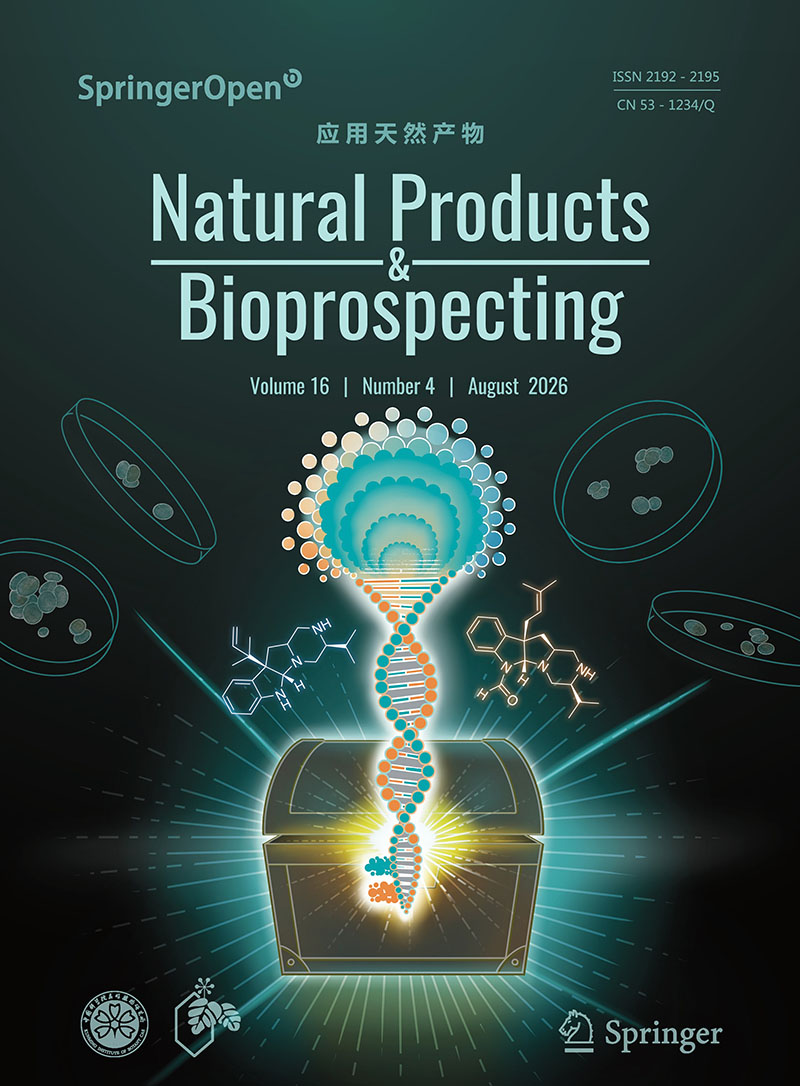
Three new pyridone alkaloids, tolypyrone A (1), tolypyrosides A (2) and B (3), and a new tetramic acid 2′-epitolypoalbin (4), along with ten known compounds, were obtained from Tolypocladium sp. CPCC 401485 isolated from an unidentified Antarctic lichen specimen. Structural elucidation of new compounds was achieved by analyses of HRESIMS and NMR spectroscopic data combined with X-ray crystallography, advanced Marfey's method, and ECD calculation. Tolypyrone A (1) was the first 4-pyridone alkaloid with an unusual octahydro-1H-isochromeno[3,4-b]pyridin-4-one triheterocyclic ring system. Compounds 1, 4 and 6 exhibited antimicrobial activities with the minimum inhibition concentration of 16-64 μg/mL.
New dearomatized isoprenylated acylphloroglucinols hyperprzewones A (1) and B (2) were isolated and characterized from the dried aerial parts of Hypericum przewalskii. The structures of these compounds were confirmed by extensive spectroscopic experiments. A facile synthetic route to 1 and 2 was developed via Friedel-Crafts acylation, alkylation, dearomatization, and oxidative [4 + 2] cyclization, giving a 17% overall yield. Moreover, the synthetic derivative 8 exhibited moderate inhibition on T-type calcium channels Cav3.2.
Coumaronochromones, characterized by a distinctive benzofuro[2,3-b]chromenone core, constitute a rare subclass of isoflavonoids. Biosynthetically, they are proposed to originate from carbohydrate metabolism and the phenylpropanoid pathway like other isoflavones. To date, 92 natural coumaronochromones have been isolated and characterized from nearly 28 species across 24 genera within 7 families (including one fungal source). These compounds are predominantly distributed in the Fabaceae family, which accounts for over half (64%) of all known derivatives. Notably, approximately 20% of coumaronochromones are derived from the genus Euchresta (Fabaceae). The unique scaffold of coumaronochromones confers a broad spectrum of notable pharmacological activities, including anti-inflammatory, antibacterial, insecticidal, cytotoxic, and immunomodulatory effects, highlighting their potential as valuable natural leads for pharmaceutical and agrochemical development. This review comprehensively summarizes recent advances in the chemistry and biology of coumaronochromones, providing a detailed account of their natural occurrence, documented biological activities, and chemical syntheses.
Prenylation modifications of natural products typically introduce greater structural complexity and enhance their biological activities. Yet, the modification of piperazine alkaloids by dimethylallyl tryptophan synthases (DMATS) remains unreported. In this study, we identified and activated a silent DMATS-containing piperazine biosynthetic gene cluster (BGC), flz, in Aspergillus flavipes via heterologous expression and in vitro enzymatic assay, leading to the isolation and identification of sixteen metabolites. Among these, twelve are new, including five tryptophan-valine-derived alkaloids (2-6) and seven previously unreported prenylated analogs (8-13, 17). Notably, 8 and 9 represent novel prenylated piperazines featuring a unique 6-5-5-6 ring system. Most significantly, we uncovered a versatile DMATS, FlzE, capable of catalyzing mono-prenylation on flexible substrates, such as piperazine, pyrazine, and diketopiperazine, at multiple sites in either regular or reverse manners. This study not only expands the chemical space of indole alkaloid derivatives but also provides a versatile and engineerable biocatalyst for the prenylation of both natural and synthetic products.
Fungi are a rich source of chemical diversity for bioprospecting, yet most of their metabolic potential remains unexplored. This study investigated the metabolic profile of phytopathogenic fungi of the genus Fusarium, isolated from fruits with high protease content, such as papaya and pineapple. Comparative metabolomics was used to evaluate how culture substrates and co-cultivation with the endophyte Neofusicoccum ribis modulate secondary metabolite production. Molecular Networking analysis (GNPS2) revealed an impressive diversity of 173 annotated metabolites, including one previously undescribed compound. Metabolite production was highly dependent on the substrate and fungal strain, showing a strong correlation between phylogeny and metabolic profiles. Several extracts displayed significant inhibitory activity against the protease papain, with some co-cultivation combinations further enhancing this effect. These findings highlight how environmental conditions and microbial interactions activate silent biosynthetic pathways, confirming these fungi as promising sources for bioactive molecule discovery.
The obligate intracellular bacterium Chlamydia trachomatis is the most common bacterial sexually transmitted infection globally, with approximately 131 million new cases each year. It contributes to widespread reproductive health issues, including infertility and chronic pelvic pain. The unique cell morphology and biphasic life cycle pose challenges to their effective eradication. Guided by the identification of essential oils (EOs) capable of suppressing C. trachomatis intracellular growth, this study evaluated the antichlamydial properties of the monoterpene limonene and its metabolites perillyl alcohol and perilic acid. The antichlamydial activity was assessed through qPCR-based quantification of bacterial genome copy numbers and immunofluorescence staining of chlamydial inclusions to monitor bacterial growth and infectious progeny production. Elementary body membrane integrity was assessed with viability PCR. Citrus limon essential oil exhibited dose-dependent inhibition of C. trachomatis growth, decreasing infectious progeny by over 90%. Pinus sylvestris EO displayed consistent but non-dose-dependent effects. Limonene, a major constituent of the EOs, exhibited significant suppression of chlamydial growth and progeny production, particularly for its R-enantiomer. While viability-PCR data indicated that the EOs and limonene affected EB membrane permeability, EB infectivity was not affected by the treatments. Perillyl alcohol suppressed chlamydial growth at a lower concentration (100 μg mL-1) than the parent compound limonene. The antichlamydial activity of both limonene and perillyl alcohol was suppressed when infected cultures were supplemented with farnesyl or geranylgeranyl, indicating that the antichlamydial mechanism of the two monoterpenes involves competitive inhibition of protein prenylation. Hence, targeting host protein prenylation may be an effective antichlamydial strategy.
Pulmonary fibrosis (PF) is a chronic, progressive and irreversible inflammatory disease with limited therapeutic methods in clinic. Deacetylforskolin (DFSK), derived from the plant Coleus forskohlii, is a potent adenylyl cyclase activator with potential anti-inflammatory activity. Herein, we attempted to investigate the therapeutic potential and mechanisms of DFSK against PF in bleomycin (BLM)-induced mouse models and TGF-β1-induced A549 cells. Our results showed that DFSK treatment alleviated lung injury and reduced inflammatory cytokines in a mouse model of BLM-induced acute lung inflammation, an early stage of PF. In a BLM-induced PF mouse model, DFSK attenuated pathological lung injury and collagen deposition, decreased pro-inflammatory cytokines (TNF-α, IL-1β) and profibrotic mediators (TGF-β1, CTGF, hydroxyproline). Upregulation of the epithelial marker E-cadherin and downregulation of the mesenchymal marker α-SMA were observed following DFSK treatment. Furthermore, DFSK significantly restored the pulmonary function of PF mice with decreased Te, f, Penh and increased RT, TV. Mechanistically, DFSK suppressed the phosphorylation of JNK and p38 MAPK, and inhibited TGF-β1-induced epithelial-mesenchymal transition (EMT) in A549 cells. Collectively, our findings demonstrate that DFSK is an effective therapeutic agent against PF by suppressing inflammation and EMT.
Six new matrine-based alkaloids, sophflarines F-K (1-6), featuring a rare aromatic system, were obtained from the water-soluble alkaloid fractions of Sophora flavescens by UV-guided separation. Their structures were elucidated by the interpretation of spectroscopic analyses, quantum chemical calculation, and X-ray diffraction data. Compounds 1 and 2 represent highly modified 15,16-seco-17-nor-matrine derivatives incorporating a rare 4,5-dihydro-3H-pyrrolo[2,3,4-ij]quinolizine moiety, while compound 5 possesses an unusual 6/6/6-5 tetracyclic skeleton. A copper sulfate-induced zebrafish assay revealed that compounds 1, 4, and 5 exhibited moderate anti-inflammatory activity at non-toxic concentrations. Checkerboard assays demonstrated that compounds 5 and 6 potentiated colistin activity against Escherichia coli ATCC25922 and BW25113-mcr-1, reducing colistin MIC values by 16- and 32-fold, respectively. These findings expand the structural diversity of aromatic matrine-type alkaloids and highlight their potential as anti-inflammatory agents and antibacterial adjuvants.
Peptides from natural sources have often served as valuable leads in drug discovery. Plant-derived protease inhibitors are a notable class, yet their distribution, diversity, and targets remain underexplored. Here, eleven tropical Psychotria species were screened for cyclic cysteine-rich peptides, with extracts showing concentration-dependent inhibition of human prolyl oligopeptidase (POP). Peptidomics combining mass spectrometry and transcriptome mining revealed multiple inhibitory peptides. From Psychotria solitudinum, which contained 37 peptides, a novel peptide (psysol 3) was purified and sequenced. Its synthetic analogue inhibited POP with an IC50 of ~ 1.3 μM. Sequence analysis and synthetic probes identified loop 3 as the inhibitory motif. Psysol 3 is a new probe for POP pharmacology and future structure-activity studies.
Livia Ramos Santiago, Estéfani Alves Asevedo, Maria Eduarda Jeunon de Oliveira, Karen Cota Pereira, Maria Fernanda da Silva Trindade, Ana Gabriela Silva Oliveira, Marina Andrade Rocha, Sojin Kang, Amama Rani, Moon Nyeo Park, Michel William Tan, Rony Abdi Syahputra, Bonglee Kim, Rosy Iara Maciel de Azambuja Ribeiro
Cancer remains one of the leading causes of death worldwide and continues to pose a serious public health challenge. The limited success of many current treatments—often due to toxicity, poor selectivity, and the development of drug resistance—highlights the need for new and more effective therapeutic options. Phytochemicals have emerged as a valuable source of anticancer agents, offering rich structural diversity and a wide range of biological activities. However, identifying promising compounds from the vast chemical space of natural products remains difficult using conventional screening methods, which are typically slow, costly, and inefficient. In recent years, artificial intelligence (AI) has begun to transform phytochemical-based drug discovery. Machine learning and deep learning approaches are now used to support key steps in the discovery process, including metabolite identification, virtual screening, target prediction, and toxicity assessment. By integrating chemical, biological, and multi-omics data, AI enables a more systematic and data-driven exploration of natural product diversity. Despite these advances, challenges persist, particularly the scarcity of high-quality experimental data, the structural complexity of phytochemicals, and their limited representation in public databases. This review critically examines current AI applications in phytochemical-based anticancer drug discovery and discusses emerging strategies aimed at overcoming these limitations. Overall, AI-driven phytochemical screening represents a promising path toward accelerating the development of next-generation cancer therapies.
Oxidative stress (OS) is a major contributor to aging and the pathogenesis of numerous conditions, including diabetes, neurodegenerative, cardiovascular, and autoimmune disorders. Consequently, therapeutic strategies aimed at enhancing endogenous cytoprotective pathways have gained significant interest. Plant-derived essential oils represent attractive sources for such interventions due to their natural origin and low toxicity; specifically, the monoterpenoid geraniol, a principal component of rose oil, has demonstrated promising antioxidant properties in vitro. In this study, we utilized Caenorhabditis elegans to investigate the in vivo efficacy and molecular mechanisms of geraniol effect. Our results show that geraniol significantly reduces intracellular reactive oxygen species and enhances resistance to acute OS induced by juglone. Mechanistic characterization using GFP-reporter strains revealed that geraniol activates the DAF-16/FOXO and SKN-1/Nrf2 transcription factors, while surprisingly causing a slight but consistent downregulation of the HSF-1-mediated heat-shock response. Crucially, genetic epistasis analysis using null/hypomorphic mutants demonstrated that only SKN-1 is strictly essential for geraniol-mediated protection against induced OS. In conclusion, this study underscores the utility of C. elegans as a robust and accessible platform for the pharmacological screening of natural products. Our findings establish geraniol, a key constituent of rose oil, as a multifunctional modulator of cellular defenses that orchestrates multiple cytoprotective pathways, identifying the SKN-1-dependent response as a critical driver of its antioxidant efficacy in C. elegans. By delineating this specific genetic requirement, these results provide a mechanistic foundation that supports the therapeutic potential of geraniol in mitigating aging and pathophysiology driven by OS.
Twenty-eight prenylated acylphloroglucinols, including the new hypulatones C-F (1-4), have been isolated from the fruits of Hypericum patulum and structurally characterized. Compound 1 represents a rare meroterpenoid formed through the addition of a prenylated acylphloroglucinol unit and a sesquiterpenoid moiety. Spirocyclic polycyclic polyprenylated acylphloroglucinol 2 contains six chiral centers, and its relative configuration was established based on 1H-1H coupling constants, conformational analysis, and NOE correlations. The cytotoxic activities of all isolates against two human carcinoma cell lines (Huh-7 and Panc-1) were evaluated using the CCK-8 assay. Bioassay results indicated that compounds 6, 8, and 15 exhibited moderate antiproliferative activity.
As an important and beneficial gut commensal, Akkermansia muciniphila plays a crucial role in regulating host metabolism and immunity. Lipooligosaccharides from A. muciniphila (ALOS) show anti-obesity effects in high-fat diet-fed mice. Herein, we investigated the chemical characteristics of core oligosaccharides of ALOS and explored its anti-atherosclerotic efficacy. The LC-Q-TOF-MS analysis indicated a high structural diversity of core oligosaccharides in ALOS, comprising fourteen distinct oligosaccharide species with different degrees of phosphorylation. Functionally, administration of ALOS significantly attenuated hyperlipidemia and reduced atherosclerotic plaque burden in high-fat diet-fed ApoE-/- mice. The improvement of these metabolic symptoms was related to the restoration of intestinal barrier integrity. Mechanistically, ALOS upregulated the IL-23/IL-22 immune axis, which in turn promoted intestinal epithelial repair and modulates the microbiota. ALOS intervention reshaped the gut microbiota composition by enriching beneficial genera such as Bifidobacterium longum, Roseburia intestinalis, and Oscillibacter sp., while suppressing potential pathobionts. Our findings highlight the structural diversity and anti-atherosclerotic effect of lipooligosaccharides from A. muciniphila.
Ten novel trichothecene sesquiterpenoids including two new seco-trichothecenes, trichotheciumones A (1) and B (2), a new trichothecene sesquiterpenoid glycoside, trichothecinoside A (3), and seven new trichothecene sesquiterpenoids, trichothecrotocins T-Z (4-10), together with three new natural products (11-13) and thirteen known compounds (14-26), were isolated from the soil fungus Trichothecium sp. DWS815. The structures and absolute configurations of the new compounds were elucidated by extensive spectroscopic analyses and quantum chemistry ECD calculations. Given the notable anticancer properties of known trichothecenes, the isolated compounds were evaluated for the cytotoxic activities against three cancer cell lines (HCT116, 4T1, MHCC97H) and one normal cell line (GES-1). Cell cycle analysis revealed new compounds 7 and 8 induced G2/M phase arrest in HCT116 cancer cells, which resulted to cell proliferation inhibition activity.
Iron homeostasis has recently emerged as a key determinant in the early stages of plant-pathogen interactions, particularly in phytopathogens that exploit iron-dependent cell death (known as ferroptosis) to initiate host invasion. In Pyricularia oryzae, the causal agent of rice blast disease, appressorium formation is tightly linked to ferroptotic events in germinating conidia. Accumulation of intracellular Fe3+ and reactive oxygen species (ROS) promotes lipid peroxidation, ultimately triggering conidial cell death and, consequently, appressorium maturation. Therefore, inhibition of ferroptosis by targeting fungal iron homeostasis represents a promising strategy to suppress appressorium development and block subsequent host infection. Rhizoferrin, an α-hydroxy carboxylate siderophore secreted by Rhizopus microspora, was identified as a suitable precursor of its ring-closed derivative glomuferrin. The obtainment of an unexpected succinimide intermediate within the synthetic pathway enabled the access to both rhizoferrin and, to our knowledge for the first time, glomuferrin. Chelation evaluation revealed that rhizoferrin exhibits significantly higher affinity for iron than glomuferrin. The effects of these siderophores on conidial germination and appressorium formation were evaluated in wild-type and strobilurin-resistant P. oryzae strains, at concentrations ranging from 5 mM to 200 μM. The promising activity observed, especially for rhizoferrin, highlights the potential of α-hydroxy carboxylate siderophores as ferroptosis inhibitors and offers new perspectives for their development in crop protection.